2009-07-09

Drama!

Our last day in Britain. The morning we would spend going through book stores on and off Charing Cross Street. As it is one of the first, we started with Motorbooks. We found it only due to me looking in the right direction at the right time—it has moved from S:t Martin's Court to Cecil Court, the next street over. In fact all the nice niche bookstores on S:t Martin's Court have moved or disappeared and the streetlet now consists of an unbroken length of pubs. One of the bookstores on Charing Cross Road proper had a lament in its window, explaining how rising costs forced bookstores out of business, and indeed, several of my old favourites had disappeared, replaced by shops for traditional Chinese medicine and the ilk. I was much saddened. Still, Motorbooks was in good shape, even though the fantastic basement stairwell covered with graffiti, stickers, and business cards from every air line, military aircraft unit and private plane owner that had ever passed Motorbooks, was gone. I bought some books I thought I'd manage to carry and looked longingly at some others, which I'll simply have to order later on.

Then we continued to Foyles. They were still in good shape and some more books were added to the collection. Then it was time to head back and pick up our bags. Pull the cart with our bags to Victoria, carry it down into the underground. Honeybuns is getting a bit jittery about our time schedule, I'm more like: “No worries, we should make it with minutes to spare.” She does not look calmed.
When we arrive at King's Cross the PA system blares: “This is an emergency, proceed to the exits immediately!” Oops, well, we were in a hurry anyway. The station pours out hundreds of people onto the street. We push ourselves towards the entrance to S:t Pancras, just as we see it being closed up as well. Is it more than just the underground station being closed? I accost one of the guards by the gate: “Pardon me, is the rail station closed as well?” “Yes, yes, don't you see, all the electricity is gone, nothing is running, everything is closed. Please move out of the way.” Clearly not all of the electricity is gone, as the escalators had been running and other signs of electrical activity are obvious, but of course you would have to have backup systems for those. Now what are we going to do? We'll miss our train and all connections, who should be approached to sort this out?
MillersPeople milling around.
After milling around a bit we sit on the steps outside the station and consider our plight. After a while it strikes me that there doesn't seem to be all that many other forlorn people milling around, maybe Londoners know what to do under these circumstances, but where do all the other tourists that should be on our train go?
Honeybuns peers curiously at some people that go up the steps, is there a pub up there, maybe we could at least have lunch? We lug our cart and ourselves up the steps and Blimey! there's another entrance to S:t Pancras and the station is obviously in full operation! We rush in, carry the cart down the stairs and come running into the Eurostar terminal as we hear: “Final call for the 14:34 to Brussels, proceed to checkin immediately!” I bang our tickets on the desk and we are checked in. We even have time to pick up some sandwiches and drink on the way to the train, which pulls away soon after we've sat down.
I love the active and curious mind of Honeybuns more than ever, as my breathing calms down. I also check some news sites with the web browser in my mobile, but there seems to be nothing about the emergency, maybe it's a fairly common occurence and nothing to write home about.
Our connection in Brussels is smooth and then we get to Cologne, where we have a couple of hours' wait. Time for dinner. We find a sushi bar, operated by some Vietnamese, and get some quite good sushi (yes, vegetarian too). They do however not accept credit cards. A Colognial sitting on the stool next to us offers to pay the difference for us, but Honeybuns runs away to a cash machine and gets some Euros.

Finally our train arrives and we pile into our sleeper. It is Czech too, but of a subtly different design than the one on the way down. We sleep the sleep of the exhausted, and enjoy breakfast next morning while travelling through Denmark. Again we have a layover in Copenhagen, which I spend writing a few postcards, and then we suddenly run into an old colleague of mine, who's also going back to Stockholm. No direct connection this time, we have get to Malmö first where we change to X2000. I make a point of travelling forwards and not reading on the way up. I avoid motion sickness this time.

Then, just a short tube-trip home. As I walk through the park on the way home, I see that the new playground has been opened and is full of children with their parents, playing in the early summer evening.

2009-07-08

Here, fishy, fishy!

Charles Darwin in effigyRebbe Darwin in the foyer of the aquarium.
The next morning we walked down Vauxhall Bridge Road to the Sea Life London aquarium and got in as they opened for the day. So did also half a dozen school classes. Their main goal in life was apparently to be as loud as possible, and their teachers were dedicated to helping them in their efforts. The aquarium was marketed towards children, even though the darkened corridors and the calm of the fish tanks lent themselves to a more meditative experience than a hundred yelling pre-teens allowed. Fortunately they were in more of a hurry to get out of the learning experience than we were, so they eventually disappeared ahead of us. I've noticed before that modern museums often seem to encourage noise, both in exhibits and visitors. Presumably this has something to do with making science more attractive. I just don't get it.

Streaked gurnardIt was almost impossible to get good pictures of the fish, but here is a streaked gurnard. Note the tendril-like reformed pectoral fins, they are supposedly for probing for food on the bottom, but dammit, they actually walked along the bottom on those. I'd never heard of these, but they are apparently quite common fish.
We went slowly from tank to tank, gazing at marine creatures we'd never seen before. I reflected that it didn't seem as if they were interested in eating each other. Do they carefully select animals that aren't interested in each other or do they keep them constantly satiated with easily accessible non-struggling fish food, so that they aren't tempted to go for live food?

The shark tank was rather eerie, not only containing sharks and a big ray, but also some really big fish, all swimming around and around and around. We were reminded of the mental polar bear that used to be at Skansen, pacing back and forth, back and forth, back and forth in its pen. (It's been gone now for many years, I hope they shot it.) I wonder what the sharks thought of it all.

After surprisingly many hours we emerged, blinking in the brighter lights outdoors and then decided to walk along the South Bank. The used book market immediately trapped us and some urgently needed books were purchased. We counted bridges over the Thames and found a pub to have late lunch at, while peering at a cricket match on the telly. UK vs Australia, I gathered.

We got to Tate Modern, and looked at a bit of an exhibition. You need a very large museum to exhibit some modern art, e g when a piece consists of a Volkswagen bus and 24 sleds… However, we felt the need for more air and escaped out again fairly soon, continuing towards the Tower. We got there just in time for their closing. Bummer! We browsed the museum shop for a while and then went home, picked up food in a Sainsbury and ate in our room.

2009-07-07

Plants, flowers, trees, epiphytes, and a bit of meat broth

The Grange Wellington served “Continental buffet” for breakfast. So with the “full English” at Gables Guesthouse, we went from a fat-and-protein based breakfast to a completely carbohydrate based.

Then the tube and a commuter train to Hampton Court for the expected next high point: the Royal Horticultural Society Hampton Court Palace Flower Show. There were plenty of other middle-aged middle-class couples on the train, most of them pulling little collapsible carts. When we arrived we found out that the first few days of the show were members-only, but out of the goodness of the receptionist's heart, we could have a couple of unbooked tickets. Quite expensive ones, at that.

Iron DragonFancy one for your garden?
Anyway, we were soon in, and about as soon as we got in, a drizzle started. It continued throughout the day, occasionally letting up in favour of serious showers. As we walked through the show, we found that it actually wasn't so much about exhibiting flowers as selling garden accessories. And what accessories! 1:1 scale gorillas in bronze, stylised giraffes, three-metre high sculptured dragons, garden fairies, gargoyles, module-assemblable mediæval ruins, fountains, gazebos, realistic giraffes, more giraffes, huge steel balls, nymphs in bronze, marble, and cast stone.

Concept GardenA concept garden. A friend commented: “Yeah, that's what I'd like my burial place to look like.”
There were also “concept gardens”, top-of-the-line garden designers coming up with the least likely design for you to have in your garden.

2009 is the 500th anniversary of the coronation of Henry VIII, which you aren't allowed to forget anywhere, so here there was a Tudor-themed scarecrow competition for school classes.

The Lifestyle tent had less immediately garden-related stuff for sale, paintings, indoor sculpture, clothes, sausages, organic apple cider, etc.

Carnivorous plantsCarnivorous plants are way cool, but did you know many species are threatened with extinction due to habitat loss and plant theft? Only buy specimens that have been nursery-grown.
Finally we found a tent with actual plants. They were of course also for sale. Ducking for yet another shower we ended up in a tent where some unknown to us B list celebrity introduced a fashion show. It seemed to have nothing whatsoever to do with gardening, so left to rest our legs over lunch in a food tent.

We found a tent exhibiting plants significant for British gardening history, not least ones that may have been, somewhere, on some occasion, possibly glimpsed by Henry VIII. This was actually quite good an exhibition and, incidentally, not at all as crowded as the other tents.

After having seen yet a few more stands hawking giraffe sculptures, we decided to leave and go see Hampton Court Palace instead. As luck would have it, a little lady was handing out leaflets as we were leaving and we accepted one. This turned out to be discount tickets to Hampton Court Palace, two for the price of one. What luck, ho!

MistletoeThis mistletoe is about as tall as I am, and there were several in the same tree.
On the way to the Palace entrance we found a tree with huge clumps of mistletoe, just above us. This brought us to a standstill for some time.

At Hampton Court Palace there were ongoing activities throughout the day: a reenactment of the wedding of Kateryn Parr and Henry VIII (him again!), including selecting a wedding gown, a stag party for Henry, the wedding dinner and so on. We decided to forego that and instead take in the palace at our own pace. We started by exploring the famous maze. It wasn't quite as large as I had imagined and at the time was invaded by an audio sculpture, which would make various sounds as people moved through the maze. It was actually just mostly annoying. Anyway, with my 1337 maze navig8r zkillz we found the centre of the maze no problemo and continued to walk around the rest of the garden. Or, to be precise, round the part closest to the palace—the garden is huge. Or gardens, there are several distinct parts of it.

The Great VineThe Great Vine is kept in this greenhouse. The field outside is where the roots are kept.
We never found the way into the Orangery but we found the world's largest (and oldest?) vine, planted in 1769 and still producing several hundred kilogrammes of grapes a year. The longest branches are something like 75 m, folded up several times inside the greenhouse.

Finally we entered the palace itself. There were several new exhibitions on Henry VIII (that man again!), they, like many other displays we'd seen recently, were much on how he really couldn't have acted otherwise than he did. Complete bollocks, one suspects. Anyway, there was much to look at and finally we found ourselves in the Tudor kitchens. They were furnished with mock food and one even contained a cauldron that distinctly smelled of meat broth. Veggie Honeybuns was much revolted.

Here too, the museum closed long before we were done, but we ambled back to the train, accompanied by lots of flower show visitors, their collapsible carts now unfolded and filled with seedlings, gardening tools and what not. Very few bronze giraffes, though.

We decide to have dinner in the Indian Diner just behind the hotel. Slightly on the posh side but excellent food and the staff saw fit to not only supply us with after-dinner mints, but also a long-stemmed rose to Honeybuns. Very sweet.

2009-07-06

Goodbye, hello!

Leisurely packing of things in the morning, take our farewells of our host with promises to return one day and then catch the bus into town, pick up a Lincolnshire Echo and then wait for the train to Peterborough. A railway employee kindly and politely directs us to the right platform.

East Midlands Trains Class 153East Midlands Trains Class 153. Note that curiously the serial number on the side is 52319, but the number on the front 53319.


That special whine-growl of the diesel engine of the accelerating Sprinter, and we roll through the countryside. I do the cross-word puzzles—the Quick Clues is no problem, the Cryptic Clues is more of an effort, perhaps not more so than Geijerkorsordet in Dagens Nyheter, but it still nags at my language confidence.

We get delayed (a hallmark for this journey, it seems) and miss our connection in Peterborough, but it turns out trains to London run about every ten minutes, so we don't have to suffer the pouring rain for long. It feels very luxurious to just wave our Interrail tickets at the conductor.

Eventually we are at King's Cross again. I stand in an interminable queue to buy three-day travelcards for the London Underground, which for some reason can not be bought in the ticket machines, even though one-day travelcards can be. Ah, the Tube, the accumulated heat of more than a hundred years of trains and surely a milliard people. The Victoria Line, we find, has exactly two Accessible stations, none of which we will pass, so we have to carry our luggage down and up stairs. I check my map to locate the best way to continue from Victoria. We're soon by the quiet park of Vincent Square and I'm having déja vu feelings. We check in at the Grange Wellington Hotel but it's only when I visit the bathroom in the corridor that the memory clicks: This is the former Wellington Hall of King's College London, where I stayed a weekend twelve years ago. In the meantime the premises have gone from cheap to shabby. Still, they're reasonably adequate. (Googling around, I later find that King's College London started selling off their student housing in 2001, in an effort to improve their finances. This was not appreciated by the students..)

Having installed ourselves, we go out to introduce London to Honeybuns. Late lunch at an Italian diner, good food but snotty service. No tip.

Regent Street of course, where we hurry through the rain to Hamleys. We're both childishly interested in toys and spend a couple of hours going through the entire shop. They still have model kits, though set up in an interesting fashion: at one end of the floor they have the Revell kits, at the opposite end they have the Airfix kits, together with all other brands owned by Hornby, i e mostly model railway stuff. No Tamigawa kits anywhere. Hm.

We saunter down to Piccadilly Circus and meet up with an old friend of mine, find a cafe and bring each other up to date on our lives. Honeybuns patiently abides us talking shop.

My friend finally has to return to his family and we stroll past Trafalgar Square, where there is some kind of performance going on on the Fourth Plinth. We continue down to the Thames and take lots of touristy pictures of the Houses of Parliament and such. We return to our hotel room, which seems quite uninfested by cockroaches or any other kind of invertebrate life, and while the bed makes interesting squeaky noises it is more comfortable than it seems and we soon fall asleep.


Update. Of course Wikipedia has all answers. Class 153 units are originally two-car units, with a separate number for the individual car and the unit. Thus, the pictured unit is car 52319, but unit 153319.

2009-07-05

Slightly subdued

Fossdyke canalPicture yourself in a boat on a river…
Honeybuns clearly had mixed feelings of concern and “I told you so”. I felt like a decomposing zombie at the breakfast table. Still, let's make the best of the day. We passed the nearby ASDA and bought sunscreen (SPF 50+) for me, no good hats though, but when we got into town I bought myself a snazzy-looking straw hat at the Marks & Spencers—not exactly my size, but when you are a hat size 64, you take what you get. Honeybuns suggested I needed a linen suit as well, but I wasn't up to that much clothes shopping at the moment. Instead we went down to the Brayford Pool to catch the Brayford Belle, a tour boat up the Fossdyke Canal, an (reputedly) originally Roman-dug canal connecting River Witham with River Trent. It was a quite pleasant trip at a very sedate pace (max speed 3 mph in the canal), with occasional comments from a (presumably) recorded tour guide, with the usual humorous quips on the sites we passed—in particular he seemed to be quite unimpressed with the students at the University of Lincoln, who were repeatedly ragged.

When we returned to town, we had a pleasant lunch at the Riverside Cafe and then ascended the hill to have a look at the Museum of Lincolnshire Life, though all too short as they closed fairly early. I still had time to be impressed by all the tractors and farming engines on display. More visits will be necessary.

From there we proceded to the cathedral, where we sat and waited for Sunday Mass to finish and then walked about. We were handed a leaflet on how to make a pilgrimage inside the cathedral, with suitable prayers to say at various points. I thought to myself that if a pilgrimage was a journey of spiritual discovery, they couldn't bloody well know beforehand what prayers would be appropriate for my spirit at that point. There was plenty of reflection to be made at the shrines for the armed forces anyway.

Along one wall of there was a temporary exhibition of wooden sculptures on the Life of Christ, which generally failed to impress me. The artist did not seem to like “representatives of the state”, though. There was restoration work under way at various points in the church, here too with some annoyance expressed at meddlesome Victorian restorers, who'd messed up some items. Then again, I suspect the eroded stone sculptures were not merely due to Victorian sulphur emissions.

I like churches, especially when they are mostly empty, they are good places to sit and relax, or cool down on hot days, and mostly there's always something interesting to watch. So we remained until the church closed, and then walked down the hill to where we found an Italian restaurant by the river and had some very nice salads.

After dinner we continued down the river along what seemed to be the old industrial area of Lincoln. Now there seemed to be some work at turning the old factories into housing. We tried to figure out how the local economy worked. In the city centre there were a number of closed-down shops. Out in North Hykeham there was any number of new housing developments that clearly still had not sold out all houses, but which must have been good-quality farmland just a few years ago. The house prices did not seem very high, especially considering the generally high housing prices in Britain. I wonder if the financial crisis hit recently, just when all these projects had started and the shops had been hit worst and first.

Green Dragon pub.Old and new. Very British.
Honeybuns decided the surroundings felt creepy, so we returned towards more populated areas and managed to catch a bus going our way.

2009-07-04

Ups and downs

Now then, the event for which we had come to Lincoln: The Royal Air Force Waddington International Airshow.

As I've mentioned before, I've longed to see an Avro Vulcan in the air and XH558 was one of the main attractions, if not the main attraction. During the spring there was some question whether the Vulcan To The Sky Trust would be able to afford the airshow circuit during the summer, but a major collection effort succeeded in securing the needed funds, so everything was set for a great show.

On the suggestion of the Tourist Information officers we didn't even attempt to order a cab to get to Waddington, but instead walked there. It took us two hours in the brilliant morning sunlight, but it really seemed as if we walked faster, or at least kept an even pace with, than the car queues that stretched as far as we could see.

When we got to Waddington village we got ourselves drinks for the rest of the way but hadn't even finished them before we found ourselves inside the airbase and then on the airfield itself. And then! I'm not the only one to state that the Brits really know how to put together an airshow, and Waddington is probably the largest of them all. It is a two-day event, but I'm not sure if we could have seen it all even if we had spent both days there. (Though another couple at the bed & breakfast had arrived several days early to see all the planes fly in and would remain a couple of more days to see them fly out again. That's devotion. Not least on the part of the wife, who clearly wasn't all that keen a plane spotter. On the other hand, as I've implied, there's plenty of other things to do in the area.)

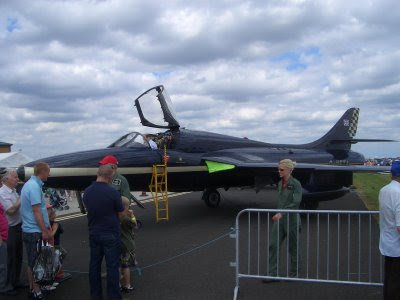
My little Exilim is not very good at photographing planes in the air, so here are some pictures of pretty aircraft on the ground (and there were probably several hundred there to look at, so imagine me rushing about going “Ooh, look!” all day, yet seeing only a fraction of what was there):
Aérospatiale GazelleA Gazelle from the Empire Test Pilots' School, which is partly run by QinetiQ, the privatised part of the former Defence Evaluation and Research Agency.


Hawker HunterA privately-owned two-seater Hunter.

BAC Jet ProvostOne of several Jet Provosts, this in Kuwait Air Force markings. A four-ship formation Jet Provosts gave a very nice performance later in the day.


But, it wouldn't be a British air show without some completely unrelated displays as well, so in the middle of everything was the local stationary engine society, displaying their carefully polished machines:
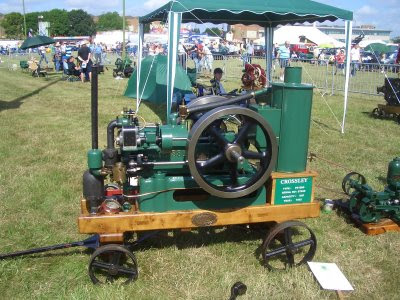
Crossley PE 1060A Crossley PE1060. The Crossley Brothers were strict teetotallers, so they refused to sell their engines to breweries.


And next to that, rows upon rows of carefully polished vintage cars:
A carThis is a car, I don't know anything about those. Oh, well, the one in the background is an Audi 100, I know because we had one when I was a kid.


Of course all the armed forces were there, recruiting. The RAF brought out all the fun you can do besides killing people, such as e g joining the RAF Bobsleigh team:
BobsleighsFor optimum performance you need a hill. With ice.


Now of course, there was considerable activity in the air. The Polish Air Force display team Orlik did a very nice performance. They were then followed by the Red Arrows. When I first saw them at a Bromma air day ages ago, I first didn't get the point, they seemed to just fly round and round. Only after a while did I realise the extremely precise formation flying they did, reformating so smoothly you had to strain to see how they did it. Today, with only a few scattered clouds, they were able to do their full ‘high’ programme. Their speaker, “Red 10” kept up a constant patter, carefully introducing each pilot with humorous quips (“‘Boomer’ has flown in the Royal New Zealand Air Force and the Royal Australian Air Force, so he speaks both languages fluently. He is now struggling to learn English.”) and also stressing the combat experience of each.
The Red ArrowsHopeless picture, I know, but, The Red Arrows!


Some time after lunch (Cornish pasty) I picked up that we were not going to see a Vulcan in the air. Briefly: Ex-military aircraft require a Permit to Fly. This has to be regularly renewed, and this entails demonstrating that the aircraft is in a certain defined good working order. The Permit to Fly for XH558 had expired the day before. This obviously would not have come as a surprise for the Vulcan To The Sky Trust, but what with one thing and the other, they had failed to fulfil the certification requirements and had instead just hoped that the Civil Aviation Authority would waive the requirements for that weekend, seeing as they had an airshow to do and all that. The CAA did not agree and thus the plane was grounded. To say that I and a significant part of the other roughly 100 000 attendees were disappointed is like saying it's a long walk to the Andromeda galaxy. I would have appreciated a bit more grovelling on the part of the VTTST spokesperson rather than the “Unfortunate, but we couldn't really help it.” attitude displayed. That they got their PtF renewed just a couple of days later further indicates some seriously bad planning. Boo, hiss!

Ah well, there was still plenty to see in the air and on the ground: More Hawks in the air, the aforementioned Jet Provost display, some quite interesting formation flying and simulated missile attacks by a group of Hawks and Falcons, helicopters cavorting, and then a very noisy display by a solo Eurofighter. I'd worn ear protectors all day, but when a plane like this turns on the afterburner, it's like it grips your stomach and shakes it, you have to tense up just to remain standing.

We made a quick tour of the various stands, I picked up some pre-ordered modelling supplies in the Hannants booth, and then I spent an hour in the Airfix tent.

Eventually the day wound down and we started to look for the exit. Food time! The first pub we found in Waddington was full and didn't look as if it served food either, but then we came to the Horse & Jockey, where we were welcomed and had a perfectly good dinner. On consideration, we didn't feel like walking the two hours back, but when we had finished dinner the stream of cars leaving seemed to have thinned out, so we decided to get a taxi. The pub staff recommended Discount Cabs, so I called them and they promised to have a car there in 15 minutes. 15.00 minutes later our cab turned up. We piled in and the driver sort of dove into a rabbit hole in the village, bypassing all queues, while lambasting Vulcan To The Sky in no uncertain terms and a very thick Lincolnshire accent and then deposited us by the door. And it was cheap.

Honeybuns had during the day become increasingly more agitated about the state of my skin. I for my part considered myself to be well protected by the tan I had gotten myself in Lappland, so wasn't too concerned, but it did feel like maybe it would be a good idea to apply some cream to my face and legs before going to bed.

Then. The next morning. My bright red face was oozing yellowish liquid and I'd covered the pillowcase in stains. My legs wouldn't bend properly and my skin felt too small for my body.

That day we would clearly only do shady activities…

2009-07-03

Lindum Colonia

Lincoln has an interesting topology. Most of Lincolnshire is fairly flat, but here there is a fairly high hill. On top of this hill stands Lincoln Cathedral, a very tall building, which accordingly is visible very far away. The modern city centre lies down by the river Witham (downtown, as it were). You go between the two by way of High Street, which continues as Steep Hill.

Riverside Cafe on the High BridgeThe Riverside Cafe on the High Bridge over River Witham.
So, this Friday morning we got off the bus by the market square where we wandered around the stalls, to the musical accompaniment of a country & western singer (who actually was quite good), and Honeybuns bought herself an interesting cheese. We ascended Steep Hill, which, in addition to other interesting shops, contained a goodly number of used book shops, which obviously all had to be visited. As we were going to do some walking that day, we couldn't obviously buy all worthy books, but some sufficiently light-weight items found our favour.
High StreetThis is just High Street, it gets steeper than this.


Eventually we were at the summit of the hill. Not by coincidence, this is where the Tourist Information Centre is (there is another one down at the city centre, but it is currently closed for renovation), so I might as well stick in a bit of tourist information here:
The general area of Lincoln has been inhabited for a long time, but the name and the first stone buildings date from the Romans. There are still a few remains, such as bits of the old city wall, left from Roman times. The next high period for the town came with the Normans, who started on the castle and the cathedral, both of which were greatly expanded in mediæval times; there are also a few Tudor era houses left. The first World War I tanks were constructed in Lincoln and during World War II Lincolnshire was “Bomber county”. All these various historial eras are carefully commemorated with signs, museums and the items themselves, of course, and there are a number of marked theme trails around town, so show off Roman, Norman, etc remains. Even though the town is so obviously prepared for tourists, there didn't seem to be particularly many around, which I provisionally put down to the English school term not being over yet. Swedish tourists were clearly not common here, I suspect they only leave Regent Street to go see Mamma Mia!.

Lincoln Castle model for non-sightedLincoln Castle in bronze.
Cobb Hall TowerHoneybuns descending into the interior of Cobb Hall Tower. Lots of dark nooks and crannies down there.
Anyway, we decided to start with Lincoln Castle. Inside the walls was a carefully tended garden, just made for picknicks. We had a long look at the Magna Carta, went through the prison exhibition and then climbed the walls and the towers. The sky was overcast, but from the Observatory Tower we felt as if we could have seen all the way to the North Sea had it been a clear day. Towards the west we could see another castle tower, which we couldn't fit to any feature on our maps, very strange.
View of Lincoln and surroundings from Observatory TowerA view southwards from the Observatory Tower of Lincoln Castle.


Finally hunger drove us out and we found a little vegetarian restaurant on Steep Hill, where some rather surly teenagers served us a quite good lunch.

Bishop's PalaceThe remains of the Bishop's Palace.
Then we walked a circuit around the cathedral, but decided to see the mediæval Bishop's palace instead. It is mostly a ruin these days, but an audio presentation did its best to bring its old splendour alive to us. I actually enjoyed this audio tour better than the one at the recent Titanic exhibition as this one only played fairly short clips and then waited for the user to start the next clip, thus allowing much better self-pacing.

Lincoln water towerA rather fancy water tower.
The museum closed, so we had to leave, and decided to set out to find the mysterious tower we had seen. Oh, it was a water tower. Apparently it didn't qualify for marking on any maps, just being public works, as it were. We found a pub for dinner and then descended the hill for the bus home.

2009-07-01

Running late

X2000 pulling in at Stockholm Central StationX2000, the vomit express.
We found somewhere to house the cats and went for a longer trip, to England where my heart lies. The usual trip with the 12:21 from Stockholm to Copenhagen and then the night train to Cologne, from whence on to Brussels. Well, not so fast!
We were late into Copenhagen, but as SJ in their wisdom had insisted on purveying us with tickets with generous margins between trains, this was not a problem. However, the motion sickness which I had accrued on the X2000, was.
Eventually we boarded our sleeper, which was a Czech single-decker this time, and rolled through Denmark into the night. I didn't sleep very well (Honeybuns bravely slept in the upper berth, risking being tossed to the floor whenever the train lurched) and when I headed for the shower in the morning, not feeling particularly well at all, the conductor informed me that we were already running two hours late, so they were going to dump us in Dortmund, from where we could catch a faster train to Cologne.
We gathered our belongings and then scrambled to this other train, some platforms away.
Well on the train, I withdrew to the lavatory to yell at Ralph, after which I felt slightly better and then dozed a bit.
Kölsch beer advertisingThey are still remembered!
Our wide margins saved us again, so we had no problems catching our connection in Cologne. While we waited, Honeybuns explored the just-opened food stalls and eventually found me an unfilled croissant (you can't imagine the stuff the Colognials put in their croissants!) which I gingerly nibbled at, but my oculo-vestibulo-gastrointestinal system had calmed down by now.
Instead of the usual Thalys, we travelled with an ICE train. It seemed to me they must have straightened the tracks, because the journey was half an hour shorter and I didn't quite recognise the landscape we passed through, even though the stations were the same. This meant I missed my favourite sights on this leg.
In Brussels we spent a long time going in circles, trying to locate the Eurostar terminal. Finally we found the mysteriously elusive entrance and ended up in long queues for checkin, exit passport control, security control, and entry passport control (Britain not being a part of the Schengen area). Eurostar has a serious case of flight envy, but doesn't quite manage to pull it off: All luggage has to be tagged and “Dangerous items such as knives” are prohibited, so I slipped my Victorinox in my suitcase, expecting it to be placed in a locked hold after being X-rayed, but no, the suitcase was just given back to me, so there I got on the train, equipped with a deadly weapon—not only did I have a knife, but I could…err…use the screwdriver to take the train apart while rolling, yeah!
Eurostar train at S:t PancrasEurostar at S:t Pancras.
The train accelerated through Flanders, briefly stopping in Lille and then, with no further ceremonies, dove into the Chunnel and just as fanfare-lessly popped up somewhere near Folkestone a short while after. After a surprisingly short trip we found ourselves at S:t Pancras.
We had a while before our next train so had a spot of food and then wandered around S:t Pancras and King's Cross, looking for ice cream until I found a Möwenpick freezer in a shop in the former station. Another item worthy of notice: The public lavatories at King's Cross will cost you 60p, but the ones at S:t Pancras across the street are free.

National Express DVT Mk 4Two National Express-operated Driving Van Trailer Mk 4 at King's Cross.
Then we got on the next train, for Newark, and this is when the real travel started. While high-speed trains take you from A to B very efficiently, they tend to travel in trenches for noise-protection reasons. This means you don't actually see much of the landscape you travel through. Now we finally travelled on a normal train on an embankment and could enjoy the view of East Anglia, spotting churches, looking for cows and gazing at the horizon. At Newark North Gate we arrived a bit late, but still managed to get on our connecting railbus to Lincoln.

At around 16:00 we were in Lincoln, some 28 hours after leaving Stockholm.

Pulling our bags on a cart we stuck out like sore thumbs and we had hardly exited the station before the locals descended upon us, eager to tell us how to best get to the tourist information centre. On the other hand, the town was already closing down. We had time to get ourselves sandwiches and juice at the Coop, but by the time we had finished them all shops and restaurants had closed. (Later on British colleagues extolled the wild nightlife of Lincoln, to which we can just say “What!?”) We wandered around a bit, but decided we needed rest, so returned to the rail station and took a taxi to our bed & breakfast, which turned out to be just as friendly and comfortable as we had hoped for. Soon we slept.

2009-06-26

One-stop exotism

In Vindeln they don't have enough eaters for several different restaurants, so you have to combine them into one.

2009-06-23

Vroom vroom


I found an old friend in the craft shop in Åsele: The Corgi De Tomaso Mangusta, the first toy car I remember having and driving along roads made with masking tape on the nursery floor. I must have been able to read already then, as I remember having been fascinated with the strange and mysterious name.

2009-06-19

Falling off the waggon

Embla Viking at the gate at ArlandaHoneybuns' cats don't travel well, so since I was to be formally Introduced to the Honeymom, who lives up north, I got to fly for the first time in several years. Domestic. With the cats. Well, the cats actually ended up somewhere in a pressurised hold, but they still had to be excavated from inside the sofa and under the bed and stuffed into their travel basket and then brought to the airport. However, as we were travelling on Midsummer's Eve, the airport was all but empty and the staff had time to be friendly and helpful. The baggage dropper even emptied out a box of forms for me so that I could check in the Swiss army knife I only realised halfway through the security control I still had in my pocket.

The flight up on a SAS Boeing 737-683 was uneventful; the clouds disappeared somewhere over the Gulf of Bothnia and we arrived in Umeå under blue skies. We got out on the apron, but there was very little traffic to smell or look at apart from a very cool-looking ambulance helicopter.

We had a good week (of which more anon) and then flew down, cats and all, on another -683, finishing with a circuit over Stockholm, which was at its most beautiful. I was so seated that I could look down on Honeybuns' house as we passed it on final approach.

2009-06-18

The large print giveth, the fine print taketh away

At the bookstore till I vainly waved my discount coupon:
20%
discount on everything in the shop!*
* Does not apply to student priced books, magazines, gift cards, the Reading Circle, music CDs, DVDs, and electronics.

On the whole, would it have been too difficult to say “20% off on all books”?

2009-06-14

Not a bot

In high school we declared the computer room to be an independent country (mostly due to a contrived joke on my part, which we need not go further into) and as such we needed a national anthem. The then-current hit “Systems breaking down” fit the bill perfectly. It's been unavailable for long, but now has resurfaced on YouTube, and I just can't have too much 1980s synth pop on this blog.

2009-06-13

Sinking feelings

Honeybuns and I went to see the Titanic exhibition in Boathall 1 by Galärvarvet (The Galley Wharf). It was somewhat pricey at 120 SEK, but waving my Friends of the Vasa card at least gave me a discount. We were equipped with rather bulky items that turned out to be mil-spec MP3 players with the guide voice track to the exhibition. Then we were photographed on a simulated gangway before we entered the exhibition itself.

The voice track pretty much locked one to a particular, pretty high pace of going through the exhibits, which in the case they were, for example, written documents, couldn't be read while listening to the guide. With time I figured out how to pause the track and use the chapter skip buttons to adjust the timing, but that required conscious effort and some training. The voice track also had background music, which I quickly realised came from the famous film. As I haven't seen the film, I asked myself whether the exposition in fact followed the run of the film, but there were no overt references to it elsewhere. But the stated meaning of the exhbition was to remind us of the people behind the legend, who'd once lived, loved and worked.

Accordingly, each exhibit was typically a huge photograph of a person who had been on the Titanic with a case next to it, often showing personal items belonging to that person, postcards, diaries, watches, but also samples of cutlery, china, etc from Olympic, the sister ship of Titanic.

The final room listed the names of all who had perished and I noted an impressive proportion of not only Swedes, but also Finns, among the third-class passengers—emigrants to America. In an appropriately solemn mood we exited, passing the desk selling photographs of us boarding the exhbition and the souvenir shop with extremely expensive Titanic souvenirs. On the way home we thought about shipping disasters—while that of the Titanic may be the most famous, certainly it's not the worst? Wikipedia to the rescue (and several hours of reading)!

As I had remembered, Wilhelm Gustloff was the sinking with the greatest loss of life, but now I found that the latest estimates suggested around 9400 dead. What I had not known was that Wilhelm Gustloff was part of a huge rescue operation, perhaps a thousand ships moving over a million Germans from East Prussia to Germany and Denmark from under the Soviet army. Several of these ships were sunk, including the Goya with another 6000 dead.

In peacetime the worst accident is the Doña Paz sinking by the Philippines with perhaps 4000 dead, and the Kiangya, lost by the Chinese coast with around 3000 dead.

Closer to home, Estonia didn't have as many victims, but a much higher proportion of the passengers died than on the Titanic, due to the ship capsizing within minutes, trapping the passengers in their cabins.

I've always thought that a major advantage of air travel is that you die instantly if there is an accident.

2009-06-07

I count

Silent sunny summer Sunday. I thread new laces in my shoes and go out. I pour a bagful of transparent glass containers into the recycling bin and then double back a bit. I've often passed the school, but have never been to it. No worries, a sign points out “POLLING STATION THIS WAY”. It's no longer entirely pristine, this is not the first election it's been brought out for. A few party representatives handing out ballot papers by the door. Arbetarinitiativet, who on Earth are they? Anyway, I've already made up my mind, so I pick up a ballot paper in the stand on the inside and scan it for any unexpected names. I locate the polling room for my district, greet the election officials and disappear behind the green screen to stuff my envelope. Voting card, ID, and envelope handed to the official, I'm marked off and on the strike of noon my envelope is dropped in the big box. I walk back home in the cool sunshine, wondering how the next mandate period will turn out for the MEPs.

2009-06-04

Elitism

A recent article in Dagens Nyheter discusses “elite classes” in elementary school, i e classes where the students get more advanced courses in maths, physics, history, or whatever. The news item itself is that there is not a whole lot of applications to these classes, but they also quote Marie Granlund, Social Democratic spokesperson for school issues, to the effect that elite classes will create A and B teams in school, something which is anathema to the Social Democrats (to which I, on and off, count myself). I instinctively reacted with annoyance to this, but better to sort out what's what, and see what will be a rational position to take.

To begin with, as the reporter asks, why is it OK to have special classes for practical training, such as sports, music, etc, but not for more “intellectual” subjects? This never gets answered by Granlund, who just reaffirms that advanced physics classes cause student segmentation (skiktning), whereas advanced sports classes do not. Now, I've heard the argument before from Social Democratic school politicians that demands for raised academic standards are a means to keep working class children down. There is a point to this, though often left unspoken: Children in better-off families tend to get considerably more support* from home with doing homework, simply having a tradition of reading and education being taken for granted. Accordingly, I suspect the unspoken assumption is that the A and B teams feared are not split according to the giftedness of the children, but according to the wallet size of their parents.† This, I agree, is a Bad Thing. Unfortunately, the ingrained reaction of the Social Democrats is to insist that No Child Can Be Left Behind—no matter your grades, you always get to move ahead to the next class, to high school, to university, in the bizarre hope that the under-achieving student will be so overwhelmed by gratitude at this kind deed that they immediately get their act together and not only diligently study in their ordinary classes but at the same time also do all the studying they did not do in lower grades. I'm quite positive this does not work.

Segregation is a Bad Thing, as having no experience and understanding of how other people live is likely to increase tensions in society. Mixing is not a guarantee for peace, love, and understanding, but perhaps raises the chances a bit at least. Schools are of course segregated based on where the children live, which correlates with socio-economic status, so a relative once noted that compulsory military service was the one place in Sweden were men from truly all walks of life got to meet each other. I suspect this is not entirely true, certainly I had a higher than random proportion of friends working as programmers at Navy HQ and quite a few top dogs in society have passed through the famous Interpreter School, but in principle the idea held. Now that just a few get to perform their military (or non-military, for that matter) service, segregation would seem to increase.

Then again, segregation can be good, for other reasons. As I've pointed out before, being intellectually gifted is not necessarily appreciated by other people, whereas being, say, even a half-decent musician is always a hit. (Haha. Or, not to put too fine a point on it, you get more babes with a guitar case than with a laptop case.) I myself finally found my true peers and life-long friends in Young Scientists, where thinking about non-integral differentials, doing chemical experiments not necessarily (though fairly often anyway) aimed at explosions, or writing Lisp programs were not reasons for pariah-hood. So, from my own personal background I would expect “elite classes” to have social, not just academic, advantages.

I presume this means I'm for “elite classes”, but are we then likely to instead create another social stratum, separated from the rest of the world, creating engineers and scientists without much feeling for the human state of existence? I suspect this is a stereotype promulgated by those who prefer the guitar case-carriers and not even seeing all the nerds around them, the contact surfaces are there.

Much more worrisome are the barriers to properly getting gifted children through school, regardless of their family background. I am at a bit of a loss here. A common demand is that teachers should “see all children” and adapt their teaching to the children's different demands. This is obvious bunk, there are only so many ways (=1 in most cases) that you have time for to explain a concept. When we have one teacher per child, then we can have full adaptivity, but the entire idea of a school presupposes that you teach children in bulk. Having extra staff helping with homework etc can be a step, but at some point teaching must start with the parents. And what do you do with them? I frankly haven't a clue and, of course, people are complicated. Yet we really need to improve schools. Not necessarily for the matter of national competitiveness, curing cancer, or anything like that, but because young bright people deserve to have a chance at learning stuff for their own enjoyment, growing as a person and all that. It's OK if they want to be auto mechanics because they find their joy in muffler belts and suspensions, but if they become auto mechanics because they don't know that there is an alternative, or because they don't dare became anything else, then potential joy is being tossed away.


* It could be argued that I and my siblings also got support from home, but I'd say it was pressure more than suppport, we were expected to do well in school and continue to higher education, so as to get rich and independent (well, we did, I guess), but our studies we had to manage on our own.

† Another possible assumption, not outspoken either, is that sports and music classes will give working class children a chance to get ahead and become sports pros and pop stars and thus rich. Equality accomplished!

2009-06-02

Sheesh!

In the book I'm currently reading the author expounds on her tendency to become ill while travelling: “…and I ask you—I beg of you!—who gets sunburned in Stockholm?”

Well, I do. Quite regularly every summer, even though I try to stay out of the sun. Did she think we all live underground and never go out?

2009-05-30

You cheat!

I've spent the day playing with Denephew. I've never understood the principle of letting a weaker opponent win, so at one point he yelled: “You have to run slower, that's what adults do when they play with children!” Bah, he fits in narrower spaces than me*, so no mercy!

*) Here's another tip: If you play hide-and-seek and you know where the kid has hidden, you don't have to immediately retrieve them if you need a breather.

2009-05-29

Word of the week: abs tract

My PE teacher considered a nice-looking sixpack to be all-important and had written an abs tract proclaiming the necessity of training one's abdomen.

2009-05-22

Veckans ord: hagalen

Ute på landet kan man gå ner i hagen och betrakta hagalen.

Alen i Fräkentorp

2009-05-21

Best mashup ever!

That the run on the Death Star in Star Wars: A New Hope is heavily based on the climactic bomb run in The Dambusters is well known, but never so well demonstrated as in this clip made by HenryvKeiper:

2009-05-20

Analysis of Evolutionary Analysis

Biology is a hot subject. There's already a fourth edition out of Freeman and Herron's Evolutionary Analysis, but such is life that I tend to get books faster than I read them, so I only recently got around to reading the book I bought a couple of years ago.

We know that currently existing organisms, plants, bacteria, fungi, animals, etc, are descendants of earlier, different, organisms. This book gives an introduction to how we know this to be the case. This ranges from what features are naturally selected in plants of the same species growing in different environments, to the “deep homologies” that tie together bacteria and kangaroos in the same tangled tree of life.

So how do we know? Sometimes you observe, which may imply that you sit in a hideout from sunrise to sundown for weeks and watch a flock of birds nesting to check if any of them nip out of the nest for a bit of nookie with the neighbour and then work the statistics on the results of those liaisons, to see if reality matches your theory of mate selection.

Or you do experiments, formulate a hypothesis of how a certain feature benefits the organism and then try to manipulate that feature for a group of individuals to see what happens. Superglue turns out to be useful in many of these experiments. (My unhappy experiences with superglue make me even more impressed with scientists who can use it properly.)

Other work involves searching through gene databases and using various mathematical means to determine at some level of probability how genes have been duplicated, modified, deleted (and how we can tell that that is what has happened) over time to result in organisms greatly different from their ancestors.

The book lays this out in an easily accessible manner, not without humour—merely reading the first chapter using the case of HIV to explain evolutionary thinking and put it in context managed to clarify a number of things to me. The exercises and suggestions for further reading in each chapter show ways in which to go beyond the material that has been presented in the chapter proper. One reason it took me so long to read the book was that I tried to work through at least some of the exercises. Often I felt handicapped by my high school biology crash course not having gone into detail on exactly how DNA is copied during mitosis, why crossover takes place and how transcription proceeds in detail. Surely I'm not so old it wouldn't have been known at the time?

An important thing which struck me was the way in which the scientific method was presented, many of the exercises were concerned with the proper way of phrasing a research hypothesis, how to design an experiment to test that hypothesis, and how to analyse the results of the experiment. This is an undergraduate text book. When I was an engineering undergrad the idea of hypothesis generation and testing was quite alien, rather the sentiment tended to be: “if it works, you're home”. When I went into graduate studies and teaching I tried to amend this as best I could, given my own barely adequate studies in the subject. I remember one time giving an exam question: “Explain how to design a formal experiment to test X.” and a (fourth-year!) student looking confused and asking “How can an experiment be formal, experimenting means just trying random stuff, right?”.

I do not know to what extent things have improved since then.

2009-05-18

The stage is all a world

The Only-begotten Daughter's theatre class had developed a play of their own again, yet again touching on the theme of struggling for a better world while people are as they are.

The setting was of a house scheduled for demolition being squatted by a disparate gang of youths, ostensibly to turn it into a house of youth culture, but the high-flying plans coming to nothing. A dizzying ambiguity underlay everything, not allowing any easy taking of any given position, putting every interpretation into question. Their soliloquies on how life could be more beautiful or their own pain were just enough over the top to possibly be taken as ironic subversions of themselves, yet perhaps not. In the end the police storm the building and the group stand together, lighting up the dark with their little cigarette lighter sparks of hope, singing “Imagine”, yet defecting into the dark one by one.

Certainty? Nowhere.

2009-05-17

Don't mess with me or my baby will kick yer arse!

My bent hammer on the rusty grillAs foreshadowed earlier, the balcony is the next renovation project after the bathroom. Honeybuns expressed great delight at the opportunity to smash something up, so I gave her free hands with the ugly home-made furniture made of rough planks slathered in a particularly unpleasant shade of bright blue. Not only did she make short work of them, but she bent my hammer in the process.

2009-05-16

A full day

The midday sun found Honeybuns and me having lunch on the verandah of a restaurant by the water in Södertälje, a Salvation Army band playing old standards nearby. We could have stayed there the rest of the day, contentedly basking in the sunlight like well-fed snakes, but we had other goals with the day and soon walked past election campaigners on the shopping street to Tom Tits.

The most noticeable additions since I had been there last were some fairground rides out in the yard and considerably higher ticket prices. The latter however included a thickish booklet briefly explaining each of the 600+ available “experiments”, but we it put in a locker with our jackets, so as to be less encumbered while exploring. Then off to play!

We started with the outdoor activities. The helium balloon was inflated, but not available for rides yet, but lots of water was available for diversion. No trout in the salmon ladder, but the camera obscura was perfect for hugging in (yeah well, but it's more fun to do it on the sly). Honeybuns, as always fascinated by wild rides, explained how cool the freefall ride was but was put off by all the children queueing for it, so I talked her into going for the ride. Unfortunately, as I belatedly realised, this meant that I, too, would be repeatedly dropped from a great height, but I held on to the safety harness with all my might and was at no point smashed into the concrete below.

Nearby was another threatening device, The Rotor, which once, when it was standing at Gröna Lund, turned my face green, which my sister upon witnessing noted she had always thought was just an exaggerated saying. However it was not active at the moment, so I bravely walked around it and made faces at it without fear of retribution.

Crawling through the old sewer pipe below the yard was on the whole a calmer experience and pleasantly cool.

In the Earthquake house stood a young man, licking an ice lolly, repeatedly pressing all the buttons that would shake the structure in various directions while looking very bored. Apparently a mere earthquake was nothing to the jaded ten-year-old.

Then we ascended to the top floor and the Human exhibition. On one wall I found Lajos Zilahy's short story „Mikor halt meg Kovács János?”, which must have been in some high school literature reader, since so many other people of my age relate to it.

Illusions, optical and otherwise, and then a lecture hall with the seats placed according to the periodic system.

The final thing we had time for was “Recollections”, a VIDEOPLACE lookalike. Honeybuns danced for me.


Then Tom Tits closed and we went home to smash some furniture.

2009-05-15

Word of the week: lecturd

Sometimes teaching feels like crap and I deliver a lecturd.

2009-05-10

Covering all the bases


Calamities of Nature, another web comic playing with words.

2009-05-09

Internationally renowned

It was a bit of a surprise to me to find that the Polish Wikipedia entries on the Stockholm underground network are more extensive than the Swedish ones—I'd thought the Slavic conversations I hear on the trains were in Russian.

2009-05-08

Veckans ord: kokostopp

Det finns för många puckon, vi behöver ett kokostopp!

2009-05-06

Creative process

To add to the earlier post on pre-canon versions of Paul Simon songs, here is a clip showing no less than two of his songs being developed and explored.

2009-05-04


The cherry trees in Kungsträdgården are blossoming.

2009-05-03

We must tend our garden


Honeybuns was formally introduced to my mother and they (as I had surmised) immediately started discussing gardening. Before long we were on our way to Zetas market garden. I've been flower shopping with Honeybuns before but not quite gotten the point, but this was a place that was a delight to all senses—the place itself was a huge garden with the rows and rows of plants for sale nestled among rooted trees and rock gardens. There was even a shaded “Green room” with all-green plants without visible flowers which was hedged off from the rest of the garden so that it became a contemplative resting spot. The detailed labels for each type of plant gave the impression that the staff knew what they were doing. There was also a selection of various…objects that you could decorate your garden with, of which I found most fairly tasteful. Ooh, shiny! The polished steel balls I will have to get no matter what.

In the end we left with three clematises for my balcony, me feeling very cross-referential in getting a “Blue Angel” and a “General Sikorsky”. More stuff (including a shiny ball) will be be procured as the balcony renovation project proceeds.

2009-05-02

The middle-class intellectual calculating his gut reaction

We were for a change shopping dinner at Coop Forum Rotebro and marvelled at the huge range of foods. We found a shelf with halal meats and I thought: “Cool, they even have halal bacon now!” before I did the double take. Apparently someone had just decided to offload an unwanted packet of bacon on the shelf. Funny place to leave it, though. But then there was a packet of bacon in the halal freezer as well, which was too many coincidences. Probably someone was deliberately attempting to offend the presumed buyers of halal meats. I attempted to determine my appropriate reaction to this. There are right-wing extremists in the area, as evidenced by posters and graffiti, and that makes it more than a mere prank, but I couldn't quite gauge how offensive it would be perceived to be—probably completely subject to personal predilections. Afterwards I realised I should have resolved the issue by simply buying the bacon, thus earning myself breakfast while removing any perceived offence.

2009-05-01

Veckans ord: ohållbart

Lokalen var dubbelbokad, så mötet var ohållbart.