Showing posts with label nautics. Show all posts

2023-09-03

Finished model 2023-III

A souvenir from a friend who visited St. Petersburg some years ago: The protected cruiser Aurora, known from the October revolution, as a snap-together carton model by Umbum. The scale seems to be 1:900-ish. I put this together in ten minutes or less – the sturdy carton is pre-cut and the fit of the pieces is almost good enough that the kit just falls together—but you must follow the instructions carefully. The printing is excellent, and results in a good-looking model with minimal effort.

2022-09-04

Finished model 2022-II

Another horrid paper model: The Royal ship Vasa. Box scale, or rather, post card scale. The double-curved surfaces were impossible for me to bend correctly, I wonder if there is some magic trick to make the card stock more pliable. By the stern there were several very thin wedges the were to be cut and glued to make the curved shape. Only afterwards did I realise I should have just cut away the tiny triangles intended as glueing surfaces and instead glued a wider piece of card onto the back. One may note that the bowsprit, which carried a quite sizeable sail, is not represented in the kit. I could perhaps have used a cocktail stick to add it, but couldn’t be bothered.

2021-10-27

Anti-submarine warfare

Completely coincidentally, in these days of submarine anniversaries, I found the site Indicator Loops on Allied harbour protections against submarines. Apparently there was one of these just next to the grounding site at the time, one wonders if they are still around or if they have been dismantled.

2021-09-14

Ship spotters

Reading up on aircraft carriers, I ran into scores of codes indicating the convoys the carriers were protecting. I could distinguish certain patterns, but the full information is of course available at ConvoyWeb

2012-02-22

Finished model 2012-I


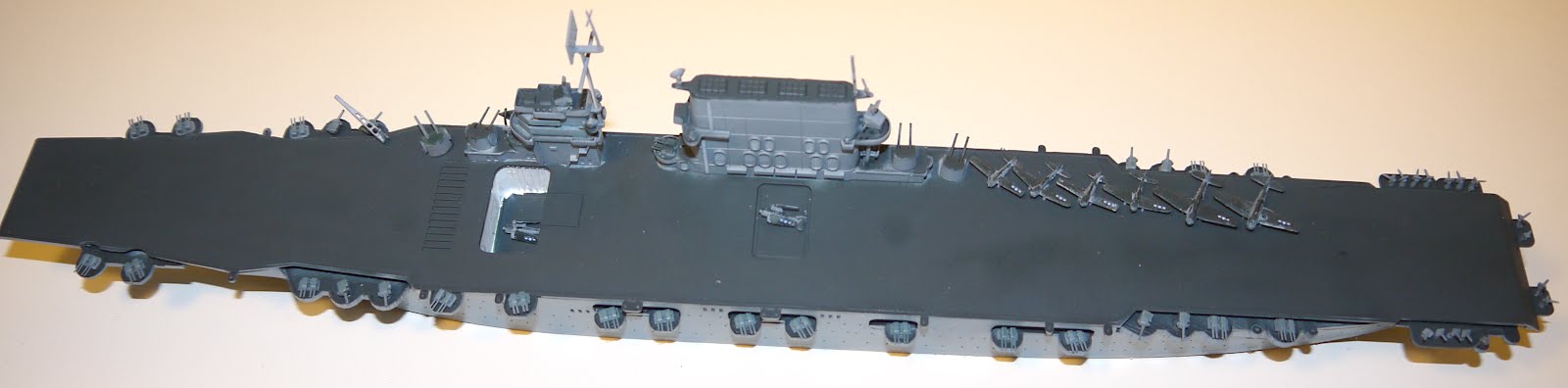
Ulf thought I needed to build more ships, so donated me the Fujimi 1/700 waterline model of USS Saratoga. I’ve been struggling with it for quite a while, but now I decided to call it finished even though I’m not exactly happy with it. One of the difficulties I encountered was that I really don’t have a very good feeling for what’s what on a ship, so I couldn’t always tell if parts were misshapen or were actually supposed to be like that. But the absolutely worst obstacle was Fujumi’s building instructions. I have later been able to compare with their other ship models and they consistently suggest constructing the kit in exactly the opposite order of what would make best sense, i e they suggest first making the fiddly bits, then putting them together with all the superstructure and only in the final step adding them to the hull. This in fact makes it almost impossible to paint the ship with any success and almost guarantees that masts and the like will get broken in the process. (And no, it’s not that I can’t read Japanese instructions—I will at least for the moment assume that even the Japanese count from 1 and upwards.)

What I should have done is:
Paint all parts on the sprue.
Assemble the hull with flight deck, putty and paint as needed. (It’s a waterline model, i e, there’s a huge seam all along the bottom which is well-nigh impossible to get right.)
Assemble the superstructure, paint each level before adding the next.
Finally, add masts, aerials, guns and aircraft.

Anyway, the model is painted as Saratoga would have looked c 1943, in Measure 21. (The US Navy seems to have spent considerable time during the war repainting their ships in ever new camouflage systems.)

There is a small assortment of aircraft included, Wildcats, Dauntlesses and Avengers. They are moulded in clear plastic with the idea that with proper masking you will automatically get a clear canopy. Alas, I haven’t figured out how to effectively mask such a small nubbin. I tried with Maskol, but as usual found it to be useless. There were decals supplied for national insignia in pre- and post-1942 styles. They seemed to me to be too few, but eventually I realised there were exactly as many stars as would be carried on the wing topsides; underside and fuselage insignia had been skipped. In the event, these decals turned out to be the absolutely worst I’ve ever tried: they refused to leave the backing paper, and usually ended up shattering into little flakes, thus being available for even fewer aircraft.

So, in the end I was rather unhappy with the results, but I have now built an aircraft carrier and have a little better idea of how to attack a ship should I try to do another one.

2011-03-04

Coincidence? I think not!


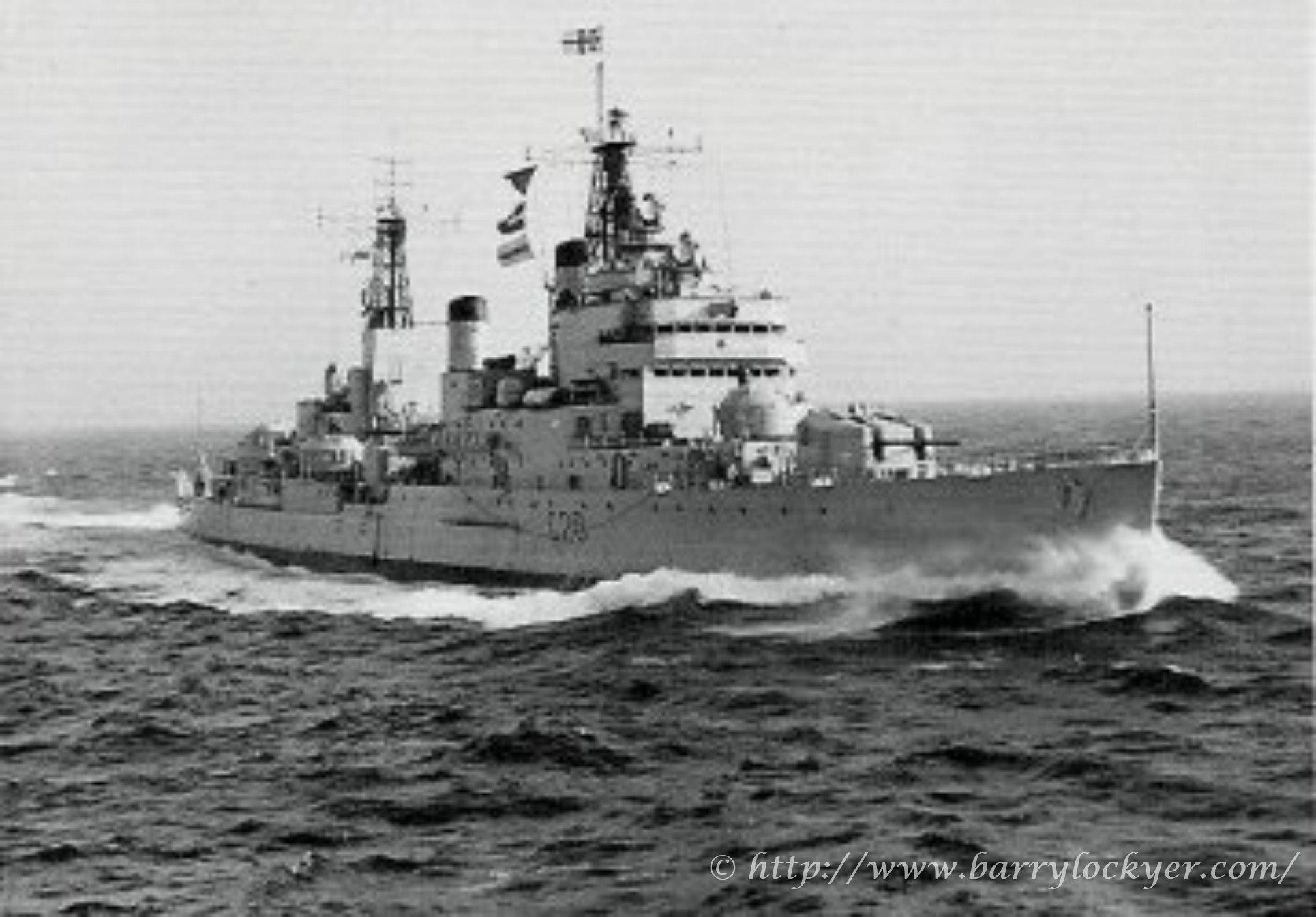
The sister ship of HMS Tiger was HMS Blake. The Royal Navy claims it is named for Robert Blake, but I think some clever fellow at the Admiralty had William Blake in mind.

2009-06-13

Sinking feelings

Honeybuns and I went to see the Titanic exhibition in Boathall 1 by Galärvarvet (The Galley Wharf). It was somewhat pricey at 120 SEK, but waving my Friends of the Vasa card at least gave me a discount. We were equipped with rather bulky items that turned out to be mil-spec MP3 players with the guide voice track to the exhibition. Then we were photographed on a simulated gangway before we entered the exhibition itself.

The voice track pretty much locked one to a particular, pretty high pace of going through the exhibits, which in the case they were, for example, written documents, couldn't be read while listening to the guide. With time I figured out how to pause the track and use the chapter skip buttons to adjust the timing, but that required conscious effort and some training. The voice track also had background music, which I quickly realised came from the famous film. As I haven't seen the film, I asked myself whether the exposition in fact followed the run of the film, but there were no overt references to it elsewhere. But the stated meaning of the exhbition was to remind us of the people behind the legend, who'd once lived, loved and worked.

Accordingly, each exhibit was typically a huge photograph of a person who had been on the Titanic with a case next to it, often showing personal items belonging to that person, postcards, diaries, watches, but also samples of cutlery, china, etc from Olympic, the sister ship of Titanic.

The final room listed the names of all who had perished and I noted an impressive proportion of not only Swedes, but also Finns, among the third-class passengers—emigrants to America. In an appropriately solemn mood we exited, passing the desk selling photographs of us boarding the exhbition and the souvenir shop with extremely expensive Titanic souvenirs. On the way home we thought about shipping disasters—while that of the Titanic may be the most famous, certainly it's not the worst? Wikipedia to the rescue (and several hours of reading)!

As I had remembered, Wilhelm Gustloff was the sinking with the greatest loss of life, but now I found that the latest estimates suggested around 9400 dead. What I had not known was that Wilhelm Gustloff was part of a huge rescue operation, perhaps a thousand ships moving over a million Germans from East Prussia to Germany and Denmark from under the Soviet army. Several of these ships were sunk, including the Goya with another 6000 dead.

In peacetime the worst accident is the Doña Paz sinking by the Philippines with perhaps 4000 dead, and the Kiangya, lost by the Chinese coast with around 3000 dead.

Closer to home, Estonia didn't have as many victims, but a much higher proportion of the passengers died than on the Titanic, due to the ship capsizing within minutes, trapping the passengers in their cabins.

I've always thought that a major advantage of air travel is that you die instantly if there is an accident.

2008-05-21

Double feature

The Vasa museum and the Maritime museum had joint inaugurations of model exhibitions today:
The 1:10 Vasa model placed next to the original has gotten all its sculptures painted according to what has been found about the original colouring. It is quite surprising to see the ship that traditionally has been rendered in blue and gold as in fact having had a red background with sculptures coloured like candy with illegal additives.

Vasa

At the Maritime museum Göran Forss's 1:50 model of the destroyer Halland has finally been finished after almost 40 years in making. Listening to people talking, I gathered a sizable part of the audience had done their military service on board at some time or other and were very pleased to see the detailed model.

Halland