Showing posts with label England. Show all posts
Showing posts with label England. Show all posts
2017-08-20
Rare people
Watching British detective series it has often struck me that no matter in how seemingly remote a place a person has been killed, the body will typically be found within a few hours. An explanation for this might be suggested by Northumberland (where Vera is located) being the most sparsely populated county of England at 63 persons/km², which population density is in Sweden only surpassed by the three “big city” counties of Västra Götaland, Skåne, and Stockholm.

2009-07-06
Goodbye, hello!
Leisurely packing of things in the morning, take our farewells of our host with promises to return one day and then catch the bus into town, pick up a Lincolnshire Echo and then wait for the train to Peterborough. A railway employee kindly and politely directs us to the right platform.
 East Midlands Trains Class 153. Note that curiously the serial number on the side is 52319, but the number on the front 53319.
That special whine-growl of the diesel engine of the accelerating Sprinter, and we roll through the countryside. I do the cross-word puzzles—the Quick Clues is no problem, the Cryptic Clues is more of an effort, perhaps not more so than Geijerkorsordet in Dagens Nyheter, but it still nags at my language confidence.
We get delayed (a hallmark for this journey, it seems) and miss our connection in Peterborough, but it turns out trains to London run about every ten minutes, so we don't have to suffer the pouring rain for long. It feels very luxurious to just wave our Interrail tickets at the conductor.
Eventually we are at King's Cross again. I stand in an interminable queue to buy three-day travelcards for the London Underground, which for some reason can not be bought in the ticket machines, even though one-day travelcards can be. Ah, the Tube, the accumulated heat of more than a hundred years of trains and surely a milliard people. The Victoria Line, we find, has exactly two Accessible stations, none of which we will pass, so we have to carry our luggage down and up stairs. I check my map to locate the best way to continue from Victoria. We're soon by the quiet park of Vincent Square and I'm having déja vu feelings. We check in at the Grange Wellington Hotel but it's only when I visit the bathroom in the corridor that the memory clicks: This is the former Wellington Hall of King's College London, where I stayed a weekend twelve years ago. In the meantime the premises have gone from cheap to shabby. Still, they're reasonably adequate. (Googling around, I later find that King's College London started selling off their student housing in 2001, in an effort to improve their finances. This was not appreciated by the students..)
Having installed ourselves, we go out to introduce London to Honeybuns. Late lunch at an Italian diner, good food but snotty service. No tip.
Regent Street of course, where we hurry through the rain to Hamleys. We're both childishly interested in toys and spend a couple of hours going through the entire shop. They still have model kits, though set up in an interesting fashion: at one end of the floor they have the Revell kits, at the opposite end they have the Airfix kits, together with all other brands owned by Hornby, i e mostly model railway stuff. No Tamigawa kits anywhere. Hm.
We saunter down to Piccadilly Circus and meet up with an old friend of mine, find a cafe and bring each other up to date on our lives. Honeybuns patiently abides us talking shop.
My friend finally has to return to his family and we stroll past Trafalgar Square, where there is some kind of performance going on on the Fourth Plinth. We continue down to the Thames and take lots of touristy pictures of the Houses of Parliament and such. We return to our hotel room, which seems quite uninfested by cockroaches or any other kind of invertebrate life, and while the bed makes interesting squeaky noises it is more comfortable than it seems and we soon fall asleep.
Update. Of course Wikipedia has all answers. Class 153 units are originally two-car units, with a separate number for the individual car and the unit. Thus, the pictured unit is car 52319, but unit 153319.
 East Midlands Trains Class 153. Note that curiously the serial number on the side is 52319, but the number on the front 53319.
That special whine-growl of the diesel engine of the accelerating Sprinter, and we roll through the countryside. I do the cross-word puzzles—the Quick Clues is no problem, the Cryptic Clues is more of an effort, perhaps not more so than Geijerkorsordet in Dagens Nyheter, but it still nags at my language confidence.
We get delayed (a hallmark for this journey, it seems) and miss our connection in Peterborough, but it turns out trains to London run about every ten minutes, so we don't have to suffer the pouring rain for long. It feels very luxurious to just wave our Interrail tickets at the conductor.
Eventually we are at King's Cross again. I stand in an interminable queue to buy three-day travelcards for the London Underground, which for some reason can not be bought in the ticket machines, even though one-day travelcards can be. Ah, the Tube, the accumulated heat of more than a hundred years of trains and surely a milliard people. The Victoria Line, we find, has exactly two Accessible stations, none of which we will pass, so we have to carry our luggage down and up stairs. I check my map to locate the best way to continue from Victoria. We're soon by the quiet park of Vincent Square and I'm having déja vu feelings. We check in at the Grange Wellington Hotel but it's only when I visit the bathroom in the corridor that the memory clicks: This is the former Wellington Hall of King's College London, where I stayed a weekend twelve years ago. In the meantime the premises have gone from cheap to shabby. Still, they're reasonably adequate. (Googling around, I later find that King's College London started selling off their student housing in 2001, in an effort to improve their finances. This was not appreciated by the students..)
Having installed ourselves, we go out to introduce London to Honeybuns. Late lunch at an Italian diner, good food but snotty service. No tip.
Regent Street of course, where we hurry through the rain to Hamleys. We're both childishly interested in toys and spend a couple of hours going through the entire shop. They still have model kits, though set up in an interesting fashion: at one end of the floor they have the Revell kits, at the opposite end they have the Airfix kits, together with all other brands owned by Hornby, i e mostly model railway stuff. No Tamigawa kits anywhere. Hm.
We saunter down to Piccadilly Circus and meet up with an old friend of mine, find a cafe and bring each other up to date on our lives. Honeybuns patiently abides us talking shop.
My friend finally has to return to his family and we stroll past Trafalgar Square, where there is some kind of performance going on on the Fourth Plinth. We continue down to the Thames and take lots of touristy pictures of the Houses of Parliament and such. We return to our hotel room, which seems quite uninfested by cockroaches or any other kind of invertebrate life, and while the bed makes interesting squeaky noises it is more comfortable than it seems and we soon fall asleep.
Update. Of course Wikipedia has all answers. Class 153 units are originally two-car units, with a separate number for the individual car and the unit. Thus, the pictured unit is car 52319, but unit 153319.
2009-07-05
Slightly subdued
 Picture yourself in a boat on a river…
When we returned to town, we had a pleasant lunch at the Riverside Cafe and then ascended the hill to have a look at the Museum of Lincolnshire Life, though all too short as they closed fairly early. I still had time to be impressed by all the tractors and farming engines on display. More visits will be necessary.
From there we proceded to the cathedral, where we sat and waited for Sunday Mass to finish and then walked about. We were handed a leaflet on how to make a pilgrimage inside the cathedral, with suitable prayers to say at various points. I thought to myself that if a pilgrimage was a journey of spiritual discovery, they couldn't bloody well know beforehand what prayers would be appropriate for my spirit at that point. There was plenty of reflection to be made at the shrines for the armed forces anyway.
Along one wall of there was a temporary exhibition of wooden sculptures on the Life of Christ, which generally failed to impress me. The artist did not seem to like “representatives of the state”, though. There was restoration work under way at various points in the church, here too with some annoyance expressed at meddlesome Victorian restorers, who'd messed up some items. Then again, I suspect the eroded stone sculptures were not merely due to Victorian sulphur emissions.
I like churches, especially when they are mostly empty, they are good places to sit and relax, or cool down on hot days, and mostly there's always something interesting to watch. So we remained until the church closed, and then walked down the hill to where we found an Italian restaurant by the river and had some very nice salads.
After dinner we continued down the river along what seemed to be the old industrial area of Lincoln. Now there seemed to be some work at turning the old factories into housing. We tried to figure out how the local economy worked. In the city centre there were a number of closed-down shops. Out in North Hykeham there was any number of new housing developments that clearly still had not sold out all houses, but which must have been good-quality farmland just a few years ago. The house prices did not seem very high, especially considering the generally high housing prices in Britain. I wonder if the financial crisis hit recently, just when all these projects had started and the shops had been hit worst and first.
 Old and new. Very British.
2009-07-04
Ups and downs
Now then, the event for which we had come to Lincoln: The Royal Air Force Waddington International Airshow.
As I've mentioned before, I've longed to see an Avro Vulcan in the air and XH558 was one of the main attractions, if not the main attraction. During the spring there was some question whether the Vulcan To The Sky Trust would be able to afford the airshow circuit during the summer, but a major collection effort succeeded in securing the needed funds, so everything was set for a great show.
On the suggestion of the Tourist Information officers we didn't even attempt to order a cab to get to Waddington, but instead walked there. It took us two hours in the brilliant morning sunlight, but it really seemed as if we walked faster, or at least kept an even pace with, than the car queues that stretched as far as we could see.
When we got to Waddington village we got ourselves drinks for the rest of the way but hadn't even finished them before we found ourselves inside the airbase and then on the airfield itself. And then! I'm not the only one to state that the Brits really know how to put together an airshow, and Waddington is probably the largest of them all. It is a two-day event, but I'm not sure if we could have seen it all even if we had spent both days there. (Though another couple at the bed & breakfast had arrived several days early to see all the planes fly in and would remain a couple of more days to see them fly out again. That's devotion. Not least on the part of the wife, who clearly wasn't all that keen a plane spotter. On the other hand, as I've implied, there's plenty of other things to do in the area.)
My little Exilim is not very good at photographing planes in the air, so here are some pictures of pretty aircraft on the ground (and there were probably several hundred there to look at, so imagine me rushing about going “Ooh, look!” all day, yet seeing only a fraction of what was there):
 A Gazelle from the Empire Test Pilots' School, which is partly run by QinetiQ, the privatised part of the former Defence Evaluation and Research Agency.
 An Alpha Jet.
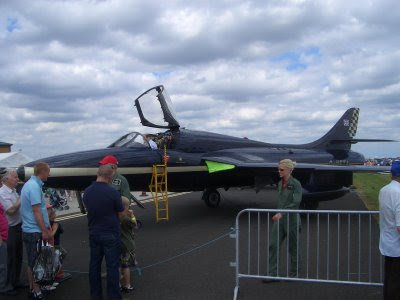 A privately-owned two-seater Hunter.
 One of several Jet Provosts, this in Kuwait Air Force markings. A four-ship formation Jet Provosts gave a very nice performance later in the day.
But, it wouldn't be a British air show without some completely unrelated displays as well, so in the middle of everything was the local stationary engine society, displaying their carefully polished machines:
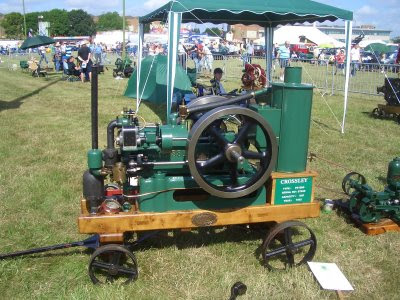 A Crossley PE1060. The Crossley Brothers were strict teetotallers, so they refused to sell their engines to breweries.
And next to that, rows upon rows of carefully polished vintage cars:
 This is a car, I don't know anything about those. Oh, well, the one in the background is an Audi 100, I know because we had one when I was a kid.
Of course all the armed forces were there, recruiting. The RAF brought out all the fun you can do besides killing people, such as e g joining the RAF Bobsleigh team:
 For optimum performance you need a hill. With ice.
Now of course, there was considerable activity in the air. The Polish Air Force display team Orlik did a very nice performance. They were then followed by the Red Arrows. When I first saw them at a Bromma air day ages ago, I first didn't get the point, they seemed to just fly round and round. Only after a while did I realise the extremely precise formation flying they did, reformating so smoothly you had to strain to see how they did it. Today, with only a few scattered clouds, they were able to do their full ‘high’ programme. Their speaker, “Red 10” kept up a constant patter, carefully introducing each pilot with humorous quips (“‘Boomer’ has flown in the Royal New Zealand Air Force and the Royal Australian Air Force, so he speaks both languages fluently. He is now struggling to learn English.”) and also stressing the combat experience of each.
 Hopeless picture, I know, but, The Red Arrows!
Some time after lunch (Cornish pasty) I picked up that we were not going to see a Vulcan in the air. Briefly: Ex-military aircraft require a Permit to Fly. This has to be regularly renewed, and this entails demonstrating that the aircraft is in a certain defined good working order. The Permit to Fly for XH558 had expired the day before. This obviously would not have come as a surprise for the Vulcan To The Sky Trust, but what with one thing and the other, they had failed to fulfil the certification requirements and had instead just hoped that the Civil Aviation Authority would waive the requirements for that weekend, seeing as they had an airshow to do and all that. The CAA did not agree and thus the plane was grounded. To say that I and a significant part of the other roughly 100 000 attendees were disappointed is like saying it's a long walk to the Andromeda galaxy. I would have appreciated a bit more grovelling on the part of the VTTST spokesperson rather than the “Unfortunate, but we couldn't really help it.” attitude displayed. That they got their PtF renewed just a couple of days later further indicates some seriously bad planning. Boo, hiss!
Ah well, there was still plenty to see in the air and on the ground: More Hawks in the air, the aforementioned Jet Provost display, some quite interesting formation flying and simulated missile attacks by a group of Hawks and Falcons, helicopters cavorting, and then a very noisy display by a solo Eurofighter. I'd worn ear protectors all day, but when a plane like this turns on the afterburner, it's like it grips your stomach and shakes it, you have to tense up just to remain standing.
We made a quick tour of the various stands, I picked up some pre-ordered modelling supplies in the Hannants booth, and then I spent an hour in the Airfix tent.
Eventually the day wound down and we started to look for the exit. Food time! The first pub we found in Waddington was full and didn't look as if it served food either, but then we came to the Horse & Jockey, where we were welcomed and had a perfectly good dinner. On consideration, we didn't feel like walking the two hours back, but when we had finished dinner the stream of cars leaving seemed to have thinned out, so we decided to get a taxi. The pub staff recommended Discount Cabs, so I called them and they promised to have a car there in 15 minutes. 15.00 minutes later our cab turned up. We piled in and the driver sort of dove into a rabbit hole in the village, bypassing all queues, while lambasting Vulcan To The Sky in no uncertain terms and a very thick Lincolnshire accent and then deposited us by the door. And it was cheap.
Honeybuns had during the day become increasingly more agitated about the state of my skin. I for my part considered myself to be well protected by the tan I had gotten myself in Lappland, so wasn't too concerned, but it did feel like maybe it would be a good idea to apply some cream to my face and legs before going to bed.
Then. The next morning. My bright red face was oozing yellowish liquid and I'd covered the pillowcase in stains. My legs wouldn't bend properly and my skin felt too small for my body.
That day we would clearly only do shady activities…
As I've mentioned before, I've longed to see an Avro Vulcan in the air and XH558 was one of the main attractions, if not the main attraction. During the spring there was some question whether the Vulcan To The Sky Trust would be able to afford the airshow circuit during the summer, but a major collection effort succeeded in securing the needed funds, so everything was set for a great show.
On the suggestion of the Tourist Information officers we didn't even attempt to order a cab to get to Waddington, but instead walked there. It took us two hours in the brilliant morning sunlight, but it really seemed as if we walked faster, or at least kept an even pace with, than the car queues that stretched as far as we could see.
When we got to Waddington village we got ourselves drinks for the rest of the way but hadn't even finished them before we found ourselves inside the airbase and then on the airfield itself. And then! I'm not the only one to state that the Brits really know how to put together an airshow, and Waddington is probably the largest of them all. It is a two-day event, but I'm not sure if we could have seen it all even if we had spent both days there. (Though another couple at the bed & breakfast had arrived several days early to see all the planes fly in and would remain a couple of more days to see them fly out again. That's devotion. Not least on the part of the wife, who clearly wasn't all that keen a plane spotter. On the other hand, as I've implied, there's plenty of other things to do in the area.)
My little Exilim is not very good at photographing planes in the air, so here are some pictures of pretty aircraft on the ground (and there were probably several hundred there to look at, so imagine me rushing about going “Ooh, look!” all day, yet seeing only a fraction of what was there):
 A Gazelle from the Empire Test Pilots' School, which is partly run by QinetiQ, the privatised part of the former Defence Evaluation and Research Agency.
 An Alpha Jet.
 A privately-owned two-seater Hunter.
 One of several Jet Provosts, this in Kuwait Air Force markings. A four-ship formation Jet Provosts gave a very nice performance later in the day.
But, it wouldn't be a British air show without some completely unrelated displays as well, so in the middle of everything was the local stationary engine society, displaying their carefully polished machines:
 A Crossley PE1060. The Crossley Brothers were strict teetotallers, so they refused to sell their engines to breweries.
And next to that, rows upon rows of carefully polished vintage cars:
 This is a car, I don't know anything about those. Oh, well, the one in the background is an Audi 100, I know because we had one when I was a kid.
Of course all the armed forces were there, recruiting. The RAF brought out all the fun you can do besides killing people, such as e g joining the RAF Bobsleigh team:
 For optimum performance you need a hill. With ice.
Now of course, there was considerable activity in the air. The Polish Air Force display team Orlik did a very nice performance. They were then followed by the Red Arrows. When I first saw them at a Bromma air day ages ago, I first didn't get the point, they seemed to just fly round and round. Only after a while did I realise the extremely precise formation flying they did, reformating so smoothly you had to strain to see how they did it. Today, with only a few scattered clouds, they were able to do their full ‘high’ programme. Their speaker, “Red 10” kept up a constant patter, carefully introducing each pilot with humorous quips (“‘Boomer’ has flown in the Royal New Zealand Air Force and the Royal Australian Air Force, so he speaks both languages fluently. He is now struggling to learn English.”) and also stressing the combat experience of each.
 Hopeless picture, I know, but, The Red Arrows!
Some time after lunch (Cornish pasty) I picked up that we were not going to see a Vulcan in the air. Briefly: Ex-military aircraft require a Permit to Fly. This has to be regularly renewed, and this entails demonstrating that the aircraft is in a certain defined good working order. The Permit to Fly for XH558 had expired the day before. This obviously would not have come as a surprise for the Vulcan To The Sky Trust, but what with one thing and the other, they had failed to fulfil the certification requirements and had instead just hoped that the Civil Aviation Authority would waive the requirements for that weekend, seeing as they had an airshow to do and all that. The CAA did not agree and thus the plane was grounded. To say that I and a significant part of the other roughly 100 000 attendees were disappointed is like saying it's a long walk to the Andromeda galaxy. I would have appreciated a bit more grovelling on the part of the VTTST spokesperson rather than the “Unfortunate, but we couldn't really help it.” attitude displayed. That they got their PtF renewed just a couple of days later further indicates some seriously bad planning. Boo, hiss!
Ah well, there was still plenty to see in the air and on the ground: More Hawks in the air, the aforementioned Jet Provost display, some quite interesting formation flying and simulated missile attacks by a group of Hawks and Falcons, helicopters cavorting, and then a very noisy display by a solo Eurofighter. I'd worn ear protectors all day, but when a plane like this turns on the afterburner, it's like it grips your stomach and shakes it, you have to tense up just to remain standing.
We made a quick tour of the various stands, I picked up some pre-ordered modelling supplies in the Hannants booth, and then I spent an hour in the Airfix tent.
Eventually the day wound down and we started to look for the exit. Food time! The first pub we found in Waddington was full and didn't look as if it served food either, but then we came to the Horse & Jockey, where we were welcomed and had a perfectly good dinner. On consideration, we didn't feel like walking the two hours back, but when we had finished dinner the stream of cars leaving seemed to have thinned out, so we decided to get a taxi. The pub staff recommended Discount Cabs, so I called them and they promised to have a car there in 15 minutes. 15.00 minutes later our cab turned up. We piled in and the driver sort of dove into a rabbit hole in the village, bypassing all queues, while lambasting Vulcan To The Sky in no uncertain terms and a very thick Lincolnshire accent and then deposited us by the door. And it was cheap.
Honeybuns had during the day become increasingly more agitated about the state of my skin. I for my part considered myself to be well protected by the tan I had gotten myself in Lappland, so wasn't too concerned, but it did feel like maybe it would be a good idea to apply some cream to my face and legs before going to bed.
Then. The next morning. My bright red face was oozing yellowish liquid and I'd covered the pillowcase in stains. My legs wouldn't bend properly and my skin felt too small for my body.
That day we would clearly only do shady activities…
2009-07-03
Lindum Colonia
Lincoln has an interesting topology. Most of Lincolnshire is fairly flat, but here there is a fairly high hill. On top of this hill stands Lincoln Cathedral, a very tall building, which accordingly is visible very far away. The modern city centre lies down by the river Witham (downtown, as it were). You go between the two by way of High Street, which continues as Steep Hill.
 The Riverside Cafe on the High Bridge over River Witham.So, this Friday morning we got off the bus by the market square where we wandered around the stalls, to the musical accompaniment of a country & western singer (who actually was quite good), and Honeybuns bought herself an interesting cheese. We ascended Steep Hill, which, in addition to other interesting shops, contained a goodly number of used book shops, which obviously all had to be visited. As we were going to do some walking that day, we couldn't obviously buy all worthy books, but some sufficiently light-weight items found our favour.
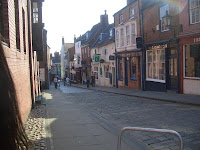 This is just High Street, it gets steeper than this.
Eventually we were at the summit of the hill. Not by coincidence, this is where the Tourist Information Centre is (there is another one down at the city centre, but it is currently closed for renovation), so I might as well stick in a bit of tourist information here:
The general area of Lincoln has been inhabited for a long time, but the name and the first stone buildings date from the Romans. There are still a few remains, such as bits of the old city wall, left from Roman times. The next high period for the town came with the Normans, who started on the castle and the cathedral, both of which were greatly expanded in mediæval times; there are also a few Tudor era houses left. The first World War I tanks were constructed in Lincoln and during World War II Lincolnshire was “Bomber county”. All these various historial eras are carefully commemorated with signs, museums and the items themselves, of course, and there are a number of marked theme trails around town, so show off Roman, Norman, etc remains. Even though the town is so obviously prepared for tourists, there didn't seem to be particularly many around, which I provisionally put down to the English school term not being over yet. Swedish tourists were clearly not common here, I suspect they only leave Regent Street to go see Mamma Mia!.
 Lincoln Castle in bronze.
 Honeybuns descending into the interior of Cobb Hall Tower. Lots of dark nooks and crannies down there.Anyway, we decided to start with Lincoln Castle. Inside the walls was a carefully tended garden, just made for picknicks. We had a long look at the Magna Carta, went through the prison exhibition and then climbed the walls and the towers. The sky was overcast, but from the Observatory Tower we felt as if we could have seen all the way to the North Sea had it been a clear day. Towards the west we could see another castle tower, which we couldn't fit to any feature on our maps, very strange.
 A view southwards from the Observatory Tower of Lincoln Castle.
Finally hunger drove us out and we found a little vegetarian restaurant on Steep Hill, where some rather surly teenagers served us a quite good lunch.
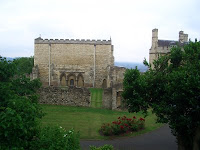 The remains of the Bishop's Palace.Then we walked a circuit around the cathedral, but decided to see the mediæval Bishop's palace instead. It is mostly a ruin these days, but an audio presentation did its best to bring its old splendour alive to us. I actually enjoyed this audio tour better than the one at the recent Titanic exhibition as this one only played fairly short clips and then waited for the user to start the next clip, thus allowing much better self-pacing.
 A rather fancy water tower.The museum closed, so we had to leave, and decided to set out to find the mysterious tower we had seen. Oh, it was a water tower. Apparently it didn't qualify for marking on any maps, just being public works, as it were. We found a pub for dinner and then descended the hill for the bus home.
 The Riverside Cafe on the High Bridge over River Witham.
 This is just High Street, it gets steeper than this.
Eventually we were at the summit of the hill. Not by coincidence, this is where the Tourist Information Centre is (there is another one down at the city centre, but it is currently closed for renovation), so I might as well stick in a bit of tourist information here:
The general area of Lincoln has been inhabited for a long time, but the name and the first stone buildings date from the Romans. There are still a few remains, such as bits of the old city wall, left from Roman times. The next high period for the town came with the Normans, who started on the castle and the cathedral, both of which were greatly expanded in mediæval times; there are also a few Tudor era houses left. The first World War I tanks were constructed in Lincoln and during World War II Lincolnshire was “Bomber county”. All these various historial eras are carefully commemorated with signs, museums and the items themselves, of course, and there are a number of marked theme trails around town, so show off Roman, Norman, etc remains. Even though the town is so obviously prepared for tourists, there didn't seem to be particularly many around, which I provisionally put down to the English school term not being over yet. Swedish tourists were clearly not common here, I suspect they only leave Regent Street to go see Mamma Mia!.
 Lincoln Castle in bronze.
 Honeybuns descending into the interior of Cobb Hall Tower. Lots of dark nooks and crannies down there.
 A view southwards from the Observatory Tower of Lincoln Castle.
Finally hunger drove us out and we found a little vegetarian restaurant on Steep Hill, where some rather surly teenagers served us a quite good lunch.
 The remains of the Bishop's Palace.
 A rather fancy water tower.
2009-07-01
Running late
 X2000, the vomit express.
We were late into Copenhagen, but as SJ in their wisdom had insisted on purveying us with tickets with generous margins between trains, this was not a problem. However, the motion sickness which I had accrued on the X2000, was.
Eventually we boarded our sleeper, which was a Czech single-decker this time, and rolled through Denmark into the night. I didn't sleep very well (Honeybuns bravely slept in the upper berth, risking being tossed to the floor whenever the train lurched) and when I headed for the shower in the morning, not feeling particularly well at all, the conductor informed me that we were already running two hours late, so they were going to dump us in Dortmund, from where we could catch a faster train to Cologne.
We gathered our belongings and then scrambled to this other train, some platforms away.
Well on the train, I withdrew to the lavatory to yell at Ralph, after which I felt slightly better and then dozed a bit.
 They are still remembered!
Instead of the usual Thalys, we travelled with an ICE train. It seemed to me they must have straightened the tracks, because the journey was half an hour shorter and I didn't quite recognise the landscape we passed through, even though the stations were the same. This meant I missed my favourite sights on this leg.
In Brussels we spent a long time going in circles, trying to locate the Eurostar terminal. Finally we found the mysteriously elusive entrance and ended up in long queues for checkin, exit passport control, security control, and entry passport control (Britain not being a part of the Schengen area). Eurostar has a serious case of flight envy, but doesn't quite manage to pull it off: All luggage has to be tagged and “Dangerous items such as knives” are prohibited, so I slipped my Victorinox in my suitcase, expecting it to be placed in a locked hold after being X-rayed, but no, the suitcase was just given back to me, so there I got on the train, equipped with a deadly weapon—not only did I have a knife, but I could…err…use the screwdriver to take the train apart while rolling, yeah!
 Eurostar at S:t Pancras.
We had a while before our next train so had a spot of food and then wandered around S:t Pancras and King's Cross, looking for ice cream until I found a Möwenpick freezer in a shop in the former station. Another item worthy of notice: The public lavatories at King's Cross will cost you 60p, but the ones at S:t Pancras across the street are free.
 Two National Express-operated Driving Van Trailer Mk 4 at King's Cross.
At around 16:00 we were in Lincoln, some 28 hours after leaving Stockholm.
Pulling our bags on a cart we stuck out like sore thumbs and we had hardly exited the station before the locals descended upon us, eager to tell us how to best get to the tourist information centre. On the other hand, the town was already closing down. We had time to get ourselves sandwiches and juice at the Coop, but by the time we had finished them all shops and restaurants had closed. (Later on British colleagues extolled the wild nightlife of Lincoln, to which we can just say “What!?”) We wandered around a bit, but decided we needed rest, so returned to the rail station and took a taxi to our bed & breakfast, which turned out to be just as friendly and comfortable as we had hoped for. Soon we slept.
Subscribe to:
Posts (Atom)
