Jag tackar YouTube-användaren peglegsam för att ha påmint oss om detta fina gamla skånska okvädingsord. Ex: ”Där gaur du å e peglegsam, din klydderöv!”
Helt klart bör peglegsam användas oftare för att inte helt falla i glömska, låt oss alla nyttja det minst en gång i veckan!
2008-12-26

2008-12-25
2008-12-22
Call out the Ents!
Without warning, the little copse of trees across the street is suddenly gone. This morning I saw a human moving on the plot, looking as if he might know what was going on. Ah, a parking lot for the planned new house up the hill… It's not as if they could have added another floor to the parking house just next to it (or simply filled it to capacity, it's usually half-empty), or let people park on the empty parking lot next to the shop, or let people use the excellent public communications and manage without a car at all. No, no, the Tree Killers have been at it again. I am very upset, there certainly aren't too many trees in this city, not even here at the outskirts.
If trees could scream and struggle a bit, maybe it wouldn't be so easy to just saw them down without a second thought.
If trees could scream and struggle a bit, maybe it wouldn't be so easy to just saw them down without a second thought.
2008-12-21
Let it snow!
After a rainy week today is a bright and sunny day in Stockholm. The Only-begotten Daughter grumbles that it's not very Christmas-like, but such is the climate in southern Sweden. Honeybuns has travelled north, where things are otherwise:


2008-12-20
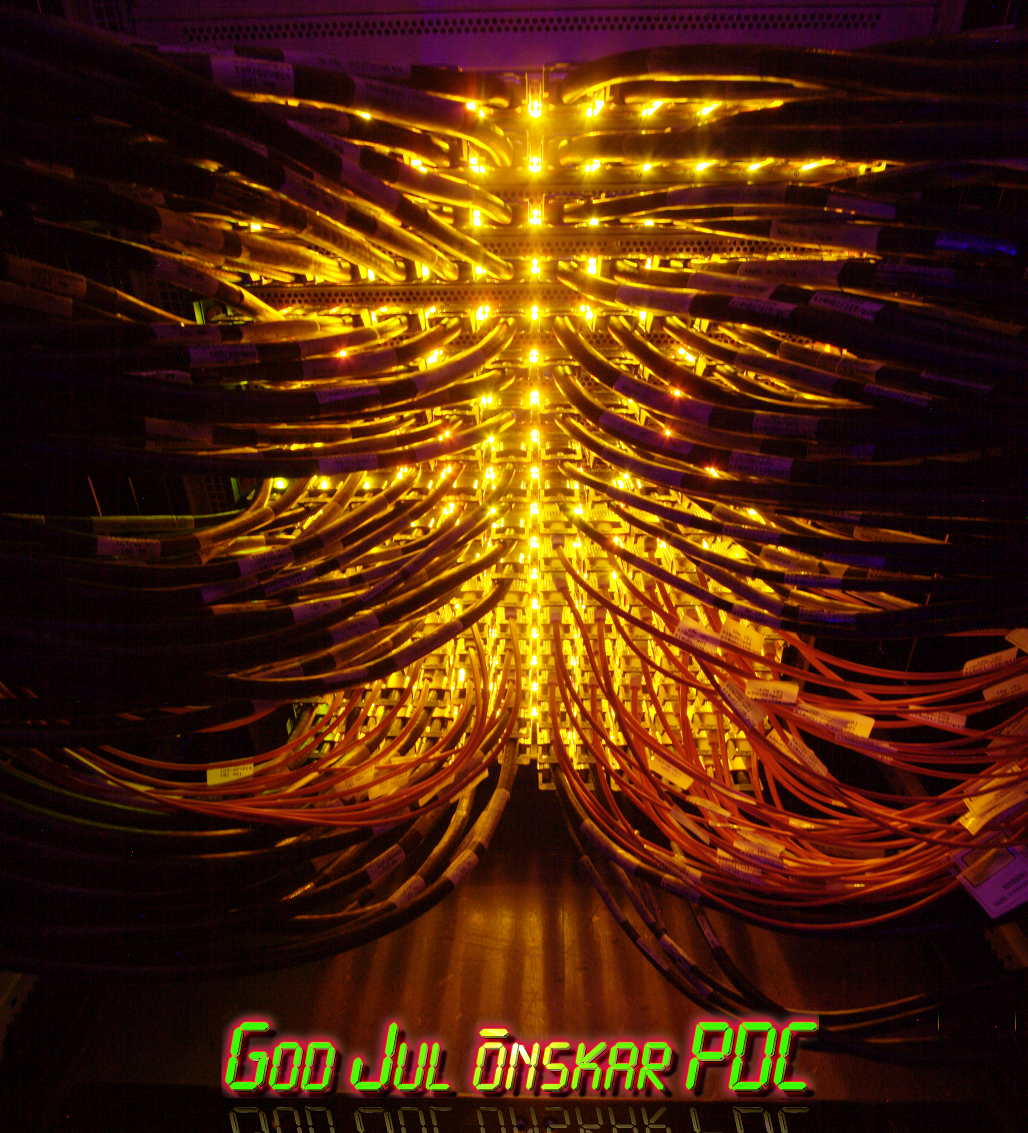
2008-12-19
Word of the week: ad verb
I got to thinking about what verbs might be likely to turn up in advertisements, so I went through 60 non-classified ads in today's Dagens Nyheter and counted the ad verbs.
It turned out that 15% made do without any verbs at all, and in a fairly large proportion of the rest there would only be verbs in the fine print.
The most common verbs were vara (be) with 27 occurences, and ha (have) with 20, obviously to a large part due to them being auxiliary verbs.
The third most common (17) was finnas (exist), typically explaining varieties of items.
The next two (14 each) are gälla (be valid for) and få (get)—here we are looking at the fine print.
These are then followed (at 9 and 8) by ge (give) and köpa (buy), not surprising around Christmas.
A group with 6 instances each is göra (do), komma (come), kunna (be able to), and sälja (sell).
5 instances each for bli (become) and läsa (read)—the latter in exhortations to find out more on the companies' websites.
Then it sort of peters out into verbs with at most few instances each.
It turned out that 15% made do without any verbs at all, and in a fairly large proportion of the rest there would only be verbs in the fine print.
The most common verbs were vara (be) with 27 occurences, and ha (have) with 20, obviously to a large part due to them being auxiliary verbs.
The third most common (17) was finnas (exist), typically explaining varieties of items.
The next two (14 each) are gälla (be valid for) and få (get)—here we are looking at the fine print.
These are then followed (at 9 and 8) by ge (give) and köpa (buy), not surprising around Christmas.
A group with 6 instances each is göra (do), komma (come), kunna (be able to), and sälja (sell).
5 instances each for bli (become) and läsa (read)—the latter in exhortations to find out more on the companies' websites.
Then it sort of peters out into verbs with at most few instances each.
2008-12-05
2008-12-04
Conservation efforts
Jean Piaget developed a model for children's intellectual development. One of the milestones is the understanding that a liquid doesn't change its volume when it's poured from one container to another of different shape. This is known as conservation. However, sometimes it's painfully obvious that this is an understanding on a more superficial and intellectual level, as when a friend poured the contents of a can into a glass with seemingly larger diameter yet the water level ending up much higher in the glass. We could figure out that the thickness of the walls of the glass was larger than those of the can, yet the effect was eerie.


2008-12-03
Christmas season
Honeybuns and I had a most enjoyable last weekend. The Saturday we spent at the Butterfly House. There weren't very many butterflies about though, maybe even the tropical lepidopterans have decided to hibernate through the winter. The museum restaurant was a delightful surprise, the food was actually quite good and not too expensive, an unusual combination in most museum restaurants.
On Sunday we went to Skansen for the Christmas Market. To our joy we found that Skansen has made an excellent effort this year, the main entrance met us with light cascades down the hillside and a choir singing traditional Christmas songs, i e not the ones you'll hear every day in every supermarket, but old and yet less worn-out ones.

As we wandered around the city quarter and looked into shops and workshops we found that they all used period lighting, in other words it was quite dark in most places. It brought home very strongly what wintertime must have meant just a few generations away, Christmas being when you would celebrate and use the half a dozen of tallow candles made at the autumn slaughter. The high point was when we entered Älvrosgården and listened to three violinists playing folk music in almost complete darkness.
The market itself contained more booths than I remember ever having seen there before, selling waffles, sausages, slippers, knives, fish, and whatever other folkloristic Christmas items, all very pleasant in the winter night (i e early afternoon). When the market closed at around 16:00, we haggled ourselves to a bag of discount saffron buns and then stood by Solliden and looked out over the city, glittering in the darkness. I noted how experiences are intensified by sharing them, not least so when shared with my beloved Honeybuns.
We passed through the Skansen shop for some aurora-flavour glögg (I will let you know what aurora tastes like) and then proceeded to Gröna Lund and watched brave people riding roller-coasters in the chilly air while others skated beneath them. The Christmas market was tiny and not very exciting, so soon we caught the tram and continued to Kungsträdgården, which also had a Christmas market. We bought doughnuts and munched on them as we walked towards the Old Town, to see the Christmas market there. I consider it to have lost much of its charm since they discontinued the paper trumpets for children (on account of the complaining residents), but we still found some more stuff for the Christmas table. I would have sung ”Jul i Gamla Stan”, but I don't know the words and besides I think it's a bit tacky.
Tired and satisfied with our day, we went home and made rice pudding for dinner in order to continue with the Christmas theme.
On Sunday we went to Skansen for the Christmas Market. To our joy we found that Skansen has made an excellent effort this year, the main entrance met us with light cascades down the hillside and a choir singing traditional Christmas songs, i e not the ones you'll hear every day in every supermarket, but old and yet less worn-out ones.

As we wandered around the city quarter and looked into shops and workshops we found that they all used period lighting, in other words it was quite dark in most places. It brought home very strongly what wintertime must have meant just a few generations away, Christmas being when you would celebrate and use the half a dozen of tallow candles made at the autumn slaughter. The high point was when we entered Älvrosgården and listened to three violinists playing folk music in almost complete darkness.
The market itself contained more booths than I remember ever having seen there before, selling waffles, sausages, slippers, knives, fish, and whatever other folkloristic Christmas items, all very pleasant in the winter night (i e early afternoon). When the market closed at around 16:00, we haggled ourselves to a bag of discount saffron buns and then stood by Solliden and looked out over the city, glittering in the darkness. I noted how experiences are intensified by sharing them, not least so when shared with my beloved Honeybuns.
We passed through the Skansen shop for some aurora-flavour glögg (I will let you know what aurora tastes like) and then proceeded to Gröna Lund and watched brave people riding roller-coasters in the chilly air while others skated beneath them. The Christmas market was tiny and not very exciting, so soon we caught the tram and continued to Kungsträdgården, which also had a Christmas market. We bought doughnuts and munched on them as we walked towards the Old Town, to see the Christmas market there. I consider it to have lost much of its charm since they discontinued the paper trumpets for children (on account of the complaining residents), but we still found some more stuff for the Christmas table. I would have sung ”Jul i Gamla Stan”, but I don't know the words and besides I think it's a bit tacky.
Tired and satisfied with our day, we went home and made rice pudding for dinner in order to continue with the Christmas theme.
2008-12-02
Having a gay old time
Honeybuns and I recently visited the National Museum of Natural History, a favourite of both of ours. We started with an astronomy show in the Omnimax theatre, Cosmic Collisions. Rather sensationalistic, but some quite nice computer animations.
Our main target was the exhibition “Rainbow Animals” (yup, that's the original, “Swedish”, name of the exhibition) on homosexuality in non-human animals. They had a couple of (plastic) dolphin pairs in quite explicit positions, but generally the exhibits were just random stuffed animals and we had to contend ourselves with reading about their lascivious natures. They did not show any whelks, but I was much amused to find there is a “Red-faced lovebird”, they must constantly get interrupted at inopportune moments. All in all the exhibition was quite small, but all exhibits were carefully cross-referenced to the relevant peer-reviewed literature, so there is plenty of further reading, should one feel like delving deeper into the subject.

We continued to see the other exhibitions. I've often complained that modern museums are too loud, but now found a very elegant solution to the problem, sound hoods that keep sounds restricted to the listeners standing right beneath them.

In the mineralogy department we found another clever invention: the mineral samples were placed in shelves that could be pulled out, lamps inside lighting up when the shelves were pulled out, very space-efficient and an excellent way to display the rocks.

The museum restaurant on the other hand had gone from indifferent to bad with the latest change of ownership, snagging a chorizo from the hot dog stand outside seems a viable option—for the non-vegetarians at least.
Then, just before we had to leave, we found a most delightful little exhibition on biological diversity, well hidden in the corridor leading to the whale exhibition. Do not miss!
Our main target was the exhibition “Rainbow Animals” (yup, that's the original, “Swedish”, name of the exhibition) on homosexuality in non-human animals. They had a couple of (plastic) dolphin pairs in quite explicit positions, but generally the exhibits were just random stuffed animals and we had to contend ourselves with reading about their lascivious natures. They did not show any whelks, but I was much amused to find there is a “Red-faced lovebird”, they must constantly get interrupted at inopportune moments. All in all the exhibition was quite small, but all exhibits were carefully cross-referenced to the relevant peer-reviewed literature, so there is plenty of further reading, should one feel like delving deeper into the subject.

We continued to see the other exhibitions. I've often complained that modern museums are too loud, but now found a very elegant solution to the problem, sound hoods that keep sounds restricted to the listeners standing right beneath them.

In the mineralogy department we found another clever invention: the mineral samples were placed in shelves that could be pulled out, lamps inside lighting up when the shelves were pulled out, very space-efficient and an excellent way to display the rocks.

The museum restaurant on the other hand had gone from indifferent to bad with the latest change of ownership, snagging a chorizo from the hot dog stand outside seems a viable option—for the non-vegetarians at least.
Then, just before we had to leave, we found a most delightful little exhibition on biological diversity, well hidden in the corridor leading to the whale exhibition. Do not miss!
2008-12-01
Death in the age of Facebook
The mobile on my nightstand played its chirpy little tune. Picking it up I automatically noted the time: 01:27. My older half-brother S had—unexpectedly and prematurely—died a few hours earlier, please forward the message to Sis and Mom. I decided I could probably wait till morning to call them. While I returned to sleep the search for the members of a scattered family in infrequent contact continued, using Eniro, Hitta and whatever other sites allowed suitable searches for incomplete ID information. S's partner M was travelling abroad and had to be reached. A friend of hers in another city was located who managed to get hold of M on Skype in the early morning.
In the morning I left voice mail messages to call me on my mother's and sister's numbers. As I came in to work I saw S still logged in to his Skype account, where he'd left it going for his final exercise round. More subdued phone calls during the day, there would be a viewing at the hospital the next day. I was unfamiliar with the term, but googling confirmed that it was an opportunity to see the body. When had this procedure been (re-)introduced?
The next morning grim-faced siblings and half-siblings met at the hospital chapel with S's children and M. Raw unconstrained grief from M, we others struggling to keep outward emotions in check in the prescribed Nordic manner, this sometimes necessitating rapid exits to the bathroom, outdoors or just fixed staring away, breathing deeply. (I turned on my clinical mind and observed.) A hospital-issue welfare officer hovered nearby, but soon withdrew as she felt her presence unnecessary.
Eventually we had to leave, making space for others to meet their dead, and all went to S and M's house to find solace in each other and to manage the situation by planning practical details. Work, always a sure way to keep oneself from thinking. Where should the ceremony be, how should it designed? Buddhist or Orthodox ritual? “But none of that God stuff.” Those who had their laptops with them brought up iPhoto and shared their pictures of S.
The next few days we made points of friending each other on Facebook, adding each other to our Skype contact lists, updating our telephone numbers and email addresses to better stay in touch.
Eventually came the funeral, on the time when it had been possible to book a chapel and officiants. A completely secular occasion in a chapel in a silent forest burial ground, restrained and sad; token memories offered by grieving friends and colleagues. For practical reasons the actual interment took place at a different burial ground, now with an Orthodox priest blessing the dead, rapidly reeling off the necessary many words in the cold air, comforting perhaps not so much through any presumed presence of God, but by the familiar ritual, ingrained since childhood, the bedrock of generations behind. We others, brought up in Western Lutheranism, may not have understood what was being said, but still recognised the fundamentals of ritual and the support it gave.
And perhaps it is a modern kind of votive candle that S still is logged in to Skype.
In the morning I left voice mail messages to call me on my mother's and sister's numbers. As I came in to work I saw S still logged in to his Skype account, where he'd left it going for his final exercise round. More subdued phone calls during the day, there would be a viewing at the hospital the next day. I was unfamiliar with the term, but googling confirmed that it was an opportunity to see the body. When had this procedure been (re-)introduced?
The next morning grim-faced siblings and half-siblings met at the hospital chapel with S's children and M. Raw unconstrained grief from M, we others struggling to keep outward emotions in check in the prescribed Nordic manner, this sometimes necessitating rapid exits to the bathroom, outdoors or just fixed staring away, breathing deeply. (I turned on my clinical mind and observed.) A hospital-issue welfare officer hovered nearby, but soon withdrew as she felt her presence unnecessary.
Eventually we had to leave, making space for others to meet their dead, and all went to S and M's house to find solace in each other and to manage the situation by planning practical details. Work, always a sure way to keep oneself from thinking. Where should the ceremony be, how should it designed? Buddhist or Orthodox ritual? “But none of that God stuff.” Those who had their laptops with them brought up iPhoto and shared their pictures of S.
The next few days we made points of friending each other on Facebook, adding each other to our Skype contact lists, updating our telephone numbers and email addresses to better stay in touch.
Eventually came the funeral, on the time when it had been possible to book a chapel and officiants. A completely secular occasion in a chapel in a silent forest burial ground, restrained and sad; token memories offered by grieving friends and colleagues. For practical reasons the actual interment took place at a different burial ground, now with an Orthodox priest blessing the dead, rapidly reeling off the necessary many words in the cold air, comforting perhaps not so much through any presumed presence of God, but by the familiar ritual, ingrained since childhood, the bedrock of generations behind. We others, brought up in Western Lutheranism, may not have understood what was being said, but still recognised the fundamentals of ritual and the support it gave.
And perhaps it is a modern kind of votive candle that S still is logged in to Skype.
2008-11-28
Veckans ord: skumplast
Winston Churchill lär ha föredragit sin champagne kall, torr och gratis, men även när han fick betala för sin skumpa förbrukade han ansenliga mängder per dag, eftersom han hade en svår skumplast.
2008-11-14
Veckans ord: tågluffare
När de Enfödda Barnen var små var de väldigt förtjusta i att gnaga på sina fötter, riktiga tågluffare var de.
2008-11-06
2008-11-02
The benevolent pusher
The club was the main attraction at the Hobby Fair this year again with our traditional introduction to modelling for children. The kids get a model for cheap on the condition they sit with their parents and build it there, which they happily do. Many come back year after year to do build models at the fair. It's not clear if we are bringing them into the hobby—they certainly don't turn up at our meetings, but at least they have been exposed to the joy for a while. And we get to feel like drug-pushers. Sort of.
2008-10-31
Veckans ord: penision
Män har i snitt högre lön än kvinnor. Som följd därav har de också högre inkomster när de slutat arbeta: penision.
2008-10-30
Political meme
Via Thnidu:
Copy this sentence into your blog if you're in a non-same-sex marriage, and you don't want it "protected" by the bigots who think that gay marriage hurts it somehow.
Strictly speaking I'm not married, but even if I were, I wouldn't feel threatened anyway. Even further I don't think the state has any reason to legislate about my relations with other consenting adults. Abolish all marriage laws!
Copy this sentence into your blog if you're in a non-same-sex marriage, and you don't want it "protected" by the bigots who think that gay marriage hurts it somehow.
Strictly speaking I'm not married, but even if I were, I wouldn't feel threatened anyway. Even further I don't think the state has any reason to legislate about my relations with other consenting adults. Abolish all marriage laws!
2008-10-28
Uh-oh
This isn't all that recent and other bloggers have already commented and drawn the same conclusions, but I'm still so shocked I have to add my own entry.

I've felt it to be a bit over the top when USAians accuse Republicans of being fascists, but finding a cartoon like this in a mainstream conservative newspaper, executed without the slightest hint of irony or sarcasm, drives the point home, so to speak. I feel like going over, picking up all my friends and bringing them to safety. Now, before it's too late.
I've felt it to be a bit over the top when USAians accuse Republicans of being fascists, but finding a cartoon like this in a mainstream conservative newspaper, executed without the slightest hint of irony or sarcasm, drives the point home, so to speak. I feel like going over, picking up all my friends and bringing them to safety. Now, before it's too late.
2008-10-27
Blind to the consequences
As I was walking through the city, I realised that a building I've passed quite often contains the head office of that pearl of Swedish social politics, the Swedish Social Insurance Agency. I had missed it before, as the sign on the building is fairly small and unostentatious and in fact what now had drawn my eye was something that literally shouldn't have—the line of Braille below the printed text.

Contemplating this I thought of many things. One thing was that probably the Braille was not intended to actually be read—after all, how many walk around stroking walls to find signs on the off chance that there is a bit of Braille there? Nonetheless, the symbolism is clear: “We're here for everyone.” (that can read Swedish at least).
The other thing was the Braille itself. Now, as I said, the sign itself is pretty inconspicuous, but it could well have been larger. The text is written in a simple sans-serif typeface, indicating simplicity, seriousness, matter-of-factness. For Braille, as far as I know, there aren't really different typefaces, and there is not all that much room for variation in size—each character should fit under a fingertip. I guess it would technically be possible to indicate style, corresponding to italic, boldface, etc, by having the bumps have different profiles—not just hemispheres, but pyramids and hemicubes. I'm not sure how finely graded differences are actually distinguishable, but then again, most sighted readers aren't consciously aware of the distinctions between Times New Roman and Bookman either. There are dynamic Braille displays that can vibrate the needles, presumably the rhythm could be varied for a different feel. Then again, I'm sure the Braille community have come with their own ways of indicating style and character, I wonder how Discworlds novels are rendered in Braille. The audiobooks read by Steven Briggs are of course excellent.

Contemplating this I thought of many things. One thing was that probably the Braille was not intended to actually be read—after all, how many walk around stroking walls to find signs on the off chance that there is a bit of Braille there? Nonetheless, the symbolism is clear: “We're here for everyone.” (that can read Swedish at least).
The other thing was the Braille itself. Now, as I said, the sign itself is pretty inconspicuous, but it could well have been larger. The text is written in a simple sans-serif typeface, indicating simplicity, seriousness, matter-of-factness. For Braille, as far as I know, there aren't really different typefaces, and there is not all that much room for variation in size—each character should fit under a fingertip. I guess it would technically be possible to indicate style, corresponding to italic, boldface, etc, by having the bumps have different profiles—not just hemispheres, but pyramids and hemicubes. I'm not sure how finely graded differences are actually distinguishable, but then again, most sighted readers aren't consciously aware of the distinctions between Times New Roman and Bookman either. There are dynamic Braille displays that can vibrate the needles, presumably the rhythm could be varied for a different feel. Then again, I'm sure the Braille community have come with their own ways of indicating style and character, I wonder how Discworlds novels are rendered in Braille. The audiobooks read by Steven Briggs are of course excellent.
2008-10-26
Spitless
The F11 Museum by what now is Skavsta airport had geared up for the celebration of the 60th anniversary of the arrival of the first Spitfires in Sweden. A visit by a Spitfire was promised, though it would be a Mk XVI whereas the Swedish S31 was the Mk XIX. This could of course not be missed, so we, a few friends, bundled into a car and rolled through a rainy Södermanland towards Nyköping.
As we arrived we found the cozy little museum and a sizable crowd of people. An Airbus from MyTravel was just coming in to land, but had to abort with a mighty engine roar, possibly because they failed to brake on the slippery runway. It was thus not a very great surprise that the promised Spitfire visit was cancelled on account of the weather.

Still, the well-filled museum hangar housed an S29C, an S32C, an S35E, and the front part of an SF37 and various other bits and pieces. I have always liked reconnaissance aircraft for all the odd bumps and lumps they end up with in order to fit the cameras, electronic equipment and additional fuel tanks. (The S31 however was a very clean aircraft for flying high and fast.) I spent considerable time crawling around underneath the aircraft photographing their landing gear, my special fetish.
Other parts of the museum housed exhibits of uniforms, equipment and various bric-a-brac and several nicely made model aircraft. There was also a couple of trailers demonstrating the work place of an intelligence platoon, all 1970s vintage, but apparently the same equipment is still in use. The HP7221A plotters were a fond reunion—I first learned computer graphics on one.
Eventually we felt that we had seen enough for the day and returned to Stockholm, on the whole satisfied with the day. Spitfires, next summer!

As we arrived we found the cozy little museum and a sizable crowd of people. An Airbus from MyTravel was just coming in to land, but had to abort with a mighty engine roar, possibly because they failed to brake on the slippery runway. It was thus not a very great surprise that the promised Spitfire visit was cancelled on account of the weather.

A spot of rain does not disturb a planespotter.
Still, the well-filled museum hangar housed an S29C, an S32C, an S35E, and the front part of an SF37 and various other bits and pieces. I have always liked reconnaissance aircraft for all the odd bumps and lumps they end up with in order to fit the cameras, electronic equipment and additional fuel tanks. (The S31 however was a very clean aircraft for flying high and fast.) I spent considerable time crawling around underneath the aircraft photographing their landing gear, my special fetish.

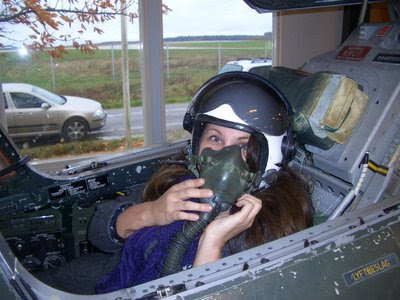
Honeybuns tries out the Draken cockpit.
Other parts of the museum housed exhibits of uniforms, equipment and various bric-a-brac and several nicely made model aircraft. There was also a couple of trailers demonstrating the work place of an intelligence platoon, all 1970s vintage, but apparently the same equipment is still in use. The HP7221A plotters were a fond reunion—I first learned computer graphics on one.
Eventually we felt that we had seen enough for the day and returned to Stockholm, on the whole satisfied with the day. Spitfires, next summer!

As close as we got to a Spitfire, an S31 propeller.
Subscribe to:
Comments (Atom)
