One of the more obscure languages I've had reason to program in (indeed, have taken a course in) is Erlang. Erlang is a declarative real-time language, which owes much to Prolog and ML. It was originally developed in the 1980s as a more modern replacement for PLEX, but it never managed to topple the huge installed PLEX codebase, so Ericsson telephone exchanges are still programmed in PLEX, albeit a somewhat more developed and modernised version. On the other hand, Erlang is also still a living language with new releases coming out every few months.
Anyway, I was sent this old demo video, where Bjarne Däcker & Co show off the features of the new language. It's a marvellous document of its time, so if you were involved in CS research twenty years ago, watch and get nostalgic!
2007-01-19

2007-01-18
Lack of characteristics
My lack of personality is pervasive, I did the gender test at Transtukipiste and was deemed gender neutral.
Olet sukupuolineutraali eli sukupuolisesti sitoutumaton. Et pidä meteliä sukupuolesta, etkä tuo omaa sukupuoltasi mitenkään erityisesti esille. Persoonaasi ei hallitse eikä määritä vahvasti sen enempää mieheys kuin naiseuskaan Sukupuoleen liittyvässä itseilmaisussa olet melko pidättyväinen - jopa sukupuolipihtailija. Tiedostat sukupuolijärjestelmän olemassaolon ja otat siihen mielellään etäisyyttä ja toimit yksilöllisesti, etkä sukupuolimäärittyneesti. Et aina ymmärrä, miksi monet muut ihmiset pitävät sukupuolesta niin kovasti meteliä ja antavat sukupuolensa ohjailla toimintaansa.
Olet hyvin vahvasti sitoutumaton kumpaankaan sukupuoleen- jopa sukupuolipakoilija.
2007-01-17
Bitch-slapping with precision
Sigma-6 is a blog that unfortunately has not been updated for a while, yet contains a lot of worthwhile reading, including this long and detailed history of tanks and anti-tank weapons, all for the purpose of demonstrating conclusively why the stated reasons for the invasion of Iraq were drivel.
2007-01-16
Mad scientist par excellence
It is my great pleasure to have known Anders Sandberg for many years and all through this time he has always been been coming up with weird and interesting ideas. Of course he has a blog, and among his recent work is a study on the evolution of zombie populations.
2007-01-15

2007-01-07
“TELL ME AN INTERESTING FACT”
In Roger MacBride Allen's short story “Phreak Encounter” aliens run a bulletin board system in order to figure out what humans think is important. Of course, in the mid-1980s, the people frequenting BBSs were not a representative sample of the world's population, so the question was what impression the aliens would get of humans.
Today, the people on web fora, blogs etc are still not a representative sample of the world's population, but perhaps a bit closer to it. We are also seeing the putting online of all human knowledge, something that has been foreseen since at least the 1950s. But, Wikipedia is not Multivac. The cold, objective truths, entered by serious men in white lab coats are not there, instead there are disputed statements, discussed, constantly edited and perhaps not always true.
There has been considerable debate and criticism of the Wikipedia project, primarily centred on the question of whether the information is trustworthy. There is of course much to be said on that, but the thing I think is interesting with Wikipedia is precisely its property of being an encyclopedia of the things the readers think are interesting. Thus we find lots of information that probably never would have found its way into any printed encyclopedia, such as entries on Yeovil Junction railway station, frameservers and Tetraiodothyronine 5'-deiodinase.
Today, the people on web fora, blogs etc are still not a representative sample of the world's population, but perhaps a bit closer to it. We are also seeing the putting online of all human knowledge, something that has been foreseen since at least the 1950s. But, Wikipedia is not Multivac. The cold, objective truths, entered by serious men in white lab coats are not there, instead there are disputed statements, discussed, constantly edited and perhaps not always true.
There has been considerable debate and criticism of the Wikipedia project, primarily centred on the question of whether the information is trustworthy. There is of course much to be said on that, but the thing I think is interesting with Wikipedia is precisely its property of being an encyclopedia of the things the readers think are interesting. Thus we find lots of information that probably never would have found its way into any printed encyclopedia, such as entries on Yeovil Junction railway station, frameservers and Tetraiodothyronine 5'-deiodinase.
2007-01-02
Video mixes at YouTube
The Disney version of Alice in Wonderland becomes much improved with Monty Python lyrics:
The Cheshire cat sings “Always Look on the Bright Side of Life”
Flowers sing “Every Sperm is Sacred”
The Mad Hatter sings “The Money Song”
The White Rabbit sing “I Want to be a Lumberjack”
The Mad Hatter and the March Hare sing “The Philosophy Song”
The Cheshire cat sings “Always Look on the Bright Side of Life”
Flowers sing “Every Sperm is Sacred”
The Mad Hatter sings “The Money Song”
The White Rabbit sing “I Want to be a Lumberjack”
The Mad Hatter and the March Hare sing “The Philosophy Song”
2006-12-31
Compartments of the mind
My thesis supervisor Y often remarked on the to him paradoxical state that I was a radical pacifist, yet would attend military air shows.
I for my part pointed out that one could be, say, an expert on dangerous diseases yet have no desire to inflict said diseases on people, but Y never got the point of my analogy. And, thinking deeper, there may be a point to that too. Germs don't care if we study them or not, they just are. Air shows on the other hand are made by and for people, the audience who is to be wooed and the participants whose egoes certainly are boosted performing for the audience. So, studying live military forces can certainly be considered as an encouragement and endorsement of their activities and therefore clearly problematic.
My interest in (military) aviation clearly has complex reasons and roots—certainly at the bottom there is what in my childhood was considered a “boyish” interest in fast and noisy things that make other things explode. Certainly I played a lot with the little plastic soldiers that were abundant at the time (I actually didn't have very many myself, but I had friends who were willing to compensate for that lack) and I don't think any of us considered either the battles or the soldiers to be “real”; soldiers fall over, you get a point, whoever has most standing at the end wins, then you can raise them all again and start another round.
Then, aircraft, something that you could learn more about; catalogue, classify, connect, makers, users, performance figures. Yet again those things boys were supposed to be fascinated by, and I was, and I am.
But then also, as I have found, for most any subject, learning deeply about a subject brings also an æsthetic appreciation of it. I have over time and with learning and practice developed a feel (not necessarily identical to that of other professionals) for elegance in an algorithm, beauty in a mathematical proof and the quality in a well-written text, but perhaps stronger than all this is the experience of a beautiful aircraft. And yes, then there are the the big and strong aircraft, the clumsy but lovable aircraft, the plain planes, and, of course, the hopelessly ugly and useless, loved not even by their manufacturers.
And which aircraft belong in which categories can of course be argued for hours, and what colours they would have been painted in at a given time, what retrofits and upgrades were performed over time and what the actual performance would have been of various armament options. And this consumes a large amount of modellers' time and never does it really pass beyond the abstract. For most. Then there are the…creepy ones, who seem a little too interested in wearing period uniforms and collecting militaria. On one occasion I received, with models I'd bought, the seller's business card with SS mottoes, and they did not seem to be ironically meant. Not least disgusting was the idea that this was apparently intended to encourage further purchases from the person in question and presumably it had worked before. Fortunately there are none of these kind of people in the local modelling club, as far as I've been able to tell, and we have pleasant evenings arguing about the exact caliber of the nose guns on the various subversions of the Bf 109G without worrying about the people that ended up in front of them.
So, when I found this collection of clips of German aircraft, purportedly from the Battle of Britain period, I was geared up for a pleasant little nitpick post, noting how the He 177 wasn't even built in 1940 and how the loaded bombs obviously couldn't have been from the period in question, but then I saw the comments… There were the people for whom a He 111 wasn't a somewhat obsolescent aircraft in late 1940, underpowered and underarmed but still elegant with the characteristic elliptical Heinkel wings and the rounded Plexiglas-covered nose; there were the people for whom it was a weapon for murdering other people and they approved of murder. This was like finding maggots in your half-eaten sandwich and the fun went out of studying the video.
And so we live our lives, desperately trying to justify ourselves. *sigh*
I for my part pointed out that one could be, say, an expert on dangerous diseases yet have no desire to inflict said diseases on people, but Y never got the point of my analogy. And, thinking deeper, there may be a point to that too. Germs don't care if we study them or not, they just are. Air shows on the other hand are made by and for people, the audience who is to be wooed and the participants whose egoes certainly are boosted performing for the audience. So, studying live military forces can certainly be considered as an encouragement and endorsement of their activities and therefore clearly problematic.
My interest in (military) aviation clearly has complex reasons and roots—certainly at the bottom there is what in my childhood was considered a “boyish” interest in fast and noisy things that make other things explode. Certainly I played a lot with the little plastic soldiers that were abundant at the time (I actually didn't have very many myself, but I had friends who were willing to compensate for that lack) and I don't think any of us considered either the battles or the soldiers to be “real”; soldiers fall over, you get a point, whoever has most standing at the end wins, then you can raise them all again and start another round.
Then, aircraft, something that you could learn more about; catalogue, classify, connect, makers, users, performance figures. Yet again those things boys were supposed to be fascinated by, and I was, and I am.
But then also, as I have found, for most any subject, learning deeply about a subject brings also an æsthetic appreciation of it. I have over time and with learning and practice developed a feel (not necessarily identical to that of other professionals) for elegance in an algorithm, beauty in a mathematical proof and the quality in a well-written text, but perhaps stronger than all this is the experience of a beautiful aircraft. And yes, then there are the the big and strong aircraft, the clumsy but lovable aircraft, the plain planes, and, of course, the hopelessly ugly and useless, loved not even by their manufacturers.
And which aircraft belong in which categories can of course be argued for hours, and what colours they would have been painted in at a given time, what retrofits and upgrades were performed over time and what the actual performance would have been of various armament options. And this consumes a large amount of modellers' time and never does it really pass beyond the abstract. For most. Then there are the…creepy ones, who seem a little too interested in wearing period uniforms and collecting militaria. On one occasion I received, with models I'd bought, the seller's business card with SS mottoes, and they did not seem to be ironically meant. Not least disgusting was the idea that this was apparently intended to encourage further purchases from the person in question and presumably it had worked before. Fortunately there are none of these kind of people in the local modelling club, as far as I've been able to tell, and we have pleasant evenings arguing about the exact caliber of the nose guns on the various subversions of the Bf 109G without worrying about the people that ended up in front of them.
So, when I found this collection of clips of German aircraft, purportedly from the Battle of Britain period, I was geared up for a pleasant little nitpick post, noting how the He 177 wasn't even built in 1940 and how the loaded bombs obviously couldn't have been from the period in question, but then I saw the comments… There were the people for whom a He 111 wasn't a somewhat obsolescent aircraft in late 1940, underpowered and underarmed but still elegant with the characteristic elliptical Heinkel wings and the rounded Plexiglas-covered nose; there were the people for whom it was a weapon for murdering other people and they approved of murder. This was like finding maggots in your half-eaten sandwich and the fun went out of studying the video.
And so we live our lives, desperately trying to justify ourselves. *sigh*
2006-12-29
Watch this airspace
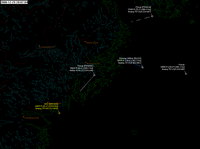
The flight path to Bromma passes straight across my office window, so most of the times when I stare into space for a bit of inspiration, I see an aircraft coming in for landing. Now I don't even have to raise my eyes to see the landing aircraft as I can have the relevant radar plot on my desktop.
While the plot gives you flight number, registration number and type, unfortunately you can't click them to get more information. While it shouldn't be too difficult to arrange, the next best thing has been done on this plot centred on Aalborg, which contains a fill-in form for Airliners.net, so you can easily look up pictures on the individual aircraft, general type or whatever.
Link tips via Haba.
2006-12-28
Worse than alligators
Last night I dreamt the End Of The World had come with Final Battle and all. At one point ICBMs were erupting out of the pavement and I realised
“It's true, there are Polaris submarines living in the sewers!”
“It's true, there are Polaris submarines living in the sewers!”
2006-12-20
Evil and not
Many years ago, I and my parents were staying at the house of an elderly couple in our circle of acquaintances. Naturally, I first checked out their bookshelf. It wasn't very big, and mostly contained various Christian tracts and other religious literature, but interspersed with this was books with titles like 21st Century Weapons Systems and Lebanon, Pearl of the Mediterranean which did not seem at all at home with the rest of the fare. The conversation during the day revealed that our hosts were expecting Armageddon in the near future and I realised they simply had been boning up on where and how the End Times would take place.
I was rather put off by these apparently nice people joyfully looking forward to the destruction of the entire Universe and spent the rest of the weekend looking very grim. Or so I thought. On the way home my mother told me the couple's daughter had complimented her on how kind eyes I had. Foo! So, no surprise that I've failed the evilness test:

How evil are you?
I was rather put off by these apparently nice people joyfully looking forward to the destruction of the entire Universe and spent the rest of the weekend looking very grim. Or so I thought. On the way home my mother told me the couple's daughter had complimented her on how kind eyes I had. Foo! So, no surprise that I've failed the evilness test:
How evil are you?
2006-12-18
“…where the future is made today”
Lunch queue. Colleague A is fiddling with his mobile. Colleague B accuses him of always texting. A: “No, I'm editing video! Look, I'm making a TV series on the mobile: shot and edited with theme music, credit rolls and everything.”
And so it was.
And so it was.
2006-12-15
Apologies to New York
It has been brought to my attention that Scandinavians travel to New York in order to cover buildings and public conveyances in graffiti.
I want to express my regret at this bad behaviour by my countrymen. (I almost wrote "inexcusable", but in that case an apology would of course be rather pointless.)
I want to express my regret at this bad behaviour by my countrymen. (I almost wrote "inexcusable", but in that case an apology would of course be rather pointless.)

2006-12-11
Fucking IDIOTS!
I am exhausted, exasperated and extremely annoyed with the helpdesk at my ISP Comhem. I'm trying to be charitable and think that probably the staff are overworked and have awful support tools, but the end result is still that I get canned responses that have nothing to do with my question, every reply I send to them I have to confirm on a webpage so it gets assigned a new tracking number and is processed by a new person who thinks this is a new problem and therefore does not check the earlier email conversation and gives me some other irrelevant response. The question is whether there are humans involved at all or if it is a simple keyword-triggered answerbot that signs with a different invented name for every letter.
There is of course a telephone-based helpdesk as well, but there I am met by an answering machine telling me they are so busy they cannot take my call right now, so please call later. Every now and then they try to sell me additional services - telephony or cable TV, but I'm damned if I'm going to support them any more. Can anyone recommend an ISP that actually has a competent helpdesk?
My problem? My webpage suddenly stopped working—I get a 404 when I try to access it. This cannot reasonably be due to the firewall settings of my home laptop, the password to my ftp account or any other of the suggested “remedies” that suggest the problem is at my end, now can it? I've now spent a week trying to get this fixed.
And no sooner had I written this than there is an article in Dagens Nyheter on all the other people who are mightily disappointed in the customer service of Comhem. Well then!
There is of course a telephone-based helpdesk as well, but there I am met by an answering machine telling me they are so busy they cannot take my call right now, so please call later. Every now and then they try to sell me additional services - telephony or cable TV, but I'm damned if I'm going to support them any more. Can anyone recommend an ISP that actually has a competent helpdesk?
My problem? My webpage suddenly stopped working—I get a 404 when I try to access it. This cannot reasonably be due to the firewall settings of my home laptop, the password to my ftp account or any other of the suggested “remedies” that suggest the problem is at my end, now can it? I've now spent a week trying to get this fixed.
And no sooner had I written this than there is an article in Dagens Nyheter on all the other people who are mightily disappointed in the customer service of Comhem. Well then!
2006-12-10
Oh rats
The other night I saw a rat in my room. I gasped so loud I woke up.
Sometimes rats turn up for real and sometimes they turn up in the lavvy (City, Fältbiologen). I realised there are many things about sewers I usually don't think about. Incoming water pipes are under pressure, so they are filled with water, but sewers are fed by occasional bursts from showers, toilets, washing machines and such; the pipes in a building are then empty most of the time. I suspect even the larger pipes under the streets must be mostly empty, so that there are margins for everybody showering at the same time in the morning and so on. But, are all solids in the sewer water properly flushed away then? I guess they have to be, or the sewers would be clogged more often. So, there is enough water flowing through the system to keep everything moving. Rats then? They scamper around in the pipes, on the lookout for food I presume, or perhaps there are rat spelunkers that poke around just to see what's around the next bend in the pipe and climb up several stories in the house pipes. A water lock? Well, there's light coming through, so maybe the water's not a lot. Are these very desperate or very confident rats that take the plunge and poke their nose up someone's toilet bowl? And imagine all the rats, cautiously climbing up pipes like long-tailed Indiana Joneses and suddenly the defences of the ancient temple are triggered and a bolus of water, toilet paper and crap comes at them from five stories up. Does one survive that? Just hang on by the claws in the pipe while it passes or ride along, trying to get a breath of stinking air every now and then? Is it like white-water rafting or just sheer terror for the afflicted rat? So many questions, so difficult to find out.
Sometimes rats turn up for real and sometimes they turn up in the lavvy (City, Fältbiologen). I realised there are many things about sewers I usually don't think about. Incoming water pipes are under pressure, so they are filled with water, but sewers are fed by occasional bursts from showers, toilets, washing machines and such; the pipes in a building are then empty most of the time. I suspect even the larger pipes under the streets must be mostly empty, so that there are margins for everybody showering at the same time in the morning and so on. But, are all solids in the sewer water properly flushed away then? I guess they have to be, or the sewers would be clogged more often. So, there is enough water flowing through the system to keep everything moving. Rats then? They scamper around in the pipes, on the lookout for food I presume, or perhaps there are rat spelunkers that poke around just to see what's around the next bend in the pipe and climb up several stories in the house pipes. A water lock? Well, there's light coming through, so maybe the water's not a lot. Are these very desperate or very confident rats that take the plunge and poke their nose up someone's toilet bowl? And imagine all the rats, cautiously climbing up pipes like long-tailed Indiana Joneses and suddenly the defences of the ancient temple are triggered and a bolus of water, toilet paper and crap comes at them from five stories up. Does one survive that? Just hang on by the claws in the pipe while it passes or ride along, trying to get a breath of stinking air every now and then? Is it like white-water rafting or just sheer terror for the afflicted rat? So many questions, so difficult to find out.
2006-12-05
Finished model V

A North American F-86F-40-NA Sabre from the Japan Air Self-Defence Force, sometime in the 1960s. Model from Trumpeter, scale 1/144, donated by Oskar B. The piece of airfield is there because the plane was a tailsitter even with the lump of metal I placed in the nose, now it's glued to the surface.
2006-11-24
Hey, hey, ho, ho—the kilogramme has got to go!
It has always annoyed me that the kilogramme, one of the fundamental units of the Système International d'unités, is a prefixed unit. This completely breaks the logic of the system and I'm sure is one of the reasons that many people believe “kilo” is the name of the mass unit. (Not that they can tell the difference between mass and force either, sigh.)
Anyway, to my joy I find in the latest issue of SEK-Aktuellt that others have been equally annoyed by this and there is work underway in the Comité consultatif des unités to replace the kilogramme with another unit, which in addition would together with most other SI-units be based on a fundamental property of nature (Planck's constant in this case), rather than some arbitrary object (the kilogramme prototype in Paris). A proposed name for this new unit is not leaked in Anders J Thor's short article and I haven't been able to come up with anything witty myself, but I hope it will be some short and memorable.
Down with the kilogramme!
Anyway, to my joy I find in the latest issue of SEK-Aktuellt that others have been equally annoyed by this and there is work underway in the Comité consultatif des unités to replace the kilogramme with another unit, which in addition would together with most other SI-units be based on a fundamental property of nature (Planck's constant in this case), rather than some arbitrary object (the kilogramme prototype in Paris). A proposed name for this new unit is not leaked in Anders J Thor's short article and I haven't been able to come up with anything witty myself, but I hope it will be some short and memorable.
Down with the kilogramme!
2006-11-16
Blogs in scrubs
There are quite a few blogs written by medical people out there and they offer stories with the widest possible range of joy, despair, scientific advances and dark-age magic, all the emotions that make the medical profession so attractive to producers of fiction set in hospital environments, but still the (perhaps just slightly varnished) truth is probably the most gripping.
Orac's Respectful Insolence is probably the most well-known and with an amazing spectrum of regular subject themes, from Enemaman to the Hitler zombie, but I just found Trauma Queen, the blog of a recently graduated paramedic in Edinburgh. The stories from his daily life, mixing drunkards, injured and sick people with the children he loves so deeply and selflessly brought me unashamedly cliched tears and laughter. Read them!
Orac's Respectful Insolence is probably the most well-known and with an amazing spectrum of regular subject themes, from Enemaman to the Hitler zombie, but I just found Trauma Queen, the blog of a recently graduated paramedic in Edinburgh. The stories from his daily life, mixing drunkards, injured and sick people with the children he loves so deeply and selflessly brought me unashamedly cliched tears and laughter. Read them!
2006-11-10
Ahem…
…I just wanted to draw your attention to the language spread in my reading list in the side bar.
Subscribe to:
Posts (Atom)
