Showing posts with label religion. Show all posts

2022-12-26

The patron saint

The reception traditions at the alma mater have most likely changed considerably since my undergrad days, but at the time there were certain rites and ceremonies that had to be performed for the recently admitted students to be accepted as full members of the school, the final being a party arranged by the new students for the rest of the section. Of course I ended up on the arranging committee. As the party would coincide with All Saints’ Day, we thought we should do something saint-themed, such as introducing the patron saint of programmers, whoever that might be. So I spent some time trying to get hold of a Catholic priest I had located in the phonebook (yes, it was all analog in those days). When I finally reached the priest, it turned out he belonged to the Liberal Catholic Church which had no truck with saints. Well, I had no idea! By then it was too late to start over with finding a Roman Catholic priest, so we had to drop the saints in favour of other ideas which I hope are safely forgotten by now.

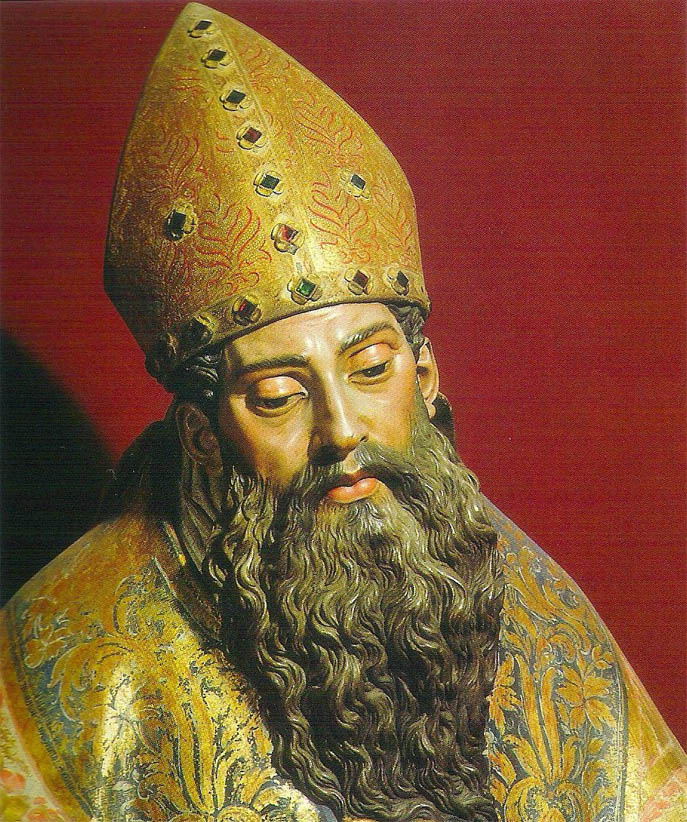
Still, with the advent of the World Wide Web, it is now possible to search for all desired information, and one then finds that the inofficial patron saint of programmers is Isidore of Seville on account of him having compiled the first encyclopaedia, so here he is.

2018-03-03

C S Lewis popping up

It was when I was working at BT Labs, that I saw a notice in the (surprisingly good for a large working place) staff canteen which explicated C S Lewis’s Trilemma. To wit, this presupposes that Jesus must have been “Lord, Liar, or Lunatic”, whence one presumably is supposed to reach the conclusion that “Lord” is the only possible alternative. This has of course been criticised by better people than me, but at the time it was a new argument to me. As I mulled it over, I first realised that the options of course aren’t mutually exclusive. I can perfectly well imagine a god who is stark raving bonkers, and lying about it to boot. (Here’s one, for example.)

As I thought about it further, I defined my own quadrilemma, also of mutually non-exclusive alternatives: ”Mythical, Misguided, Misquoted, and/or Misunderstood”. Not that I think it will convince any believer, but I was rather proud of the alliteration, one letter up, and one alternative more. Take that, Lewis!

In other news, Ana Mardoll has, with the aid of her faithful commentariat, over the last few years, been doing close readings of the Narnia books and actually working out the consequences and implications of everything that happens in them. Not only do they find serious inconsistencies in how the world of Narnia supposedly works in terms of geography, time passing, political relations, etc, but also that the theology espoused boils down to “whatever Lewis personally enjoys (which is not particularly consistent either) is ordained by God”. Quelle surprise !

One does not have to require perfect consistency of stories, but as they say, once you’ve seen it you can’t unsee it. As it happened, as a child I read the Narnia books in internal order and completely failed to notice that they were supposed to be Christian allegories until I got to The Last Battle, where it was so heavy-handedly presented even I couldn’t miss it. I felt immensely betrayed – I had enjoyed the books for stories of adventure and meeting magical creatures. Realising it was all a trick in order to indoctrinate in a religion I even then had deemed irrelevant was, I imagine, somewhat like finding yourself in the forest with the weird man and no candy forthcoming.

2014-12-17

Hope and hops

It struck me that my relation to religion is much the same as to beer drinking: While I see that it clearly is important and enjoyed by many, not least as an excuse for meeting friends (but may get you into fights about which brand is best), possibly may have health benefits under certain circumstances, has been historically very influential, and arguably may even have enabled civilisation, I still don’t quite get why anybody would see it as enjoyable, and suspect it is probably not good for you in the long run, especially as your arguments become increasingly more unintelligible the more you have partaken of it.

2012-07-23

Stupid Westerner

Working in a multi-national corporation, half of my work team is located in Asia. One should of course be culturally sensitive, but the thing is, that no culture is homogeneous, even among brown-skinned people in a faraway land. So, the other day I made a point of noting that Ramadan would start the next day and asked if they would celebrate it somehow. “Some people fast, scepticals don’t.”
The next day we were trying to figure out some code and I realised I wasn’t quite sure how to proceed: “Hm, I’ll have to look this up, it could take a while.”
“Is it OK if I go for lunch in the meantime?”
D'oh! Yeah, I don’t fast during Lent either.

2011-12-12

So much unspoken

Even when I had access to TV, I apparently didn’t watch it all that much—there are several programmes I must only have seen bits and pieces of. One of these is Brideshead Revisited, but Martin R kindly donated the DVD box to us so Honeybuns and I have been watching it.

It’s something like 11 hours in total, so there is room for many themes to be touched on.

An occupational hazard, but I reacted to the video quality—there was a constant fuzz in the image. Presumably this was the quality you would get on video in the late 1970s and nobody thought about it then, but today, used to the razor-sharp images of professional digital video cameras, it felt odd.

The actors have been well-deservedly lauded for their performances, but since many of the actors were in their 30s, even as their characters were much younger, they seemed all the more immature. Cordelia Flyte, I eventually realised, should have been around ten years old or so in the first episodes, but played by an adult actress she came across as a half-wit.

The beginning of the story is the love affair between Charles and Sebastian. Neither of them speak of it in those terms, and the Flyte family do not allude to it either—except for Rex Mottram, who in passing mentions the Swiss doctor who is good at “sexual problems”, the character of which is not further discussed. At the time, their relation would have been illegal, so one imagines that nobody was very interested in raising the subject. It hurt to see a unhappy Sebastian weep forlornly, Charles unable to comfort him. I wanted to yell: “Hold him, you dolt!” Later on, safely in a heterosexual relation, Charles speaks disparagingly of “pansies”—so at least outwards he does not self-identify as homo-/bisexual. Interestingly enough, the narrative itself adds to the ambiguity—the most open display of affection Charles and Sebastian show is a sideways hug a few times, whereas the beginning of Charles and Julia’s relation is shown in a sex scene giving us ample view of Diana Quick’s nipples. It is as if the camera itself shies back from peeking into the closet.

I wonder whether the Oxford barbers who are so fond of Sebastian and the university porter who proudly declares he has no wife are implied to be homosexual. I’ve gotten the impression that at least in university settings homosexuality was accepted—as long as it was not explicitly mentioned, and apparently that’s why the openly gay Antoine Blanche is “sent down” (expelled). It is unclear to what extent Sebastian’s discomfort with his family is due to repression of his sexuality, rather than the general oppression by the Catholic Church so important to the family. He describes the dangerous charm of his mother, but she mostly comes across as fairly stiff and repressed—a pivotal castigation of Charles is done in measured and unemotional tones even though she would have been furious.

Charles also has family issues, while these are not made as much of. His father seems not to care much for him and treats him as mostly a nuisance when he turns up in the Ryder home. In adulthood Charles continues the family tradition in his complete neglect of his own children and I had absolutely no sympathy for him when he after his divorce whinges about having lost the right the see his son grow up.

As Sebastian sinks deeper into alcoholism, Charles is a very active enabler, keeping him with booze. At first I thought that perhaps he thought his love would reform Sebastian, but eventually I came to the conclusion that he just couldn‘t say no to Sebastian. At the same time, the rest of the company seem unable to cope with the situation, alcohol apparently so important to all of them that they just can’t imagine how to do without. (On top of that, all chain-smoke like chimneys, but that is not seen as a problem at all.)

Another theme, which is just presented and not discussed at all, is that of class warfare. For some reason the blurb on the Swedish DVD implies Charles is a Man of The People, but it is obvious that he is in fact quite well-off and only in comparison to Lord Sebastian Flyte could he be considered slightly further down the social ladder. If anything, Charles comes across as rather more snobbish than Sebastian and seems to agree with Lord Marchmain that the most disgusting thing one can be, is middle-class. The upwardly-mobile Rex Mottram is one of these despicable beings, being described as an incomplete person. What this incompleteness consists in is unclear, since the person we see is ambitious and competent and goes considerably out of his way to help the Flytes.

The working class is not considered at all, the numerous servants are just names to be thanked when they bring yet another drink on a tray. (In general it is a source of amazement to me that Britain doesn’t more regularly erupt in bloody popular uprisings.) When workers demand fair pay Charles joins a gang of truncheon-equipped and helmeted upper-class strike breakers to beat down the strikers.

Then the issue of religion. Waugh converted to Roman Catholicism and the book is intended to describe Charles Ryder’s path from agnosticism to the One True Faith, yet the religion is not really described as anything positive, and it destroys the lives of basically all the protagonists. This is somehow A Good Thing.
There is some excellent, yet possibly unintentional, comedy when religion is discussed. When Charles first meets Lady Marchmain, she immediately sets out to convert him. Teasingly he then asks her how she can expect to get to Heaven, as it is easier for a camel to get through a needle’s eye than for a rich man to enter Paradise. She serenely replies that God works miracles. How terribly convenient for her… Rex Mottram’s earnest attempts to figure out Catholic dogma is wonderful satire.

Finally, when the long-ago converted, then lapsed, Lord Marchmain is dying, the family pulls out all the stops in order to have the last rites performed. Charles opposes this on the grounds that it would be disrespectful of the Lord’s wishes and tries to find out what the exact purpose of the rites is. Nobody is actually able to answer him, but all are very adamant that they Have To Be Done. At this point Honeybuns got quite annoyed with Charles’ interference, why did he have to be such a dick about it? Then when the sacrament was administered and both Julia and Charles immediately become born again and decided to forswear happiness for the rest of their lives in order to please God her face fell. And then the series ended with Charles contentedly understanding that God’s purpose with the Second World War was that the briefly shut Roman Catholic chapel at Brideshead could be reopened, which was of course an all-important Good Thing.

Honeybuns was horribly down-cast after this and demanded that we immediately watch a more up-lifting film. I glanced at the shelf: six Shakespeare tragedies, a documentary on strategic bombing, more aviation-themed features, etc, but nothing in the way of comedy. “What kind of a person are you!? You watch sad films, you listen to sad music and you read sad books! You…you!” Well yes, that’s me.
2011-05-13

I am a mullah

As I was walking home I came upon a gaggle of boys, around twelvish. One of them asked if I could help them. Well, sure, what’s the matter? Isn’t this a Thor’s hammer? So it seems. Wouldn’t it be haraam for a Moslem to wear it? Aaah, ha ha, you’ll have to ask your imam about that.

I eventually figured out that one of the younger boys in his innocence had gotten himself the pendant and just been challenged by the more theologically astute boy who first had addressed me. He proposed it would be humiliating to be wearing the symbol of another god. I suggested it was just an ornament, to be worn for æsthetic reasons, but by now the boys had reached the decision they should get rid of the heathen symbol. They offered me to buy it for cheap, but I declined on the grounds that I never wear jewellery. Another reason is that all too many wearers of Thor’s hammers tend to be of the nationalist persuasion, so I, too, had symbolic reasons not to wear it.

2010-11-15

I have seen Jesus!

I mentioned Adelsö church yesterday, which in turn reminded me that I’ve actually been there: Way back when the lab had planning days on Adelsö at a youth hostel (which in itself is an interesting nuance difference, the Swedish term is literally “wanderer’s home”, the visitors are all kinds of tourists and not necessarily poor youth).

The steamboat jetty, from which we were going to return home, lies just next to the church and since I’m rather fond of churches I decided to have a look inside. I pulled open the heavy door, entered, and my brain stopped in its tracks. By the altar stood Jesus, clearly alive and well!

Eventually I also saw the vicar directing his actor in preparation for the Sunday’s Passion play and the world turned right again. I left them to it. As I exited another curious colleague was on his way in and I warned him:
“Jesus is there.”
He soon came out again:
“I didn’t think you meant it literally.”

2010-09-08

Happy New Year!

There are very few Jews in Montana, which is probably why there isn't a Rosh Hashannah Montana.

2010-07-26

2008-05-08

Go shop!

This afternoon I was invited to a sneak preview of the new Fair Trade Shop on Tegnérgatan 8 that will open on Saturday. Now, those of you who are familiar with this part of town will recognise this as the house of the Mission Covenant Church of Sweden and indeed the shop turns out to share premises with Gummessons bookstore and all of the staff seemed to have ties to the church. To my disbelief(!) there was even a speech made by a mission pastor who then prayed over us and surprisingly many in the audience bowed their heads. I didn't quite expect such things to happen in Sweden, but then again, I live a sheltered life.

Still, the shop has nice stuff, in particular Fair Trade clothes, which have been difficult to get hold of in Stockholm, so I'll just sigh deeply and shop there anyway.

2007-11-22

Buzzword of the year

I don't know if it is due to the onmarch of New Atheism, but suddenly “agnostic” is the word to use, though with regards to technology rather than the supernatural. What last year would have been “format-independent” is now presented as “format-agnostic”. I don't see that we thereby have gained in clarity.

To further confuse the issue, in many cases even “format-independent” would be a bit of marketing lies, as what in most cases is intended is “supports several different formats” where the magnitude of “several” is subject to the subjective opinion of the writer. A system could of course be format-independent in the sense that it is easily extended with user-supplied code to handle any new formats, very neat from a programming perspective, but usually not what someone buying a computer system expects.

2007-02-07

Clearly, I've earned the right not to believe in it

You know the Bible 100%!
 

Wow! You are awesome! You are a true Biblical scholar, not just a hearer but a personal reader! The books, the characters, the events, the verses - you know it all! You are fantastic!

Ultimate Bible Quiz


Via Pharyngula.