
2016-05-23
Finished model 2016-I and II

2015-05-25
Dreams
The couple embraced and threw themselves on the ground.
For the longest time it seemed they would miss.
For the longest time it seemed they would miss.
2014-12-19
2014-12-17
Hope and hops
It struck me that my relation to religion is much the same as to beer drinking:
While I see that it clearly is important and enjoyed by many, not least as an excuse for meeting friends (but may get you into fights about which brand is best), possibly may have health benefits under certain circumstances, has been historically very influential, and arguably may even have enabled civilisation, I still don’t quite get why anybody would see it as enjoyable, and suspect it is probably not good for you in the long run, especially as your arguments become increasingly more unintelligible the more you have partaken of it.
2014-12-16
R
Prompted by a student project, I started looking into R today.
Well, this is what the usual Hailstone program looks like in R:
hailstone <- function(n)
  while (print(n) > 1)
    n <- if (n %% 2 == 0) n / 2 else 3 * n + 1;
I started writing it in a very C-like way, but the functional nature of the language made itself increasingly more apparent as I played around with the code.
2014-12-01
Still going strong
During my first course in calculus, Ambjörn the TA was going through whatever it was and I innocently asked “Isn’t this, like, fractal?” He spun around: “Yes, exactly!”, spun back towards the blackboard and proceeded, chalk blazing, to explain how the current course segment was tied to fractals, their implications for geometry and how that in turn related to other branches of mathematics, ever faster and further into ever more exotic subjects while we students could just hold on to our desks for dear life in the storm blast of imparted knowledge. Forty-five minutes later he suddenly made a double-take, checked the time, and with an embarrassed cough noted: “I think we ran over the time a bit there, let’s take the break now.”
During the break Å accused me of setting Ambjörn into self-oscillation and suggested I shut up in the future, lest we never manage to cover what was actually coming on the exam.
Well, I did pass the calculus exams, eventually even the dreaded Theory exam, though that took me five attempts (in no way an exceptional number). Still, perhaps that was more due to diligently doing all exercises and repeatedly reading the books, rather than thanks to Ambjörn’s TA efforts, which, while always entertaining and mind-opening, tended to veer off from the official subject into Deep Maths.
Eventually I became a colleague of Ambjörn’s, whose wide-ranging interests could no longer be contained within either the Department of Mathematics or that of Physics and thus had moved into Computer Science (which at the limit contains all other sciences). Passing his room would often imply getting drawn into impromptu lectures on maths and their relation to everything else in (and occasionally outside) the universe. He even stored some of his parabolic rock-melting mirrors in our lab, though we irreverently ended up using them as towel racks.
Today, Ambjörn was officially retired, though, as is the custom in academia, that simply means the end of salary, but not necessarily the end of research. So, I returned to the Alma Mater for Ambjörn’s Last Lecture, which, true to form, ranged from how to explain what weekday it will be in a million days, over homotopies of snakes on a torus, to how human culture is an integral over time.
I regretted Honeybuns wasn’t there to get some kind of idea of where I come from, intellectually, but the OBCM was there and afterwards we had a nice chat about teaching and geometric modelling over a cuppa.
2014-10-10
If this is the last time I hold you
A song that pops up in my head every now and then, but that I hadn’t been able to place. For some reason I thought it might come from a Fame episode, but googling around I eventually found it was actually from the final episode of Secret Army, which in addition to this has the most haunting opening titles of any TV programme I’ve seen (the images played in reverse for the end titles).
2014-07-15
Växeln hallå
I would assume it would be easier to confuse the connections between Ipswich and Norwich, rather than Northwich, but I guess Naarich just doesn’t sound nice to sing. When I saw the title, I first assumed it was about someone travelling on train, but the song is instead about the modern social media of its day. Note also the very careful enunciation of the singer, which makes every word of the lyrics come across clearly in spite of distortion high enough to make grown men cry.
2014-07-14
Clean lyrics
As noted earlier , well-known songs often have a far older original, so here is a famous Monty Python piece in its 1930s guise:
2014-07-12
List of songs about Stockholm
Liza Minelli, in one of her shows, told of how she’d investigated what city had had the most songs written about it and, of course, found it was New York, giving her cause to sing “New York, New York”. Number two was apparently London, so she did a London-themed song as well. I was a bit patriotically incensed that she didn’t even mention the number of songs written about Stockholm. Fortunately others have addressed that issue.
2014-07-10
Forgotten lyrics
All too often, and especially with lyrics in foreign languages, I don’t catch the exact lyrics and so I’ve long been humming on this rhythmic piece that goes something something breakfast in London. But, of course Wikipedia has a List of songs about London and halfway through that I found it: “Last train to London”.
2014-07-09
Swashbuckling
Another song that’s stuck in my head: “Song of the Musketeers” from the 1935 version of The Three Musketeers.
2014-07-08
The Only-Begotten Children
I’m not the only one to have Only-Begotten Children, but so does Prince Philip, as witnessed by the Reverend Hubert Rumtumtibumbum (starts at 5:00):
2014-07-07
Version originale
The Flash animation “Shii’s song” with an up-pitched version of Jennifer Stigile’s recording of “Wind’s Nocturne” was an Internet phenomenon long before the term “viral video” was invented, but here is the original Japanese version.
2014-07-06
More 1970s ballads
I’m sure the YouTube comments claim that they just don’t make music like this anymore. Well, why would they? It’s already been made.
2014-07-05
Web-adapted
Now is the time for the JavaScript version of the Hailstone program:
<script>
  function hailstone(seed) {
    var output = "";
    for ( ;
   output += seed, seed > 1 ;
   seed = seed % 2 ? seed * 3 + 1 : seed / 2) { output += ", "; }
    return(output);
  }

  function submit(seed) {
    document.getElementById("output").textContent =
      hailstone(seed);
  }
</script>

<p>
  Seed: <input type="text"
            id="seed"
            onchange="submit(this.value)">
</p>
<p id="output"></p>
Put that into an HTML page and it generates the following box: (Try it, it actually works!)
Seed:
2013-04-29
Finished model 2013-II
While I arrange modelling competitions, I don’t compete, mainly because I’m just not good enough, but when we were at Model Expo in Helsinki last year, one of the IPMS Finland guys pressed a Frog Fokker D21 in my hand as a parting gift. I could but take it as a challenge.

The Frog model, while older than I, is not completely horrible. The shape is OK and it has separated control surfaces, which, when offset, would make for a nice effect, as I decided to build it in flying configuration (which otherwise would not affect the exterior, considering the fixed landing gear). But there are deficiencies: The cockpit is completely bare, there are no wing guns (not relevant for the Danish version, but definitely for the Finnish), the engine is such a pathetic effort that all around the building table burst out laughing when I showed it, and the rather prominent exhaust pipe is completely missing. All of this is of course amenable to scratch building, which I did (I didn’t bother with the engine, though) and in addition I made elevator actuators and the large landing light present on the Danish aircraft. The rather shapeless original pilot figure was replaced by a Matchbox pilot, sculpted and painted to look as much as possible as flying suits I found in [Ancker 1997] (photographs of Danish pilots in 1940 are really rare, not to say nonexistent, on the web). A length of thick soldering wire turned out to be perfect for making the exhaust. The hemispherical landing light lens was created by heat-smashing a bit of transparent sheet. (Or rather, heat-smashing several sheets until I got a decent shape.)
By this time it was just a week left before the competition was on (as getting my Tunnan done had had priority up to that point) and I had to start the painting process. Since I persist in using Humbrol colours, which take considerable time to dry, I set up a schedule where I would paint a layer in the evening, get up before dawn to paint the next layer, go to work, come home, paint another layer, sleep a few hours, etc. In the middle of it all I ran out of adhesive tack for masking, so had to run out and buy some, but my favourite Sense 60 g tack just didn’t exist anymore, all shops suddenly carrying Pritt Multi Tac instead. I had to buy this instead. To my horror I found the next morning it would actually lift the underlying paint. I’d never seen Humbrol do that, but apparently I was cutting it a bit too fine with the drying times. In all, the paint job is pretty horrid, you can even see a couple of obvious fingerprints in the photo below. I added the decals the same morning as we were leaving, using some leftover Danish national insignia, unfortunately somewhat undersize.
For the camouflage I went with [Eberspacher 1994] and its suggested colour scheme of Olivengrøn/Brun/Skyblå, which is not inconsistent with the high-contrast camouflage apparent in contemporary photographs, using Humbrol 131 Satin Green, 9 Gloss Tan, and H.G.3 Hellgrau 76 as matches. Acquaintances frowned at this and wondered if I’d purposely chosen the most garish combination.
So, it’s not a great model by any means and will never win anything, but I did get it done in time for the competition.

Literature
De danske militære flyverstyrkers udvikling 1910–1940, Bind I, Paul E. Ancker, 1997, Odense Universitetsforlag.De danske militære flyverstyrkers udvikling 1940–1945, Bind II, Første halvbind, Paul E. Ancker, 2001, Odense Universitetsforlag.
“A Design of the Times—The Fokker D.XXI in Development and Service”, Srecko Bradic, in Military Aircraft Monthly International 9(7), July 2010, pp 32–41.
Fokker D.XXI—Dutch & Danish Service, Vol. 1, Warren Eberspacher, 1994, Phalanx Publishing.
Fokker D.XXI, Suomen Ilmavoimien Historia 3, 2. uusittu painos, Kalevi Keskinen, Kari Stenman & Klaus Niska, 1977, Tietoteos.
Fighters 1939–45—Attack and Training Aircraft, Kenneth Munson, 1969, Blandford Press.
Fokker D.21, Seria „Pod Lupą” 10, Przemyslaw Skulski, 1999, Ace Publication.
2013-04-07
Finished model 2013-I
This year’s modelling competition had the theme “What if…Sweden” and Kipper had one of his brilliant ideas—he bought up every 1:72 kit of Saab Tunnan he could find and pressed them in the hands of all modellers he met against the promise that they would build it, but not in the kit configuration. Mulling things over, I had a brainwave and accepted a bagged Heller Tunnan.
Several things came together in my head: the Prusa Mendel 2 3D printer I had just bought together with some friends (including Kipper), my interest in the Saunders-Roe SR.A/1 flying-boat fighter, the rotund shape that gave the Tun its name, and the wonderful diorama of a wartime S-17BS base in the Stockholm archipelago at a previous 08-Open, so I thought:
What if the Chief of the Air Force had been to the British Gas Turbine Week in 1951, where the SR.A/1 was displayed [Jones 1993], and had decided that it would be possible to convert the all-new Saab 29 Tunnan into a flying-boat reconnaissance version that could deploy from easily-constructed archipelagic bases, the road base system not yet having been built?
I decided that it would have been designated S29H, obviously popularly known as ”Vattentunnan”. Perhaps this would be a proposal interesting enough to extend the production run of fpl 29 beyond serial 29976 in 1956 [Flyghistorisk Revy 27], so I could depict an individual palindromically serialled 29992 (coincidentally ). Like all other seaplanes in the Air Force, the S29H would obviously be operated by F2 at Hägernäs, extending their life as aircraft operators. F2 aircraft did not normally wear squadron-specific colours or numbers, instead using the two final digits of the serial number on the fin [Hellström & Fredin, 2000], and I presume that F2 already being special in their marking schemes, they would never bother transferring to fin letters, so 2-92 it would be. However, they probably would use the high-contrast olive green fields prescribed for A29 and S29 from 1954 onwards (not least because it would add a little splash of colour). The result would be a Tunnan as it would have looked in the late 1950s.
For the actual design of the aircraft I foresaw giving it a boat hull directly based on that of the SR.A/1, retractable wingtip floats that could double as wingtip tanks, and a couple of holes in the wings for the cameras. The cameras mounted in the actual S29C recce aircraft were pretty bulky, necessitating an entire new nose section, but this design was dragooned by Colonel Beckhammar, whereas the original plans called for a rather simpler solution, so the S29H can be taken to be based on these original plans and some clever optics. The model turned out to have a convenient panel line running all the way from air intake to exhaust and I set the razor saw to work on this. Now I could tape together the two fuselage halves and scan their outline for later use.
Then I scanned Barrie Hygate’s SR.A/1 plans [Aircraft Archive, 1988]. Kipper tipped me off to Rhino 3D, which happens to have a free beta version for OS X, and during a modelling day at the Army Museum, showed me how to loft the hull profiles into a 3D structure. Then I stretched and squashed that structure in order to match it to the previously scanned Tunnan outline. I now clearly saw how much smaller Tunnan was than the SR.A/1. I created the wingtip floats, which had fewer constraints, so did them more or less free-hand. (All this took considerably more time and fiddling around than is obvious from this short description.)
The plan had been to print the hull and floats on the 3D printer, but that was a project in itself and I hadn’t even managed to get it to communicate with my MacBook yet. On the other hand, Kipper had gotten access to a Roland 3D router, and used it to produce the desired parts for me. The material used looked like some kind of light wood, but apparently was a resin. The resolution of the router was outstanding and I was very pleased with the bits. Except for the wing-tip floats, whose size I had completely overestimated—they were just little pods. I would have to rescale them by at least a factor of 2. Still, that could wait for later.
I continued putting the model together. Heller models from the 1970s, such as this, are really not bad, with good fit, and the cockpit was reasonably well detailed. I still added a thin copper wire for the ejection handle and a bit of plastic to represent the quite prominent canopy opening mechanism.
The new hull had a big lug left from routing which I had to spend a few hours to sand away with wet paper, as I’m a bit wary about resin dust, but eventually it was in a state to be mated with the (remains of the) Heller fuselage. It fit surprisingly well—I had apparently done a careful job scanning and lofting. The only trouble spot was at the air intake, where I’d sawed through the bottom part of it, this necessitating a bit of scraping and puttying. In retrospect I should have kept the intake as was, but so it goes.
In the wings I took out a section of each lower part, in order to create the attachments for the floats. I added various tubing to represent the retraction mechanism. In the meantime, the router had broken down, so Kipper was unable to supply me with resized copies, but being the man of bright ideas that he is, he came up with an emergency solution: pilfer the wing floats from a Tamiya 1:48 Rufe, and indeed they were perfect in size.Soon it was time for painting. I went with straight Humbrol 56 overall, and Humbrol 30 for the olive green fields (really too green a shade, I should rather have used 116, I made a thinko). Finally, the day before the exhibition, it was time to add the decals. The kit-supplied national insignia went on without problems, but my Specialtryck Swedish numerals completely disintegrated on contact with water. On this short notice I had no option but to leave the aircraft unnumbered. As I arrived the next morning, looking very glum, older hands laughed at my ignorance of the short shelf-life of Specialtryck decals. Still, there it was, and so were all the other ones! Kipper’s campaign activity had paid handsome dividends, the What if competition category had to be divided in two: one for Tunnan entries, the rest for everything else and then about as many additional entries in the hors concours exhibition. This caused some amount of excitement even abroad, and I was chuffed as nuts to see my flying boat singled out for comment.
A couple of weeks later I brought the Tunnan along to the Helsinki competitions, where it received IIIrd prize in the Jets 1/99–1/51 category, though that was really an artefact of their no-sweeps rules, it was in fact way down the list, but all the entries ahead came from only two builders…
Much later, with the help of Microscale Liquid Decal Film, I managed to get the numerals to stick together, and then scratch-built beaching gear for the aircraft, trying out the hairspray method on it. And here it is:

Literature
“SAAB 29 Tunnan” at Aircraft Walkaround Center, 2003.Aircraft Archive: Post-war Jets, Volume 3, 1988, Argus Books.
Kronmärkt – Målning och märkning av svenska militärflygplan under 1900-talet, Leif Hellström & Leif Fredin, 2000, Allt om Hobby.
J29-klubben, 2010
“Saro’s flying-boat fighter”, Barry Jones, Aeroplane Monthly, 22(7), July 1993, pp 34–41.
Flygplansritningar 4: Svenska Flygvapnets Spaningsflygplan 1926–86, Björn Karlström, 1988, Allt om Hobby.
”Saab 29 Tunnan · Västerås Flygmuseum”, at 4πsr, Lennart Möllerström, 2011.
Att flyga är att leva: Flygvapnet 1926–1976, Gösta Norrbohm & Bertil Skogsberg, 1975, Bokförlaget Bra Böcker.
Flyghistorisk revy Nr 27: SAAB 29 Tunnan, 1977, Svensk Flyghistorisk Förening.
Gula Divisionen, 1954, Terrafilm.
2012-10-07
2012-08-10
La route se poursuit sans fin
I’ve often remarked on the beauty of the landscape between Aachen and Lüttich (or Aix-la-Chapelle and Liège) (or Aken and Luik) and Honeybuns got very excited by the idea of hiking on foot in this region, so once we finally had gotten our holiday applications cleared (which is a story in itself, though not to be told here), we started planning. Our approaches to travelling and the necessity of planning ahead are somewhat different, but I insisted on being sure of sleeping under a roof each night, so I planned an itinerary with the invaluable help of Google Maps and booking.com, did the necessary reservations, and, hallelujah!, got hold of a person at SJ who actually knew how to operate their booking system, so I eventually had a thick folder of tickets, hotel reservations and maps to help find the hotels. Honeydad lent me a backpack (complete with pine needles) and I stuffed it with changes of underware, a couple of books to read, blister bandages, and other travel necessities. I debated for a while whether to bring the laptop along but decided against it, the backpack was heavy enough as it was. Then, off we went.
Day 1, Swedish to German
The usual 12:15 train from Stockholm C towards Copenhagen. I get motion sick as usual and Honeybuns forbids me to read. We get to Copenhagen on time and in fact could easily have taken an earlier train to Hamburg, but we have no seat reservations and the platform is pretty crowded, so we decide to have a late lunch instead. Our usual Shawarma House has disappeared and eventually we end up in O’Learys. The food is adequate and the big screens are showing Olympic sports—the Swedish handball team making mincemeat of the British team. I allow myself a moment of patriotic pride, whereas Honeybuns thinks sports are all stupid.
The continued journey towards Hamburg is uneventful and we are far enough south that it is already dark when we arrive. I don’t know why, but I always get disoriented in this station, so we first go out the wrong exit before we manage to get our bearings. The hotel is very near the station and, err, not in the best part of town. We feel rather vulnerable but we are in fact not accosted and indeed nobody even bothers giving us a second glance. Then—our hotel is closed for the night. There is however a notice stating that in the evenings, check-ins are to be made at Hotel Phoenix just down the street. But which street? I call the proferred number and get an answer immediately.
“Hullo, I’m at Hotel Condor, but I should go to Hotel Phoenix?”
”Yes.”
”So, in which direction should I go?”
“Yes.”
After a few more exchanges in the same vein I give up and we strike down a likely street and indeed Hotel Phoenix turns out to be just around the corner. We get our keys, return to Condor and our room looks quite OK, especially after a long day. We drop off to sleep.
Day 2, German
We get up early and have breakfast. We note that there are several families with children there. They must have come in earlier than us. Indeed, when we eventually get out on the street the area is as clean and calm as anything.
We have to change in Cologne and get sandwiches for lunch there. Honeybuns is disgusted to find hers is enhanced with Hollandaise sauce. The final stretch to Aachen is on a local double-decker train. It has a huge ramp for wheelchairs and prams, of which several get on and off. We manage to get seats on the top floor and enjoy the view. When we arrive, our hotel turns out to be just across the street from the railway station. (This is not a coincidence, I have booked hotels near the local stations, on the assumption they should be easy to get to.) However, it is closed. It, too, has a notice to please check in in the hotel next over. This, fortunately, is literally the next building, so is no problem to find. Here we are greeted by a very friendly receptionist who gives us our key, a map of the city and explains where to find all interesting sights. In spite of his speaking German we have no problems following his exposition.
As soon as we have dumped our bags we strike out to explore the Old Town of Aachen. The weather is warm, not to say hot, which is rather a change from the rest of this summer. You may or may not remember that Aachen was the capital of Charlemagne, but Aachen remembers this very well. We have a look-see in the Cathedral. It does not seem very large, though very tall. Looking at it from some distance one can see that the nave itself is relatively small but the chancel at least as large, giving the church rather peculiar proportions.
We have cold drinks at the Elisabethbrunn. I have some difficulty explaining I do not want vanilla ice cream (Eis), but just ordinary water ice (Eis) in my drink. We inspect the local toy store and wander around the old town.
 So maybe the toilet paper works as a head rest, but requires quite a bit of dexterity to reach when needed for other purposes. |  The Virgin Mary apparently also had a ventriloquist career. |
 The public lavatory next to the Cathedral. I get a feeling there is not actually any certification required in order to claim to be wheel-chair accessible. |  These steps on the other hand, are clearly well-adapted for wheel-chairs, but actually a bit tricky to just walk down. |
Towards evening we locate a nice-looking restaurant on a square and order dinner. Our waiter is a charmingly eager young man, quite possibly on his first employment ever. Honeybuns treats him like a labrador puppy and even I can’t help but feel paternal when he gets introduced to the mysteries of payment by credit card in the course of the evening. To my joy I find they stock a very wide selection of non-alcoholic beverages, including my favourite: banana juice (Honeybuns thinks the mere idea is about as disgusting as Hollandaise sauce). As the evening goes on I even get „Ki-Ba“, namely cherry juice layered on top of banana juice (different densities, see). Absolutely delightful and I’m very pleased with life.
On the way back to the hotel we stock up on provisions for the day ahead in a local supermarket. As mentioned, it is very warm, so we sleep with the window open. This is when we are reminded there’s a restaurant just across. One of the patrons has a very loud and distinctive laugh and is drunk enough to laugh at absolutely everything his friends say. When the restaurant finally closes, a few people think it’s too early to go home and spend the rest of the night on the doorstep of the hotel talking and smashing bottles. Around four in the morning they run out of bottles. We’re impressed by the stock they must have started with, especially if they emptied them themselves.
Day 3, German to French
The next day is not as hot, thankfully, since this is our first walking day. We pack our packs, gird our loins and set off down Lagerhausstraße. We walk through the city until we get to the Westfriedhof. We cut across this, enjoying the calm and looking at the graves. It seems that in the mid-1980s, the gravestone manufacturer(s) went computerised and made lots of new fancy fonts available to customers—you remember what desktop publishing looked like in those days, now imagine gravestones like that. (Honeybuns decreed we should spare the concerned families the embarrassment and not show any pictures.)
On the other side of the cemetery we exited right into a maize field. I had no idea maize could even be grown at this latitude. Following the road we passed a riding school. When Honeybuns walked by the paddock all the horses came up to the fence to be petted by her. The cows in the barn however did not seem to care.
We walked through a forest and quite soon we found ourselves by our first target: Dreigrenzenpunkt/Drielandenpunt/Trois bornes. We noted that this coincided with the highest point of the Netherlands (199.7 m). Treriksröset between Sweden, Norway, and Finland is a pretty desolate affair, in the middle of a lake, in fact, but this, being in a densely populated area, was a tourist attraction, complete with a number of shops and restaurants and other entertainments. Interestingly enough it seemed, at least to me, that there was not much rotation between the segments: on the Dutch side everybody spoke Dutch only, the Germans kept on the German side, and on the Belgian side French was the order of the day. We milled around a bit and then decided to eat on the Dutch side. This may or may not have been a good idea, as they fulfilled my prejudices: huge portions with absolutely no seasoning. We bravely ate, but in the end had to concede defeat. Well, we probably wouldn’t need to eat more that day.
Then, the Labyrinth!
The centre of the labyrinth is in fact a disconnected component, so the standard labyrinth solving method cannot be used (but it will at least get you safely out). Furthermore, the paths contain fountains that will suddenly blast water at you unless you jump at just the right moment—or figure out how they are triggered, but beware, they do not all use the same logic! (We met an old man in a wheelchair who apparently had been hit full blast, but he took it in good humour. It should have been more difficult for him to ascend the steps to and from the bridges, though.)
Eventually we did find the centre of the labyrinth and could continue. Honeybuns wanted to ascend the Baudoin tower on the Belgian side:
“The tower, the tower! Let’s go up the tower!”
“OK.”
[lift up]
“Uh, I just remembered I’m scared of heights.”
“OK.”
[lift down]
In the tourist shop I found something which looked as if it would be useful: a map of footpaths in the three countries region. Then, down on the Belgian side, following our new map. It was in fact a rather steep descent; we met groups of grim-faced bicyclists struggling uphill. At the bottom of the hill, we ended up in a residential area, passed through various villages and then we decided to take a shortcut on a smaller road through fields. This may sound ominous, and indeed I wasn’t too certain we were on the right road, but eventually we found ourselves back on the main road, leading to our B&B for the night. This last bit was tiring me, it was a long slow rise along a straight road. It was getting to be evening but *bam*, there it was: a farmstead surrounded by fields a bit off from the main road. Honeybuns wondered whether we’d get to sleep in the stable, but our room turned out to be an immaculately furnished room that could have been taken from an issue of Beautiful Home, and a bathroom to match. We hit the shower and were much refreshed. When I got out I was a bit confused by the bed seeming to have a lot more bedding at the footend than I remembered. After a while the mystery was resolved when I lifted away my backpack and found it had been resting against the remote control for the bed. Then I had to spend a couple of minutes coaxing the bed into the best position for relaxing in.
When our feet had recuperated a bit, we went for a walk. We found something I suspected was an old railway embankment, but now had a foot path along it. It also had a sign pointing towards « Ravel ». We’d seen signs like these before, but I hadn‘t been able to find a Ravel on the map. Very curious. While pondering this, we looked at the cows in the field, congregating to walk home for the night. And so did we.
 A foot path on the way towards the tripoint. |  There was no obvious place to store bags, so we had to negotiate the labyrinth with backpacks on. |
 Coming down Mount Vaals. |  Plaisir d´être, fulfilling all promises. |
Day 4, French to German
In the morning we were served the second part of the B&B and much excellent it was with fresh-made fruit salad, what I took to be locally-produced eggs and ham, fresh bread and so on. Today’s walk was to take us to Eupen. Our hostess had never heard of this town; finally we figured out that in French-speaking Belgium [ˈɔʏpən] does not exist, but [øpɛn] was not very far away.
We said our goodbyes and started off on the road. The map implied that we could get on a path through a forest in Hombourg, but eventually we found ourselves on the other side of Hombourg without having seen this path. (Further later, we realised we should have turned left at the chemist’s—it just didn’t look like a road into any forest.) Should we turn back? I thought we might as well continue, the road we were on would take us to Henri-Chapelle, where we could get lunch. So we trudged along the road, but found it increasingly unpleasant. Not that the surroundings were anything but beautiful, but there was no pavement and the local drivers seemed to operate on the principle “Hidden curves should be traversed at the highest possible speed in order to minimise the time available for accidents.”, so Honeybuns scoured the map for possible crosspaths up to our intended path up on the ridge we were walking along, but all paths marked seemed now to be fenced off. Finally we found a way up, and got ourselves onto a nice shady path, continuing along the ridge. On the next ridge over we could see the American War Cemetery. I had originally thought we could take a detour around it, but had realised that would, at the very least, add two or three hours to our walk. Some other time. Along our path I could see on trees and posts various coloured symbols that I’d seen the day before as well, but they didn’t match anything on our map.
Finally we were getting to the end of the ridge, so we should get to Henri-Chapelle. Strangely enough we seemed to be walking on a counter-course to our earlier path. Carefully study of the map. Hm, probably we had gotten on the path to Montzen. Ah, we’d have to turn back. Finally we found ourselves on a path bisecting a golf course, which path we couldn’t match with anything on our map. Neither could we work out what the residential area we got to was. But Honeybuns could work out the directions from the sun and we eventually got on a major road. We stopped at a bus stop to eat a bit, get our bearings and for me to rest my feet. Hm, we had actually already passed Henri-Chapelle, and in spite of fork-and-knives symbols on the map there didn’t seem to be anywhere to get anything edible around here. Maybe we should then continue to Welkenraedt? Next to us was the big road to Welkenraedt and Eupen, but the map indicated there would be a good foot path there if we retraced our steps a bit. We walked back and found what had to be the path, even if it was actually a road. We followed it and after a while found an information post with a map confirming that there was a path there. We passed fields and meadows in a pleasant countryside and finally ended up on a square in Welkenraedt. We ordered a late lunch at a café, nothing remarkable, but we felt strengthened.
Now then for the last leg to Eupen. Honeybuns suggested a path that would start by the railway and then cut across fields to bring us to Eupen. We started off and found a shady path by the railway that we followed until we realised the railway had forked off and we were following the wrong fork. Back up. Now we got into a residential area from where we were supposed to get into the fields, but try as we might, there just was no way out—either there were houses in the way, or there was barbed wire. Closer study of the map gave away that it had last been updated in 1995 and clearly this area could have been “developed” since then. In the end there was nothing else to do but return to the big road and wait for a bus for Eupen. It didn’t take many minutes until we were at the bus station in Eupen. Now just to find our hotel. It turned out to be somewhat farther away than expected, not least because Eupen is, like Lincoln, built on two levels, and our hotel was down in the Unterstadt, but we eventually found it. And ah, how wonderful, a proper four-star hotel with minibar and stuff. We also had a room with a balcony commanding a nice view of the immediate surroundings. Here we saw our first sample of something that seemed to be all the rage in the district: a piece of ancient machinery in the middle of a roundabout. We eventually decided it must be a way of celebrating the technical traditions of the cities.
After a shower and some resting of feet we looked around a bit for a nice place to eat, but in the immediate vicinity it seemed the best eatery in fact was the hotel. Could we eat outside on the terrace by the river? Absolutely. A table was procured for us and there we sat in the evening, me experimenting with the local tradition of mustard sauces.
 On the wrong track already, we should have turned left about a hundred metres before this point. |  Back on track up on the ridge, the marble arcade of the War Cemetery visible in the distance. |
 A thoughtful building in Welkenraedt |  Descending into the Unterstadt, our hotel should be near that church tower. |
Day 5, German
The next day I felt it was unlikely I would be able to walk the entire way to Monschau, but looking in the local tourist information folders I thought it should be possible to shorten the journey a bit by taking the bus to the nature centre at Ternell, which would be about halfway, then walk through the nature park, and, if necessary, take the bus again at the other end. Conveniently enough, the bus stop was just outside the hotel. So, off we went. At the Nature Centre we were greeted by a very enthusiastic lady who told us all about the High Fens (of course, that’s what Hohes Venn/Hautes Fagnes means!) and equipped us with maps, folders, and as much other information as we could carry.
We strolled around the grounds a bit and looked at the deer and the pocket cows they kept there. Then a whooshing sound announced a rain coming in our direction, so we stepped into the restaurant and had lunch. When we got out, it had almost stopped raining and we set off into the forest. The map we now had did have a listing of all symbols used on the paths in the area, so we only had to follow the markers to get where we wanted. As Honeybuns had proven to be the best interpreter of the map, she led the way. (And also because she walked faster than I.) The first hour or so we followed what was basically a road through the forest, but then we got to the actual fen part, where we got to walk on footbridges. We saw a few lizards, but other than that animal life seemed to keep well away from the path.
Eventually we returned to the big road, but missed the last bus to Monschau. Well, it wasn’t all that far and there was a pedestrian path along the road. Soon we crossed the border into Germany with no great fanfare. Honeybuns located a shortcut on the map, we stepped off the suburban road and were soon on another path along a brook through the forest. I had trouble stumbling downhill, but eventually we came to the bottom of the valley and continued along something that looked suspiciously like a railway embankment. Then another hill and time for my high-resolution Google map. Where were we really and where was our B&B? It looked to me as if we would have to negotiate another valley, but Honeybuns disagreed. To sort out the question we walked down the residential road we were on and to my disbelief found Pension Dunkel just hundred metres down the road. Relieved I rang the bell and immediately Frau Dunkel popped out and in an uninterrupted stream of German explained that we had been double-booked, but not to worry, because we would get accommodation with Frau Brune two houses away instead. In no time at all we were installed at the Hasenstübchen and washing the day’s grime away. Eventually we felt we should try to get dinner. I had noticed another house nearby had had a „Restaurant“ sign post, so we walked over. This turned out to be Hotel Hubertusklause. They were really full, but they wouldn’t turn hungry wanderers down and soon we were devouring gourmet dinners, inventively prepared by the cook who came out to greet us. As we returned to our pension, we realised that almost all the houses in the area seemed to be pensions, restaurants or offered other touristy activities. Curious.
 Tributaries to the Weser/Vesdre |  It’s the High Fens, without hyphens. |
 Don’t be fooled, this is actually in a residential area of Monschau… | 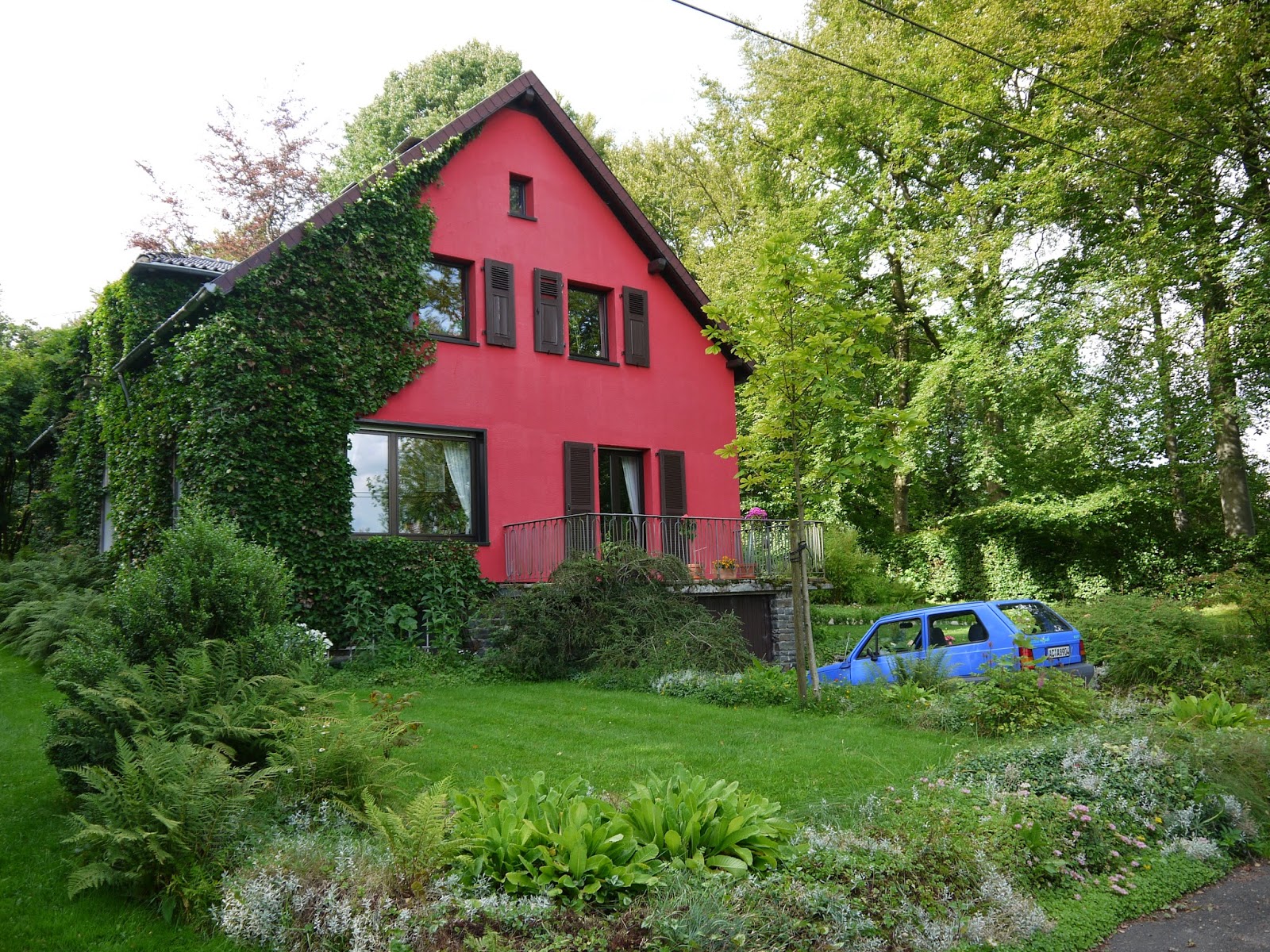 …where they don’t believe in colour coordination. |
Day 6, German to French
The next morning we were treated to another delightful breakfast, I suspected the eggs had been laid minutes before by the hens in the garden. Our plan had been to proceed with the museum steam train from Monschau to Malmédy, and the station should be nearby, but we hadn’t seen it the day before and asked Frau Brune for directions. Alas, the Vennbahn is now but a memory and has instead been turned into a bicycle path, inaugurated just a couple of weeks earlier. We’d better go downtown to the Tourist Office to find out how to get to Malmédy. So, we paid our bills, strapped on our back packs, and followed the sign pointing down along the steep Bergstraße: „Altstadt“. The residential area we were in was relatively recently-built, some house actually still being in the process of being built, but as we descended we first saw some obviously 1950s public buildings in concrete, and then! A little mediæval town, complete with fortress up on a hill. We realised that Monschau clearly was a major tourist attraction, with various events and exhibitions all summer and accordingly had a well-equipped tourist office. Indeed, no trains for us. In fact, there were no busses either to take us to Malmédy, so what we’d have to do was to return to Eupen, change to a bus to Verviers and change again to a bus to Malmédy. Disappointment, but neither of us was all that keen on walking along the bicycle path all the way to Malmédy, in particular not I, as my feet were still aching since the day before; Honeybuns thought it would be horribly boring to walk on a well-prepared asphalt road. However, we did get a map of the bicycle path, which was declared to be a part of the large Ravel network of bicycle paths. Aha, so that was what the signs we’d seen earlier meant to say!
We had a bit of time before our bus would leave, so we climbed up to the fortress and looked at the scenery in all directions. Then we had to get down again and locate the bus stop, by a more modern parking house at the border of the old town. We were soon back in Eupen, where our next bus was due to leave in a few minutes, though the bus driver first had to discuss a great many things with his colleagues before he saw fit to board the bus. The bus route followed the railroad and we were passing through the exact landscape of hills and little towns I had seen on my journeys. Looking at them closer, it seemed this was an area which had seen better times.
We arrived at the central station in Verviers and had about an hour before our connection. We decided to check out the toilet at the station. The big station was all but deserted, but we soon found the desired facilities. According to the sign on the door they were supposedly open daily, yet the door would not budge. Looking around it seemed the only place to get information was the single person sitting at a ticket window. I explained the issue in my best French, whereupon he demanded ID. I thought this a bit peculiar but handed over my card. In exchange I got the key to the loo. OK, the stratagem seemed to work, the toilet was clean and functional and I could soon return the key and get my ID card back. Planning ahead, I asked him if he had an overview of the bus routes in the area. I don’t know if I was misunderstood, or if there simply was no single map, as he disappeared into a cupboard and returned with a stack of timetables for thirty or so different busses. I packed them anyway, for later perusal.
Soon it was time to board our bus. At the last second, as the bus was already pulling out, we were joined by a young couple who were valiantly, but ultimately unsuccessfully, trying to manage two small children, one very pregnant belly, a pram, and a huge suitcase on wheels. In fact we were somewhat impressed by their ineptitude, one would think that rearing two children would have brought home that screaming one-year-olds simply do not respond well to “We’ll be there soon.”, no matter how patiently or often it is repeated. After 45 minutes or so, the mother finally hit on the idea of picking up the baby and feeding it, which worked miracles. If the trip had continued an hour or so longer they might perhaps also have figured out how to keep their suitcase from falling over in the bus aisle every time the bus turned.
In the meanwhile, as we were travelling up and down steep hills, a torrential rain had started and I hoped that the bus brakes were subject to frequent controls. On the other hand, natural selection should keep only the busses with good brakes in circulation. The rain let up just as we arrived in Malmédy and our hotel was just across the street from the bus stop. Or so we thought. It turned out that they had screwed up our booking. First they blamed us for it, but looking up their records realised it was their fault and were very confused. Nevertheless, they did not have a free room for us. Instead, they recommended another hotel across the square. They did indeed have a room for us—number 1, to be precise. It turned out to be the room on the ground floor, spatious and reasonably clean, but, at least in the current weather, rather damp and clammy. Well, beggars can’t be choosy, so we moved in.
We checked out the tourist office, just next to the bus stop. Oh, the little family was still there, the children running around playing and the parents looking a bit forlorn. The tourist office netted us a useful map for next day’s excursion and a bunch of various other tourist information. Honeybuns, who’d been exhibiting increasingly more serious withdrawal symptoms, finally got to check her email on the public PC. Then it was time for a little walk around the town, checking out the cathedral, the oldest house in town, ducks in the river, and other such to finally return to the big square for a very late lunch/early dinner at one of the eateries. As we were wolfing down our food, the rain started anew. We were sitting under large parasols, yet the rain was so intense that we were splashed with water rebounding from the ground. We moved further in under cover until the rain relented enough that we could pay and quickly return to our hotel room. And there we stayed the rest of the evening as the rain went on, so therefore no pictures from Malmédy. During the night I skooshed several insects I suspect were cockroaches.
 It looked as if the houses of Monschau had settled a bit over the centuries. |  All along our route we had seen doors with this inscription. Googling revealed that it is a Catholic benediction. |
 The railway station in Verviers has apparently seen grander days, now it was all but deserted. |  Across from the railway station was this Persian restaurant, which had me giggling until we left. I have extremely childish humour. |
Day 7, French
In the morning the rain had stopped, and though the sky looked not too promising, we decided that we should chance walking anyway. There were no good paths out of town that we were able to locate on our map, but we could take the bus to nearby Francorchamps and then walk along various paths to Spa and take the bus to Verviers from there. Along the way, I noticed with interest how the bus driver would greet acquaintances getting on the bus, and friends that happened to be around would come over and have a chat at the bus stops—clearly this was an area where most people knew each other. As I had indicated uncertainty of our target, co-passengers suggested the best place to get off in Francorchamps. There, we soon found the path, starting behind the school house, passing some farms and then entering the forest. This was an area with deep cuts with brooks at the bottom, the path serpentining up and down the steep inclines. We moved steadily upwards. Even though we were in the forest, one could clearly hear the engine roars from the F1 track, not far away. We met a gentleman out exercising his rambunctious dog and exchanged a few words. He was much impressed with our plan to walk to Spa.
We continued up the hill. Rain-swelled streams crossed the muddy path and suddenly Honeybuns slipped and fell sideways into the grass. *splunch* The grass had hidden the ditch that ran along the path and Honeybuns’ map arm disappeared in mud up to her armpit. We had to backtrack a bit to one of the streams for her to wash herself—and the map, which fortunately survived the treatment.
The path continued to criss-cross up the hill. Finally we got up to the top of the hill. Now it would be down-hill the rest of the way. But first we had to find the way. We tried to match our map to the surroundings and set out over various fields, in none of which we found the path markers we were looking for. Finally we got the idea of going around the very large and very secret military installation with the little sign that said it was not to be photographed, and there we found our path going into the thickets. We walked through the forest for a while and eventually we emerged by Spa aerodrome. I was more than happy to have some rest and refreshments in the air field restaurant and snapped some pictures of the Mirage V and Thunderflash gate guardians. Groups of parachutists were being taken up in a Cessna Grand Caravan with the congenial registration OO-SPA, and I followed it with my gaze as we returned into the forest, starting along a long and straight road. I knew there was an RAF memorial further into the forest, but my feet felt like they should get themselves to Spa as soon as possible, so I did not propose a detour to go look at the memorial. Eventually we found the path that would take us to Spa. A little brook ran by the side of the path. As we continued downwards the brook grew larger and eventually it was no longer the brook that followed the path, but the path wound by the stream. At one point the bridge across the stream had been swept away (and presumably also carefully cleaned away, as no debris apart from the concrete supports was to be seen) and we had to negotiate a ford. Eventually the slope flattened out and we found ourselves skirting a suburban area. We checked our map and were soon in the city centre. Finding the bus stop was a bit of an effort, as various repairs were underway and the locals were not quite clear over where the busses had been redirected, but eventually we located it just outside the Spa Casino.
The bus ride back to Verviers was uneventful. As we’d noticed previously, Verviers seemed a bit the worse for wear and the walk to our hotel went through a rather decrepit area, but the hotel itself turned out to be a huge former railway magazine that had been fairly recently turned into a hotel and looked very spic and span. We presented outselves at the reception with our reservation. The receptionist did the usual fiddling at her computer and then informed us that they regrettably had only a single room left: a business suite, could we manage with that? Considering our reservation guaranteed us a fixed price, we certainly could! The suite turned out to be quite roomy, with separate lavatory and bathroom, the latter equipped with both a tub and a shower; thick bathrobes and slippers lay wrapped on the bed, and there was a well-stocked minibar, which Honeybuns to her chagrin only afterwards realised was free.
I made a beeline for the shower where I quickly realised that design purity had trumped common sense—there was no door, drape or anything, which meant that quite a bit of water splashed out on the bathroom floor, which in turn completely lacked a drain, so when I had finished showering there was a sizable puddle by the sink, which later required a bit of dexterity during teeth-brushing preparations, but before that we had an excellent dinner in the hotel restaurant followed by trying out the jacuzzi.
 We found a dead mole on the path. |  Completely unexpectedly, a fire hydrant in the forest. |
 Downstream. |

Day 8, French
The next morning we checked out in good spirits and started by getting directions to the local tourist office in order to plan the path for the day. Here we finally found the volume that we should have had all along, the book of all walking and bicycle paths in France and Belgium. Finally we got the explanation for the red-white markers we’d seen throughout our journey: they indicate the nation-wide rambling network. With the kind help of the staff we worked out that the best way to proceed to Liège/Luik/Lüttich was to take the bus to Pepinster and get on the foot path there. We got copies of the relevant pages in the thick rambling book.
Now, we had finally gotten to the part of our excursion that I originally had seen from the train window, hilly country with the occasional farm yards and a little châlet. We walked along our old friend the Vesdre, deep down in the valley. After a while we realised that there were quite a few tributary brooks to the river, which meant a large number of ravines crossing our path, necessitating quite a bit of zig-zagging to locate suitable fording places and then get back on the path along the river valley. At one point as we were crossing a little stream I pushed aside what I took to be a hazel, but on touch realised was a huge nettle. I bent to soothe my hand in the cool stream and BRATSH, the entire crotch seam of my trousers split. That is the problem with favorite clothes, they get used up much faster than the others. A quick change of clothes was executed.
The terrain got ever steeper, and at times the colour bars that identified the path were painted directly on the rock, rather than on the trees next to the path. I was flagging, even though when I heard a Belgian Air Force F-16 above the leaf canopy, I quickly scrabbled up the hill to get a glimpse of it.
Finally, I gave up the struggle by the railway station in Fraipont, when my feet just couldn’t take it anymore. Honeybuns was annoyed, as she’d been happy to continue far longer. The train, when it arrived, took us to Liège in just a couple of minutes. From there we continued on to Bruxelles/Brussel/Brüssel. It was strange to see how the hilly landscapes we had been walking through the last week suddenly became flat as a table as soon as we were west of Liège. As we rode through the pancake (now without getting lost) I noted how the electronic signs on the train automatically switched language as we alternately passed through Dutch- and French-speaking regions.
We arrived at Bruxelles Nord/Brussel Noord, which, as I’ve noted before, lies just next to a red-light district, which we had to pass through to get to our hotel. Honeybuns was not well pleased, especially as we had to take a couple of rounds around the block before we found the hotel. It was definitely the seediest we’d been on this trip, but at least the room showed no evidence of larger arthropod life. We apparently shared the hotel with an Eastern European wrestling team, that turned up in the lobby with big trunks and arms, legs, and necks also like tree trunks. We went out to find somewhere to have dinner and ended up in a little bar. Honeybuns looked suspiciously around the surroundings, but it turned out to be a quite decent place and the meal perfectly good. (You can get bad food in Belgium, but usually you have to make an effort.)
Day 9, French
The next day was set aside for sight-seeing in Brussels. Our hotel was near the Botanical Gardens, so we went there and looked at the tortoises. Then we travelled out to the World Fair area, as neither of us had been to Atomium. It turned out to require quite a bit of queueing, but eventually we got up into the first atom, which contained a very nice exhibition on the World Fair itself and the construction of Atomium. We continued through the other atoms that were open (not all were, I don’t know what the closed-off ones contain, possibly conference facilities. One of the atoms had teaching facilities for children as well as sleeping pods so that they could stay the night, which I thought must be a perfectly exciting excursion. The other major exhibition was one on water and its importance for the environment, but while professionally produced, it was so bland it aroused no particular excitement on our part. Finally we decided it was time for lunch and where better to have it than in the restaurant at the top? However, you can’t get from here to there–we had to descend to the ground floor and then stand in another queue to get up to the restaurant.
The restaurant had carefully retained their original modernistic furniture and, of course, had a fantastic view over Brussels. The food turned out to be excellent, quite surprisingly for such an obvious tourist trap location. (Kaknästornet, are you listening?) Well-sated, we rode the lift down and picked up a few postcards in the exit shop. Honeybuns looked longingly at candy and pastries, but forewent them for the moment.
From the restaurant we had seen something that looked like a huge model landscape just next to Atomium, so we decided to go there and see what it was. It was Mini-Europe, displaying 1:25 scale models of characteristic buldings from each of the EU member countries. We got a slightly bad taste in our mouths—the outspoken intention was to build EU patriotism, supported by multi-lingual placards extolling all the specifically European virtues, jarringly managing to praise both Christianity and secularity. The models themselves were of quite varying quality: Grand’place/Grote Markt in Brussels was a super-detailed masterpiece, whereas Dover Castle just looked like a plastic toy from Britains. Sweden was represented by a so-so model of Stockholm City Hall, just next to a model of Olavinlinna that represented Finland. One wonders how the subjects had been chosen.
We left by tram and ended up near the city centre where we found a large comic book store that we browsed for a while. There’s still a genre of aviation comics, but I felt that they all suffer from lifelessness and stiff mannerisms. While they never drew aviation comics as such, I’ve always felt that Franquin and Janry are among the comics artists who best understood how to draw aircraft, not least how to draw aircraft caricatures.
A short walk later we were at Grand’Place, where we found more comic-themed shops that we looked through. Now Honeybuns felt the pressure to purchase presents for friends and relatives and raided several of the chocolate purveyors around the square for their best delicacies. Laden with sweets bags we made the short train ride to Bruxelles Midi/Brussel Zuid from where our train homewards would leave. Honeybuns got another lack-of-presents-anxiety attack and spent our last Euros in yet another chocolate store at the station.
Then we got on our train for Cologne, where we had a short stop until we got on the night train for Copenhagen.
 Those buildings don’t look small just because we’re high up. |  The representation of Luxembourg: a traffic jam. |
 Grand’Place in 1:25 |  1:1 |
Day 9, Danish
We arrived in Copenhagen in the late afternoon and got on the train to Stockholm without further events and then finally returned home.
Subscribe to:
Posts (Atom)

