2010-05-13

Sea, sun, sand

Bounce out of bed, time to get to Biscarosse for the 13e rassemblement d’hydravions de Biscarosse, this year featuring the centenary of the world’s first seaplane flight, performed by a Frenchman, no less. It is a four-day event, but due to earlier-mentioned time constraints we could only attend the first day (fittingly and not coincidentally Ascension Day).

Now, in spite of claims to the contrary, we found that there is no bus from Arcachon to Biscarosse, so we would have to take a taxi. The receptionist at the hotel kindly offered to take us in her own car if we could wait until she got off her shift later in the day, but we (I) were anxious to get there early so as not to miss anything, so off we went.

On the way I glimpsed something through the woods that looked like an airfield. I later had it confirmed that this was Base Aérienne 120 at Cazaux, a military airfield founded in 1914.

Presently we arrived in Biscarosse, « Capitale de l’Hydraviation ». The town was clearly proud of its aviation heritage and had streets and places named for French aviation heroes. The taxi dropped us off just outside the main gates to the airshow area. It was windy, overcast and not very warm, but what the heck, tickets for two and then in. Past a group of market stands with various parafernalia we found a gaggle of ultralight seaplanes with larger seaplanes beyond.

While we were among the early arrivals the PA system was already running full tilt blasting 80:s hits interfoliated by information about the day’s activities and exhortations to sign up for « baptêmes de l’air ». Indeed the biggest planes soon powered up, rolled down the ramp into the water (me staring and eventually figuring out how the landing gear retracted into the floats) and started boarding people. The ultralights also started into the water and then up into the air.

However, the really big aircraft, the Catalina and the Do 24 hadn’t turned up yet (and the latter never did while we were there), so we strolled around and looked at the things on the ground. Off to a side was a very sandy beach with a Bell 47G that also took people up for their air baptisms. There were plenty of market stands, some purely commercial, others promoting various aviation organisations and charities and, of course offering things to buy in order to support said organisations. We found some very earnest but disappointing graphic history books (as generalised from graphic novels) on the origins of manned flight. I suspect the stilted look comes from basing the drawings on photographs while not having a good internal feeling for the subject.

Letters and photographs
A collection dedicated to Henri Guillaumet.
There was an exhibition hall displaying (award-winning) philatelistic collections on the theme of aviation heroes. The hall was also covered with children’s drawings of seaplanes; children had also—with great creativity and innovative use of materials (grass, rubber, tin foil, etc)—created three-dimensional representations of seaplanes, that now hung from poles outside the hall. It seems that Biscarosse celebrates its heritage not only in street names, but also in the education of the local children.

Airbus simulator
The label on the side seems to say A-370, which type does not actually exist; on the other hand, at least eight different Airbusses have used the serial F-WWAS.
We found an Airbus simulator in one building, but did not try it.

We dove into our lunch, while being force-fed 80s disco. (Well, to be perfectly honest I tend to have a soft spot for it and am not all that tired of even Rick Astley, but Honeybuns made grimaces at the music.)

Now was the time to visit the seaplane museum, just a short walk up the beach. I was overjoyed to find right in the front of the museum not one but two replicas of Fabre’s « Hydravion », it being the reason for the celebration.

FlyersteamFabre 2010
Flyersteam, a replica in period materials.Fabre 2010, a replica in modern materials.


I clambered around the aircraft, which were absolutely brilliant examples of how early aircraft were operated. In particular I finally got to see gauchissement, wing warping, in action. I had assumed that a set of wires would pull at the trailing edge of the wing, but as you can see demonstrated by my beautiful assistant the control wires pull at the post through the (evidently quite elastic) wing spar and disconcertingly twist the entire wing (note also that on this aircraft it is the pedals that are used for banking, rather than the stick as became a universal standard at about this time):


(And here is a demonstration of the rudder and elevator control, much more direct.)

I would not have been quite as cavalier about testing the flight controls and pulling on the wires if I’d realised that the replicas were not just static models, but were intended to be flight tested on the Sunday, as a suitable climax to the meeting. But, I watched the planes being carefully tested and adjusted just after I’d left them, so I’m sure this was not my fault:

Fabre 2010 crashing

Another thing I only realised when I’d gotten back to my computer was that both the replicas were based on the form of the Hydravion as shown by the model at the museum:

Model of Fabre's Hydravion

Compare with this picture, presumed from that first flight on 1910-03-28. You see that the rudders are located below the wings and elevator control is performed with a single tiller.

First flight of Fabre Hydravion

Kenneth Munson notes in Flying Boats and Seaplanes since 1910 that Fabre modified the aircraft, eventually moving the rudders “to their final position in the warp-wire struts beneath the main wings”, which is where we see them in the photograph above. This would imply that the replicas are in the original configuration, and the photographs I have are in fact all from the flights made in Monaco in 1911, in spite of the captions at the Monash web site that show an identical aircraft at what is said to be both the flights made at La Mède and Monaco a year later. What a surprise that an Internet source would turn out to be unreliable…

(One could also suggest that perhaps the replica-builders should have gone for the final and presumably more effective configuration. Not that it didn’t eventually crash too…)

Anyway, after having played with the replicas we entered the museum. It was quite pleasant and there was a lot to look at, but I noted that one really had to know what one was looking at to make sense of the exhibits which were for the most part very sketchily labelled. As we were exiting the museum I saw the stand with the sign “Please return your guidebook here.” D’oh! (They could have just handed us a guidebook when they were checking our tickets, one thinks.)

Latécoère 631 model
Latécoère 631, one of the most elegant flying boats imaginable.


A bit snobbishly I noted that “museum quality model” apparently does not necessarily mean a lot in terms of finish and detailing. Still, there was plenty to look at and be inspired by. I was a bit disappointed that the museum shop was so lacking in seaplane models—just a couple of boxes with the Heller Canadair CL-215, which is nice enough, but there are so many others.

A completely new exhibition of full-scale seaplanes (together with scores more of child-produced models) was housed in a glass-walled hangar across the yard.

Donnet-Lévêque
A Donnet-Lévêque, the world’s first flying boat. The flying suit is authentic and documented in contemporary photographs.


Eventually we returned to the flight area and decided to have a cuppa in one of the food stands. Honeybuns’s cocoa sent her off on a high such as only French chocolate can do, for the rest of the day. (Forget about Belgian or Swiss chocolate, France is where it’s at.) We noted that the disco seemed to have let off and as we were in lee and there was momentarily a bit of sun, we just sat there and felt good. Then, the Breitling Wingwalkers buzzed in and did a programme. I realised we had seen the wingwalkers on the ground earlier in their black and orange uniforms. Well, I had. Those were quite tight-fitting black and orange uniforms. And wingwalking requires you to be very fit. And there were two of them. Hm, moving right long: We thought it was a bit lazy of the speaker not to have any comments on the proceedings, but it was a good show. As they left, we thought about leaving too and got up. When we moved we got in range of the PA system again and realised that the speaker had been relentlessly going on all the time and he was now explaining the rest of the programme for the day. There was actually going to be an entire hour of antics (and antiques) in the air (but which my dinky camera can’t do justice to, so you will just have to imagine it). The Catalina that had flown in during the day took off for several circuits, with floats up and down, lights on etc. I realised that the Catalina was equipped with the same Pratt & Whitney Twin Wasp engines as the C-47, so being a very familiar sound. And indeed, as soon as the Catalina had landed we were visited by a C-47 with a most interesting scheme with invasion stripes over natural metal.

This was followed by La Patrouille REVA, flying three Rutan VariEzes. I’d never seen a VariEze do aerobatics before, but I wasn’t surprised to find that they did it very, very well.
The following performances by an Extra 300 and a Sukhoi Su-31 tearing around the air, hanging off their mighty engines, was impressive, but not as elegant in my opinion.

For the aviators, there would be dinner and dance later on, but we decided to call it a day. I bought a Fouga Magister T-shirt and noted that the Swedish presence clearly was much appreciated:

Cessna 208 SE-KTH in full scaleCessna 208 SE-KTH as a modelCessna 208 SE-KTH as a post card


Our kindly receptionist had supplied us with telephone numbers to local taxi companies and soon a very friendly taxi driver picked us up and drove us back, this time along the scenic route, which turned out to be just as fast as the motorway we’d arrived by, but indeed was considerably more scenic, in particular when we passed La Dune du Pyla, a huge sand dune by the beach.

I even managed quite a bit of conversation with the driver. Oui, on parle français ici !

2010-05-12

Cross-country

Wake-up early in the morning, groggy breakfast, pack the bags. Bundle in the car for the ride to Aix. Train is late, but we have plenty of time. It’s just a twelve-minute ride to Marseille St Charles, but well there it turns out our connection is cancelled. What now?

Crowd rushing to get on replacement train to MontpellierQueue to the information desk. The clerk behind has a little English flag on her name badge, but speaks English with noticeable hesitation. A freight-train has derailed, so there are traffic disturbances in the entire region. However, a specially-chartered TGV train will take us to Montpellier from where we can continue with the Téoz train originally intended to Bordeaux. Just get on board, sit wherever you can, the train will depart soon! Except, it doesn’t. The train, and we, sit there for an hour while we wait for a conductor. Or possibly lemon-scented paper napkins, for certainly nobody comes to check our tickets when we finally leave for Montpellier.

People getting off Téoz train in BordeauxThe TGV does it best to make up for lost time, but we’re still late to Montpellier. The Téoz train stands on the next track, waiting for us. This turns out to be the weirdest train we’ve been on so far. Let us say the people on board don’t quite live up to the stylish design of the cars. There is no bistro car, but two cheerful guys, cracking jokes in a thick southern French accent I can’t follow, stand in a left-over luggage space making coffee with a little domestic water boiler, trying to pour it in the swaying and juddering train without sloshing more than half of it on the floor. They also have sandwiches in cool-boxes. The conductors clearly think it unnecessary to check tickets, but prefer to chill out in their little compartment. Somebody standing between the cars is very upset and yells loudly, whether at somebody physically present or on the phone is impossible to tell. Even a beggar turns up, handing out those little cards.

Regional train in BordeauxEven though we are late into Bordeaux St Jean the regional trains to Arcachon run often and we don’t have to wait for long, and we arrive an hour later.

We find our hotel quite easily and then go out to find some food. A Monoprix is still open and we gather supplies.

The microwave in our room prepares us our simple dinner and then we call it a day.

2010-05-11

A day without train

A square in RiansIn the morning Honeybuns and I were slow to awake, but eventually got up and had breakfast and then went for a stroll, guided by Johan. I often am surprised by places that turn out to look exactly like they do on TV. This little French village looked like exactly like a little French village. I half expected a cheerful crowd to come around the corner, waving bottles of Pommac.

Église de St LaurentThe church had seemingly a large number of secondary shrines along the walls in proportion to the length of the walls. There seemed to be a large number of slogans about the importance of religion—I wondered whether they always used to be there or if the Catholic church felt the need to rally under the onslaught of modern times and embarrassments.

We did a bit of shopping and I had spun up my French enough (it always takes me a couple of days) to use it on the shopkeepers and noted we really were far in the countryside, usually the French quickly change to English when they hear me mangling their language, but here they apparently Don’t Do English.

Saint-Martin-de-PallièresAfter lunch we decided to go further afield and visit some other villages even further up in the mountains and first went to Saint-Martin-de-Pallières which had an even smaller population, even more slanting streets, quainter houses and a big fortress on top. And a church of course. Tourist information signs told us that after the Revolution, authorities had attempted to rename the town to something less Christian, but this had not stuck. What still was left, was the public belltower, erected to provide a secular counterpoint to the church bell.

Poppies in Bois de Mont MajorWe drove away through the Bois de Mont Major, a landscape which reminded me much of Kinnekulle. In the middle of the forest we found a field of poppies and had to stop to listen to the silence.

GinasservisThen we continued until we got to Ginasservis, a somewhat larger village with an even more typical French square. We stopped for something to drink and relaxed in the shadow of the planes.

An open-air laundromatEventually we returned home, where we decided we needed some additional ingredients for dinner and went to the local supermarket. I was quite fascinated by the outdoor laundromat by the supermarket.

Then, time to prepare food. We would make ratatouille as we by chance had found a recipe in last Sunday’s Dagens Nyheter that I’d brought along for reading when we left, this for a grill-prepared ratatouille that actually looked just like the one in the film.

IngredientsFinished course


We had our dinner on the terrace behind the house and watched the sun set over the lavender fields.

2010-05-10

Snubbed and welcomed

I seldom sleep well on trains (on the occasions I have it usually has turned out that due to a derailed train ahead we’ve been standing still in the middle of nowhere for several hours) so was up well before the waking-up signal the next morning, but showers do wonders even in the most dire circumstances. The DB breakfast pack was not cœliac-adapted, but at least I got a hot cuppa, which I greedily drank (let’s face it, the quality of tea was not encouraging thoughtful sipping) while watching Lorraine/Lothringen roll by outside. Just inside the border is a town with the quite Teutonic name Forbach which is dominated by the Schlossberg, on top of which was a turret proudly flying the French flag. Thanks to the EU, no longer was anyone interested in checking our passports at any border crossing.

TGV at Metz VilleWe arrived in Metz at 06:15 and had half an hour to wait for the next train in the very impressively sculpted station. At 06:50 our TGV pulled away at high speed towards Paris. Laptop users on TGV get one dedicated seat with a power outlet situated next to the lavatory. We hove into Gare de l'Est at 08:19 and then descended into the Métro to get to Gare de Lyon via Bastille. (You all know of the English king who spent so much time on crusades in the Mediterranean he was known as Richard Gare de Lyon?)
Métro at Gare de l'EstMétro at Bastille


TGV at Gare de LyonAt Gare de Lyon we tried to procure breakfast, but here, too, breakfast was all bread-based. A packet of crisps had to substitute. At 09:46 our next duplex TGV left the station. As we travelled southwards the flat landscape began to undulate, steadily gaining in amplitude until becoming proper mountains in Provence.

We arrived in Montélimar at 12:35 in pleasant sunshine. The plan was to visit Le palais de bonbons et du nougat.

Our first disappointment was that there was no luggage deposit at the station, so we would have to tug our bags along. The second was that there was no tourist information either, so we couldn’t find out how to get to the candy palace. (Note to self, always save the Google road map before leaving on travels.) But of course, we could just take a taxi. Of course, the taxi stand was empty. After a while a taxi turned up and dropped someone off at the station, so I politely inquired whether the taxi was available. Without actually answering this the driver firmly requested us to go the taxi stand. Then he drove away, never to return, still pointing us at the taxi stand. Neither did any of his colleagues seem to appreciate the vicinity of the railway station, as no taxis could be seen anywhere. After a bit of indecisive milling about we got the bright idea of going to the nearest hotel and ask for advice.
The receptionist explained that the museum actually was just ten minutes walk down the road. Excellent!

In fact it took closer to an hour. We had already given up and intended to ask for directions back to the town centre when we realised the building in front of us was the sought-after museum. The receptionist there was friendly greetings personified, took care of our bags and gave us each a fistfull of candy along with our tickets. And, the premises were air-conditioned, which by that time was a major blessing.

The museum was an interesting experience. As befits the international museum of sugar refineries we were introduced not only to the history of sugar ever since the Egyptians but also were cheerfully told of the vital function of sugar in our bodies, not only is sugar good, but it actually keeps you alive! There was some quite impressive sugar art as well as a wall of (French) nostalgia in the form of a history of candy brands and their advertising. I was quite surprised that many well-known brands are a hundred years old or more. Possibly the pièce de résistance was The World’s Largest Piece of Nougat, a block well over a cubic metre, weighing about 1300 kg. We thought it was a horrid waste of good candy.

The adjacent nougat factory seemed half-empty, possibly because we had arrived just during lunch. The candy store was on the other hand quite full of candy. Behind it was a little toy museum. I was quite taken by the (copy of) a 3500 year old Minoan toy horse with wheels so that it could be pulled along behind you. There would have been a little toddler long ago, trying to both walk forward and watch the little horse behind to make sure it came along. Oops! There he fell over!

We decided it was time to get back into town and get something to eat, so we returned to the entrance and asked the receptionist how to best get back. “Oh! You go out there and then turn left after the military surplus store and follow the little path to the other side and there is a bus stop there.” Honeybuns thought this sounded very dubious, but I am a trusting soul and led the way up the little path and shortly we did arrive at a bus stop and shortly thereafter the bus arrived too and took us straight back to the railway station.

Now, to get some food. By the park there was any number of eateries, so let’s just pick one that has good vegetarian options. We plopped down by a table and ordered food. Sorry, only bar, no food until 19h. Oh? We looked around and realised that none of the people sitting at the tables were actually eating anything, but were drinking beers and similar stuff. Bah! Let’s find a food store then. We walked on through the shopping district, lugging our bags. Eventually we did find a food store—which was closed on Mondays. In desperation we turned back towards to railway station when we happened upon Star Kebab which was open and did serve food and did serve a large selection of good and plentiful food. Forks up!

Local train in MontélimarHappily refreshed we walked back to the station, where eventually we could catch the 17:45 to Avignon. Seemingly a simple local train, but a double-decker and with power outlets by all seats. I divided my time between letter-writing and watching the mountains grow ever craggier and the Rhône flowing by.

Mountains across the RhôneWe were in Avignon an hour later. An historical town, but we barely had time to buy and write a couple of postcards and then catch the shuttle bus to the TGV station. (Our Interrail cards were not valid on the bus.)

Avignon Gare TGVWe left the futuristic TGV station in Avignon at 19:59 and arrived in Aix-en-Provence just 20 minutes later where we were met by our friend Johan. We bundled into his car and drove through the Provence countryside to Rians, where he lives in a several-hundred-years-old house utterly bereft of straight lines, right angles and equal distances. After a light supper we fell asleep in this strange house in a strange country under a warm IKEA blanket.

2010-05-09

And now for something completely similar

To get you in the mood for the next few posts, here is some Monty Python:


Honeybuns and I had been invited to see a friend in France and eventually managed to pull it off, subject to the constraints of our respective work schedules, the cat minder, our host, the things we wanted to see, the railway timetables and that we had to make our bookings rather late in the game.

X2000 at København HSo, at 08:21 we were on the X2000 towards Copenhagen. Electricity and Wifi onboard.
København H was as usual freezing cold and we had the usual two-hour stop-over due to the defensive SJ ticket policy. We had some Levantine junkfood at Shawarma House (not bad as such) and loafed around, waiting for our InterCity Express connection to Hamburg.

ICE in CopenhagenThe train left on time at 15:45, but had no power outlets. It had a bistro that was able to procure good and plentiful (pre-packaged) salads, though. We also got a ride from Rødby to Puttgarden on M/F Deutschland. The chilly weather was not very conducive for staying out on deck, though.

Intercity in HamburgWe only had a 10-minute layover in Hamburg—a length of time I prefer, at least when the trains are on time. Our change was to an InterCity train of older style. It had power outlets at certain seats only, not ours. The seats themselves made their springs distinctly felt in our backsides, and the car felt distinctly dusty. Fortunately this would be a fairly short hop, 20:28–21:59. I noticed with some interest that on the track next over was a City Night Line train, stopping at Hannover, certainly that wouldn’t be the train we were supposed to get on, or if so, why couldn’t we get on it already here? We read our books and rode through the darkening evening. Even though the train was fairly long, there were only a few passengers along, but maybe the cars needed to be transported somewhere anyway.

In Hannover we again found the same CNL train on the track next to ours, and indeed it was the train we were to continue to France in. But! the car we were supposed to be in wasn’t there! However, on the next track over we could see sleeper cars that were marked as stopping in Metz. What now? Soon a shunting engine turned up, pulled away the cars and eventually returned to attach them to the waiting rest of the train and we could board our car and clamber into our berths as the train pulled away towards France at 22:16.

2010-05-04

Confused laughter

My old friend Erik sent me this link and I had to read it several times.

Yes, it is a real Microsoft page. Yes, they carefully explain how to become competent in using humour. With a development plan. And testable proficiency levels from “Basic” to “Expert”. With a reading list. And without the slightest attempt at levity.

So do the authors lack humour from the outset, or did a committee carefully go through the text, removing any “untimely or inappropriate humor”? Or is this an elaborately set-up meta-joke, poking extremely satirical fun at the perceived lack of humour of Microsoft? My head spins, I feel like laughing, but don’t know if I dare to.

2010-04-30

Veckans ord: stolslagen

Att segla på S/S Karaboudjan kan visa sig vara en stolslagen upplevelse.

Styrman Allan spöar besättningen

2010-04-28

Sproing!

We’re past the vernal equinox and the pet plants are racing towards the sunlight.

Hippeastrum in bloom

Growing garlic

Venus flytrap seeking the sun

2010-04-16

Ukuleles

The Ukulele Orchestra of Great Britain are currently on tour in Sweden and I took the Posse to their concert at Scalateatern, which was a great hit. Early in the first set they played their version of “Life on Mars”, which I’ve always been fond of. Later on Hester Goodman sang “Shiver me timbers” most beautifully. I frequently wished I'd been able to pause, rewind, and single-step the performance to see how on Earth they managed to get all those sounds out of their instruments.

The audience managed to wring two extra numbers out of the Orchestra and then they graciously signed CDs and DVDs in the foyer. I suggested they should cover Albatross, which they apparently had been thinking about as well. Remember, you heard it here first.

On the way home I mused that just as you have sing-alongs on concerts, you should be able to do play-alongs, but of course, they have already done exactly that:

Veckans ord: rafsset

Min normala klädsel är rafsset – det jag rafsar ihop ur klädlådan.

2010-04-15

Taram, taram, taram…

Back when I was an undergrad, the Maths department’s interface with the students was a little man universally known as “The Lightning”. (The Only-Begotten Children’s Mother reported how shocked she was when she many years later found out he actually had a perfectly normal name as well.) The reason for this sobriquet was soon made amply clear. Picture a queue of perhaps 300 students snaking down the stairwell outside the student office of the Maths dept, all out to buy the necessary textbook for the Analysis course starting that day. Eventually you get to the front desk and The Lightning curiously asks what you want. You declare that you wish to buy Funktioner av en variabel, textbook and exercises. “Oh!” quethes The Lightning and shuffles off to the book shelf at the back of the room, picks up the two books, returns to the desk, takes your money, counts out change and carefully makes an annotation in his cash ledger that he has sold Funktioner av en variabel, copies: 1, and exercises, copies: 1, @ 180 SEK. Then he raises his head, looks at the next person in the queue and inquires what he might be there for. Repeat for all students, repeat for all courses.

The Lightning eventually shuffled off this mortal coil, but I must now have run into his nephew: Honeybuns and I are preparing for a train trip again, and with the help of Die Bahn I had prepared an itinerary with all stops and connections and just needed to make the bookings. Unfortunately international travel cannot be booked on the Web, and I’ve found it impractical to do over the phone, so down I went to the Central Station to handle it in person. When I got to the ticket counter, I laid out my papers and explained the route. The gentleman behind the desk then had to look up each leg and make seat reservations and it went something like this:
Me: “…and from there we continue to Avignon, with the 18:14 connection…”
“Which day was this?”
“The same day.”
Clicks and then searches the keyboard.
Me, being helpful: “That’s A V I G N O&hellip”
“Wait, wait. A?”
Me, timing the letters with his hesitant single-finger typing: “A…V…I…G…N…O…N…”
“And this was when?”
“18:14…”
“Right, there it is. OK, wait a bit.” He clicks and then pads off to the other side of the office to the printer, retrieves a paper and puts it on the counter. “OK, now I have the train number, I’ll see if I can make a reservation…” More hunting and pecking. “Yes! It went OK.”
“Right. In Avignon we change to the 19:59 service to Aix-en-Provence…”
“Wait, wait.” Refocusses on the screen. “Which day was this?”
“Still the same day…”
“The tenth?”
“The tenth.”
“And where to?”
“Aix-en-Provence, that’s A…I…X&hellip” Etc, etc, with an unhurried excursion to the printer for each step of the way.
An hour and a half later I finally had the thick sheaf of tickets and had also missed the modelling meeting I had planned to attend. I don’t think it should be necessary for RyanAir to go into train travel to make it more efficient than that.

2010-04-09

Word of the week: awaylable

Thanks to my mobile phone clients can reach me even if I’m not in the office, I’m awaylable.

2010-04-05

I thought this just happened in comics…


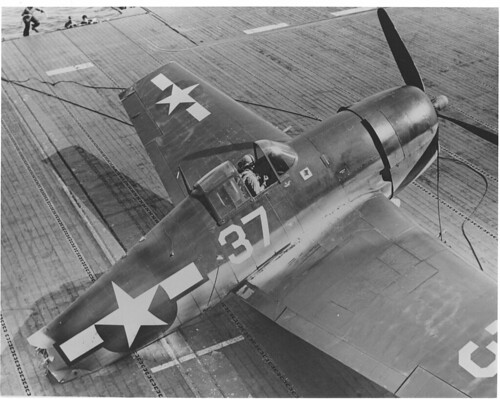
These are two different Hellcats, so clearly getting one’s tail torn off happened on more than one occasion. At least in the second case, things seem to have worked out all right.

2010-04-04

More war

Martin R, ever supplying me with MÖP material, a while back forwarded me a then new book from Gyldendal: Danskere i krig 1936–48 (Danes at war 1936–48), edited by Rasmus Mariager.

Finland and Norway have never doubted they did the right things during the Second World War, they fought against overwhelming force and acquitted themselves well under the circumstances. That Finland fought alongside with Nazi Germany is considered OK, since it was against bolsheviks. Sweden and Denmark have a more troubled relation to their history, was their collaboration with Nazi Germany necessary for survival or was it due to national spinelessness?

This book studies how Denmark was affected by the conflicts around the time of the Second World War through the examples of a few Danes who took part in these conflicts.

The first chapter is about Leo Kari, a volunteer on the Republican side in the Spanish Civil War. Now, Morten Heiberg’s text actually does not say very much about Kari, but rather discusses the political situation in Europe around the time of the war. Much of it was new to me, apparently sources unavailable during the Franco period are only now being explored, even if few eyewitnesses are left anymore.
The Spanish Civil War was a time of intense political manœuvring and positioning, with allegiances shifting over time. For example, at the time Germany and Italy were not yet formal allies, but rather rivals, so that Germany saw it fit to sell arms to the Republican side, partially in order to bring in some cash, but also so that the more numerous Italian forces on the Nationalist side would be, eh, culled. The side-effect that German participants might end up being shot with German weapons was an acceptable price. Since the Western Powers did not allow arms trade with Spain, all weapons had to be smuggled into the country, preferrably with the help of Greek merchants and ships. My reflection is that the enormous economic upswing this caused in Greece may have been an additional reason for the now-allied Germany and Italy to invade Greece some years later. The Spanish government’s arms purchases completely spent the Spanish gold reserve, which had been the fourth largest in the world.

The next chapter tells the story of Hans Fenger. When Finland was attacked by the Soviet Union in 1939 this caused dismay all over Europe and with surprising speed various help actions were organised. In Denmark many wanted to volunteer to fight on the Finnish side, but the Danish government decided this would be a breach of Danish neutrality and forbade its citizens to take part. Many managed to travel to Finland anyway, among these Fenger, even though he was an officer on active duty and thus formally guilty of desertion. Fenger travelled through Sweden to northern Finland where the various volunteers were organised and got initial training. In particular he had to learn to ski. Eventually he managed to get to the front where he got killed in his unit’s first skirmish. His body was brought home to Denmark and given a hero’s funeral. When the other Danish volunteers returned to Denmark everybody agreed to at most slap their wrists for their desertions, as they had after all defended the Danish national honour. Interestingly enough the authors Ahtola Nielsen and Kirkebæk seem to imply that Finland probably would have been better off acquiescing to the original demands by the Soviet Union than going to war to defend its territory, even though one would think that the fresh experiences at the time would have suggested this was not a sustainable strategy.

Mere weeks after the end of the Winter War, Denmark was invaded by Germany. Resistance being considered futile, Denmark capitulated with nary a shot. The Danish government then for several years continued a policy of not rocking the boat and trying to getting along with the occupational forces. This was by many felt to be humiliating and a blot on the Danish escutcheon. Paradoxically, this led to many enrolling in the German armed forces, to show that Danes could fight. In line with the policy of not giving the Germans any excuses for being dissatisfied with Denmark, Danish citizens, including military on active duty, were freely allowed to join German forces. The about 6000 Danes that did, did so for many reasons, not least of which was that signing up promised food for the day. Many professional soldiers joined up to get a chance to practice their métier and then there was a large contingent who politically aligned with Nazism, among those the subject of the next chapter: Per Sørensen. He was a Danish officer who joined the Waffen-SS and made a spectacular career before getting killed defending Berlin a few weeks before the end of the war. The authors Bundgård Christensen, Bo Paulsen and Scharff Smith point out that since all SS units committed war crimes, there is no reason to assume Danish SS members did not also do so, even though little documentary material on the Danish units exists. After the war, all Danes who enrolled in the German forces were retroactively declared criminal and in many cases sent to prison for longer or shorter periods.

A number of Danes, mostly those who were abroad at the time of the German invasion, but also a few who managed to escape from Denmark, joined Allied forces. Werner Michael Iversen was a Danish ex-soldier and merchant who acutely felt the necessity for Danes to join the fight and eventually liberate Denmark and thus worked hard at forming a Danish recruitment office in London and build up a Danish unit within the British Army. This was not entirely uncontroversial among exiled Danes in Britain, many who felt they should not get involved, not least to protect family members still in Denmark. Others agreed they should join up and many of these passed through Iversen’s recruitment office. The most promising ones were silently passed on to SOE to become secret agents in occupied Europe. Eventually though, not least due to Iversen’s abrasive and self-important personality, he was taken out of the loop and the recruitment office closed somewhat later.

After the war ended in Europe, grateful Danish volunteers offered to enlist in the British Army, at first to join the war in the Pacific, but after Japan’s capitulation wherever else His Majesty’s Government saw fit to use them. Britain hardly could refuse this gesture and out of about 11000 volunteers, 2500 were selected to serve in the British Army, most in various parts of Asia. Per Christensen was one of these. He ended up mostly serving on guard duty in the Far East, but other Danish units were used for policing in Palestine and India, both subject to civil unrest at the time. The Danish volunteers came home in 1948, when most had already forgotten about them in Denmark.

The final chapter by Ib Faurby puts all of this in context and how the foreign and defence policy of Denmark had been formed by its relations with Germany ever since the Napoleonic wars, Schleswig-Holstein being conquered and reconquered, but history eventually making Germany a Great Power and Denmark a small country that needed to keep good relations with its southern neighbour (Sweden by this time having dropped its traditional enmity with Denmark). Still, Danish volunteers have taken part in various wars and conflicts all through the 20th Century, shifting alliances causing the volunteers to sometimes fight alongside each other and later against each other.

So, what was my impression of the book? Well, it seems a slightly haphazard collection of various essays that did not necessarily form a coherent whole, and the use of select individuals (because they have left at least some amount of written material behind) as symbols of various subjects does not, in my opinion, work very well. Faurby’s wrapping-up chapter gives a much needed overview, unobscured by the minutiæ of the life stories of individuals. In the same way Heiberg’s overview of the context of the Spanish Civil war works well, and the few paragraphs about Leo Kari could have been easily excluded without losing any of the informative content.

The book ends in 1950, when Denmark joins NATO, as if Denmark just returned to its Sleeping Beauty status, but of course Danish volunteers have continued to serve in wars, now latest in Afghanistan.

2010-04-03

So it seems…

You are a

Social Liberal
(73% permissive)

and an...

Economic Liberal
(16% permissive)

You are best described as a:

Socialist


Link: The Politics Test on Ok Cupid

2010-04-02

Veckans ord: påskärring

På det hela taget låter det amerikanska “bag lady” bättre än det brutalsvenska ”påskärring”.

2010-04-01

Packet pigeons

RFC1149 is a well known April 1st joke on data communication via carrier pigeon, but of course you can't have a standard proposal just lying around without a test implementation, which the Bergen Linux User Group has done.

2010-03-28

Living in a 2D world

The archetypal way of advertising 3D monitors is by showing an object protruding past the frame of the monitor:
Philips 3D monitor

The problem is that this is the one thing you just can’t do on current 3D monitors—the entire effect is dependent on two images being displayed (simultaneously or in close succession, depending on the exact technology) on the monitor. Outside the frame there is nothing to display, so no image, and no 3D effect. For the best effects you want the viewers watching the image from straight ahead (not way off to the side, as shown in the pictures) and towards the centre of the screen, without moving their heads too much. That way you minimise the perspective distorsions, out-of-focus images and perceptual artefacts by the borders, where the stereoscopic effect breaks down.

But of course, in a printed image, how else would you indicate that there is something special with the screen—directly photographing the stereoscopic image would just show a non-marketable blur. (This also means that the resolution in the print image often enough has no relation whatsoever with the actually achievable resolution on the screen.)

Moral: check out the items in person, don’t go by the pictures.

2010-03-19

Veckans ord: utskällningsobjekt

Basil Fawltys bil blir ett utskällningsobjekt: