Showing posts with label history. Show all posts
Showing posts with label history. Show all posts
2018-11-11

2011-05-09
Older than it looks
Someone referred to the USA as “a young nation”, but compared to what? USA is older than Belgium, the Czech Republic, Finland, Germany, Italy, Slovakia, Slovenia, …
2010-08-01
Birka
Ulf suggested we go to Birka. The weather forecast didn’t look too promising, but once we were on our way in M/S Mälar-Victoria the clouds started to scatter and when we arrived at Birka the sun was shining very nicely, offset by a little breeze.
We tagged on a guided tour. Marika the guide was very good, deeply knowledgeable about the subject matter, able to make her voice heard a long distance without visible effort and going off at high speed across the island in her non-period trainers. The audience was also well-prepared, with relevant questions about what’s known about Birka’s time. After some final questions about gender issues in the late Viking age we let Marika off to her next group and pick-nicked on the side of the hill fort with a beautiful view over Björköfjärden.
We then had just a little time to try on archery and discuss Viking age metallurgy in the smithy before the boat left for the city again. As we left, the clouds gathered again, but stayed aloft.

This used to be a bustling merchant city with a thousand inhabitants. Now it’s sheep pasture. Across the bay, the church at Adelsö is faintly visible, by the site of the then royal compound.
2010-03-05
Today, 67 years ago — V
My copy of Friday’s paper is incomplete, but here are some of the news reported:
A reaction I've had when reading these old papers is that news travelled surprisingly fast—reports from the other end of the Earth are there in the next day’s paper, implying that transoceanic phone cables remain active in spite of the war or that news bureaus have access to radio communications. Very little effort is spent on layout: the news items wrap around the ads, necessitating a search for where on the page a broken column continues, with no visual indication thereof. Many articles are pseudonymous, even though most readers presumably know who’s behind the signature.
- Japanese troop transports en route to New Guinea have been sunk with horrendous losses of life in the Battle of the Bismarck Sea. [To make sure that no Japanese soldiers would get to their destination, US ships were ordered to machine-gun survivors in the water.]
- The thaw is turning the Eastern front to mud. German troops are encircling a Soviet army near Charkov, but Soviet forces are pushing back the Germans along the front from Ilmen to Orel. British commentators see this as a sign of the Germans pulling back forces in order to prepare for an Anglo-American invasion.
- Hard fighting continues in Tunisia.
- Both British night bombers and US day bombers have bombed German targets the previous day.
- While the German bomb raid against London was very limited, 178 people were killed when a woman stumbled in the stairs to an air raid shelter and the crowd rushing in from the street fell over her.
- Sweden harbours some 13000 refugees, of which 9000 from Norway.
- Professor Linkomies has managed to form a new Finnish government, which is presented. [This government would make several peace offers towards the Soviet Union during the following year, but Soviet counterdemands were deemed unacceptable.] Foreign editor Johannnes Wickman analyses the political situation Finland has ended up in, rather critically. Having aligned with Nazi Germany is not an optimal choice.
- The tradition of called-up conscripts turning up dead drunk must stop.
- Zarah Leander’s Berlin house has been bombed and she moves back to her manor in Sweden.
- Nancy and Sluggo continue their metall collecting—even in the haunted house. The mountain lion turns on King’s would-be saviour, a shot is fired…
- LM Ericsson’s burglar alarms automatically call the police.
A reaction I've had when reading these old papers is that news travelled surprisingly fast—reports from the other end of the Earth are there in the next day’s paper, implying that transoceanic phone cables remain active in spite of the war or that news bureaus have access to radio communications. Very little effort is spent on layout: the news items wrap around the ads, necessitating a search for where on the page a broken column continues, with no visual indication thereof. Many articles are pseudonymous, even though most readers presumably know who’s behind the signature.
2010-03-04
Today, 67 years ago — IV
The pick of the day’s news:
- Luftwaffe attempts a raid against London in retaliation for the “Jewish air terror” the night before, but are forced back by intense AA fire.
- Hitler has proclaimed that all Jews in Europe will be finally exterminated. Das Schwarze Korps considers this a just punishment for the Jews having started World War I.
- German troops have retreated at Demyansk and Rzhev faced with overwhelming numerical superiority. German forces however advance at Slavyansk. The Germans also retreat in Tunisia, chased by British troops.
- The Royal Navy has built 900 ships since the beginning of the war, reports First Lord of the Admiralty Alexander. US Secretary for the Navy Frank Knox warns that the US Navy has to expect personnel losses of ten percent.
- Only 10% of the Swedish people expect the war to last two more years. Axis propaganda argues that time is on their side, as the Allies surely cannot hold out much longer.
- Hakkila was not able to form a government either, now Edwin Linkomies gets the chance.
- Touched by the letter from the sailor’s widow, an anonymous donor gives a large sum to the National Fund for the Victims of the Sea War.
- Zarah Leander’s latest film Damals is a great success at its Berlin opening. Greer Garson receives an Academy Award for her role as Mrs Miniver. [Her acceptance speech was the longest ever at 5:30 minutes.]
- Svend Asmussen has been forced to cancel his tour in Sweden as he has been denied an exit visa. His orchestra has received their permits, but won’t leave without him.
- Burglars have attempted to steal clothes at Helgagatan 36 but been frightened and left with only a pair of boots.
- 70 participants have already registered for Vasaloppet the following week. [In 2010 the number of participants is 56000.]
- Nancy and Sluggo continue to steal scrap metal on behalf of the war effort. King realises his gun is unloaded but one of the suspicious-looking figures from before turns up at the last moment with his rifle.
- Cederroths introduce delicious Cedrox carrot flakes.
2010-03-03
Today, 67 years ago — III
The pick of this day’s news:
- RAF bombers have undertaken the largest raid yet against Berlin. No Swedes have been injured.
- German and Soviet forces both advance on different front segments. Likewise both Allied and Axis forces gain smaller victories on the North African front.
- Italian troops are brought home from the Eastern front. On the other hand up to 2 million Italian workers are to be sent to Germany to work in the war industry.
- The leader suggests that Social Democratic arguments for the necessity of German troop transports through Sweden are disingenious and that said transports should be stopped immediately.
- In a surprise development Speaker of the Parliament Väinö Hakkila will establish the new Finnish government. The issue of a separate peace in Finland is a hot topic everywhere except in Germany, where the mere idea of an ally throwing in the towel is unthinkable. [Finland fought on for another 18 months before being forced to sue for peace.]
- HMS Sussex is reported to have sunk an enemy tanker [the German supply ship Hohenfriedberg] but could not stay to pick up any survivors due to intense U-boat action.
- A rally in support of European Jews has been held in Madison Square Garden. A treaty has been signed between Great Britain and Bulgaria, allowing 8000 Bulgarian Jews to emigrate to British Palestine. [This emigration does not seem to have taken place.]
- 150 Norwegian political prisoners are transported to Germany. [At least the ones mentioned by name did survive their ordeal.] A dozen persons hijacked a Norwegian passenger ship and set course for Britain, but were sunk by German aircraft.
- Japanese POWs riot, 48 are shot to death.
- The parliamentary savings commission suggests a number of points where public expenses may be decreased. The commission even dares question alcohol rationing, the bookkeeping of which costs 2.5 MSEK a year.
- A “picture telegraph” connection between Stockholm and New York has been inagurated, minimum cost is 300 SEK per picture. (Remember: that’s about the price of a radio set.)
- A Siemens electron microscope has been ordered for Uppsala University for the study of viruses.
- Mahatma Gandhi breaks a 21-day hunger strike, yet without having been released from prison.
- Alexandre Yersin, discoverer of the plague bacillus, has passed away at the age of 90.
- KSAK collects money for the upkeep of an orphanage for the children of killed Finnish flyers.
- The stormy weather has caused many accidents and fires and several trains have been damaged and railways blocked by fallen trees and debris.
- Due to the unsteady weather conditions, waxing has been an issue in the recent ski competitions in Östersund: “Waxing is a problem and seems to remain so until skis are made of some new and so far unknown material.” [Well, even with modern materials, correct waxing is paramount in competitions.]
- The telephone exchanges in Bromsten and Spånga will be replaced by automatic units later in the week.
- Nancy continues to collect scrap metal and the mountain lion finally jumps at King.
- A.-B. Aerotransport proudly proclaims their role in getting the national football team to Berlin the year before.
- Ragnar Frunck is already at it’s classic address at S:t Eriksgatan, but hasn’t begun selling saunas yet. Bahco on the other hand present a kit for turning your bathtub into a sauna.
- Buy the photo-copying machine Rectophot from Oscar Sundin.
2010-03-02
Today, 67 years ago — II
The pick of the day’s news:
- A small item reports the bombing of Norsk Hydro’s Plant in Rjukan. It is noted that while owned by I.G. Farben-Industrie, Marcus Wallenberg is chairman of the board for the plant. [The significance of this attack was not clear at the time, DN assumes that the target was the production of nitrogen compounds used for explosives. In fact this was Operation Gunnerside, which successfully stopped the production of heavy water intended for the German nuclear weapons programme.]
- The re-elected president Risto Ryti swore the oath of fealty to the constitution on the Monday. In his installation speech he underlined Finland’s desire for peace, but that there had been no other option but to go to war to defend its independence and no end was in sight. This is considered insufficient to gain the favour of the United States in future peace negotiations. A new government had not been appointed yet; Tyko Reinikka was a possible candidate for the post as prime minister. At the same time a Soviet attack by Rukajärvi was routed.
- Soviet troops have gone on the offensive near Lake Ilmen and after a week’s battle forced back the Germans. The Germans report they have repelled Soviet troops by Donets.
- The Soviet government refuses Polish demands to return Soviet-occupied areas after the war on the grounds that those belong to the Ukrainian and Belarussian peoples.
- The latest bomb raids on Germany suggest that British and US bombers will soon be able to conduct around-the-clock bombing campaigns in preparation for the eventual invasion of the continent. No Swedes have been injured in the bombing of Cologne.
- 250000 additional French workers will be called to the German war industry.
- Japanese forces prepare an offensive against Australia, seemingly undaunted by their losses in the Battle of the Coral Sea.
- The Royal Navy has over the course of the last few years raised sunk ships in order to reuse the steel. The amount of metal retrieved up to now corresponds to 12–20 new cruisers. The latest ship raised is HMS Caledonia. [Interestingly enough originally built as SS Bismarck by Blohm & Voß.]
- Both Churchill and Roosevelt have recovered after respective periods of ill health.
- The earlier mentioned new rationing cards will be handed out at a number of places around Stockholm, predominantly schools, starting the next day.
- Applicants who can prove their tobacco consumption will get increased tobacco rations in exchange for their coffee/tea rations. [It would probably go against the grain of something to be allowed to choose between tobacco and coffee, you have to apply for it or society will crumble.]
- The demands by the Chief of the Air Force for a separate military weather service are rejected by the State Meteorological and Hydrological Institute—there simply are no additional meterorologists to be employed, as the state has neglected training new ones for a long time.
- A leader considers the National Board of Health’s treatment of Dr Befrits to be legally questionable, the matter seems to simply hinge on the lack of a registered midwife at his clinic.
- The road to Anjan is unpassable due to several days’ blizzard. A number of tourists are snowed in.
- A prisoner, arrested for vagrancy escaped during transport in Västerås. The escorting police officer fire several shots at the escapee, without hitting. The prisoner was eventually apprehended.
- Amusement and dismay in Aalborg where the local prophet Gabriel Mikkelsen has announced the end of the world, which however has failed to take place. Mr Mikkelsen has made himself scarce.
- Yesterday’s film openings are reviewed, most get favourable reviews, but Суворов comes across as a clichéd propaganda piece.
- Södersjukhuset, Stockholm’s latest hospital has opened and is a wonder of modern medical advances.
- An anonymous lady is upset and embarrassed that only worn, and well-worn at that, clothes are allowed to be sent as emergency help to Norway. A sailor’s widow suggests that collected funds rather be used to support widows and orphans than for the building of a memorial to dead sailors.
- ELD has already been writing causeries on Namn och Nytt for a decade and will continue to do so for four more. This day he mentions the current debate on letting married women retain their maiden names.
- On the comics page Nancy and Sluggo continue collecting scrap metal for the war effort and we find King being threatened by a mountain lion.
- The two doctors on call for the inner city of Stockholm this night are announced, they can be reached by telephone.
- Nordiska Kompaniet will demonstrate how to prepare good and nourishing vegetable meals.
- Ljusne-Woxna AB advertise their ”Ljusne Board” with excellent insulation properties.
- If the war is wearing you down, you should ingest PHOSPHO-ENERGON, prepared from healthy brain and nerve tissue. [Whose?]
2010-03-01
Today, 67 years ago — I
Martin R, the archaeologuy, found a stash of old issues of Dagens Nyheter and gave them to me. I have been reading them and it is now exactly 67 years since these news were published:
- 17 Norwegians have been executed for sabotage actions. The Church of Norway (apparently in the hold of Nasjonal Samling) offers détente for non-collaborating vicars.
- Schlesische Zeitung regrets that the public opinion in Sweden now supports the Allies. The unnatural peace policy of Sweden clearly has distorted its priorities, but SZ hopes Sweden will come around to the right side and support the struggle against Communism. On the other hand, conservative Sydsvenska Dagbladet suggest that, while occupied peoples might in principle oppose Communism, they have first hand experience of Nazi concentration camps, deportations, torture and executions and are fighting the evil they know rather than possible evil they don’t know.
- Bulgarian Jews have been taken to four concentrations camps in the country, but the “worst elements” will be deported to special ghettos in Poland.
- A Red Army offensive has been stopped by the German Army, 14000 Soviet troops are claimed to have been killed. Henry Shapiro reports from the liberated Charkov which has burnt to the ground by the retreating German troops.
- Both Allies and Axis proclaim victories in North Africa. The continued Allied pressure on the North African front is a case for concern, says Dr Kirscher at Frankfurter Zeitung, but he is convinced that the Italians are willing to continue the war. [Italy capitulated five months later.]
- More US citizens are killed by accidents than by the war. Total war losses, including POWs, are 66399.
- Afternoon “tea dances” are prohibited in Stockholm. [Apparently this has been on the table for a while, as no background is given.] The youth of the city is expected to travel to surrounding municipalities for their Sunday entertainment. The signature Geman professes himself to be a ”swingpjatt” and verbally sketches the dancing youths with their funny nicknames. That they never consume anything stronger than lemonade is made clear.
- Dr Befrits runs a private maternity clinic and refuses to close it, even though so ordered by the National Board of Health. The association of practising physicians supports Dr Befrits.
- The Sunday (1943-02-28) was the warmest in a hundred years. The warm weather caused difficulties for the charity bandy match between Sweden and Finland in Helsinki and it ended 0–0. Back in Sweden Hammarby qualified for playing in Division 1.
- There is always money for gambling, so horse races at Solvalla brought in 400000 SEK, and that’s in 1943 money.
- Football was played in the UK, England beating Wales 5–3.
- Tons of dead herring have been scooped out of the sea on the west coast. A mine explosion is the likely culprit.
- All horse-owners have to report their horses and carriages (rubber wheels to be reported separately) to the authorities yearly, for the planning needs of the defence forces. The lack of rubber is also an important point in the main leader. Indigenous synthetic rubber is being developed, but Sweden is still dependent on imported German Buna rubber.
- New rationing cards for additional rations of fat to children and teenagers.
- Colonel Gyllenkrook has written a book on partisan warfare, guerilla warfare being well suited to the Swedish national character.
- Herbert Tingsten suggests the Nordic countries should eventuelly join in a union. Atos Virtanen [sic] has argued for the same in a lecture in Gothenburg. [Wirtanen was betrothed to Tove Jansson for a period and is the basis for the character of Snufkin.]
- Martin Allwood and others are elected to the board of the Peace University Foundation and plan for the future.
- Reader’s Digest has recently started publishing a Swedish edition, which is felt to be rather too American. In particular an article on miracle treatment of polio is compared to a debunking of said treatment by Swedish experts in the magazine Nu.
- John Wall exhibit “Technology in Miniature”. What might that be?
- Poppens närande Buljong praise vegetable soup instead of surrogate coffee.
- Konsum opens a new shop in Helenelund.
- March is Danish book month; Swedes are exhorted to buy Danish books.
- Namn och Nytt was a full two-page spread and at this time concerned with debating a proposed co-Nordic spelling reform. putt (pissed off) is revealed to have been only dialectally used in southern Sweden at this time. The Royal Academy of Sciences wants a prohibition against the import of calendars as it cuts into their income. As a result they cannot afford to publish scientific articles in Swedish scientific journals and they therefore have to be published abroad, which is a Bad Thing. [The mind boggles.] På Stan on the other hand is just a single column, which today is about women’s magazines from different countries and their tips on how to repair and reuse clothes, and how to get the most out of available foodstuffs. Mazetti introduces a new egg surrogate.
- A number of new films open: In Which we Serve, The Reluctant Dragon, Le dernier des six, In This Our Life and Суворов.
- On the comics page we find Nancy, then still under the title “Fritzi Ritz”, collecting metal for the war effort, and King of the Royal Mounted, who is not visible in person in this strip, even though some nasty-looking bandits are.
- There is one radio channel, broadcasting from 07:20 to 22:15. A TAKA-572 wireless set cost 320 SEK.
2010-01-15
Discard this card
Sending out invitations for a conference, I went through the stack of business cards I’ve collected over the last twenty-odd years. There’s always a few that need to be pruned because email addresses are no longer valid or the persons have moved on to new lines of work. This year I was casting the net wide, looking for participants from all countries, and got to look at cards I don’t often consider, some of them old enough that they didn't have web addresses on them, some even so old they didn’t have email addresses on them.
I could see the cycles of IT booms and busts, some companies had hardly registered in computer history at all, some subsidiaries were brief footnotes in corporate histories from when the European market was thought to be larger than it ended up being, some did still exist, but my contacts were long gone. Web sites were nonexistent, or parked with domain name suppliers, or in some cases taken up by completely different companies who had quite independently, much later dreamt up what they thought was a witty and creative name. Then again, there were small companies who had weathered all upheavals, and still sat on email addresses with names reminiscent of dial-up connections and 2400 baud modems.
In the end I ended up with a small stack of cards whose historical value I briefly considered, but that I finally tossed in the recycling bag. Probably I will collect new cards at the conference, the little physical tokens still seem to be popular, even though I have long had electronic business cards to be Bluetoothed or IR-linked away.
2010-01-03
Fractional post
In retrospect I shouldn't have been, but I was still a bit surprised to find that the Romans did not deal in integers only, but also used a form of fractions. In order to support Western Cultural Heritage there is a tool to help you convert terrorist Arabic fractions to Roman ones.
2009-07-20
It can't be said better

I admit it. In spite of universal franchise, washing machines, the United Nations, free health care and all the other things that make people's lives better, I still think the most amazing achievement of the 20th Century is that humans managed to travel to another celestial body.
2009-07-03
Lindum Colonia
Lincoln has an interesting topology. Most of Lincolnshire is fairly flat, but here there is a fairly high hill. On top of this hill stands Lincoln Cathedral, a very tall building, which accordingly is visible very far away. The modern city centre lies down by the river Witham (downtown, as it were). You go between the two by way of High Street, which continues as Steep Hill.
 The Riverside Cafe on the High Bridge over River Witham.So, this Friday morning we got off the bus by the market square where we wandered around the stalls, to the musical accompaniment of a country & western singer (who actually was quite good), and Honeybuns bought herself an interesting cheese. We ascended Steep Hill, which, in addition to other interesting shops, contained a goodly number of used book shops, which obviously all had to be visited. As we were going to do some walking that day, we couldn't obviously buy all worthy books, but some sufficiently light-weight items found our favour.
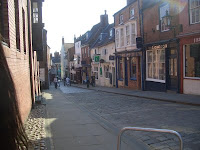 This is just High Street, it gets steeper than this.
Eventually we were at the summit of the hill. Not by coincidence, this is where the Tourist Information Centre is (there is another one down at the city centre, but it is currently closed for renovation), so I might as well stick in a bit of tourist information here:
The general area of Lincoln has been inhabited for a long time, but the name and the first stone buildings date from the Romans. There are still a few remains, such as bits of the old city wall, left from Roman times. The next high period for the town came with the Normans, who started on the castle and the cathedral, both of which were greatly expanded in mediæval times; there are also a few Tudor era houses left. The first World War I tanks were constructed in Lincoln and during World War II Lincolnshire was “Bomber county”. All these various historial eras are carefully commemorated with signs, museums and the items themselves, of course, and there are a number of marked theme trails around town, so show off Roman, Norman, etc remains. Even though the town is so obviously prepared for tourists, there didn't seem to be particularly many around, which I provisionally put down to the English school term not being over yet. Swedish tourists were clearly not common here, I suspect they only leave Regent Street to go see Mamma Mia!.
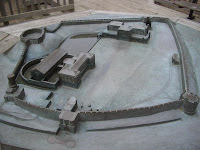 Lincoln Castle in bronze.
 Honeybuns descending into the interior of Cobb Hall Tower. Lots of dark nooks and crannies down there.Anyway, we decided to start with Lincoln Castle. Inside the walls was a carefully tended garden, just made for picknicks. We had a long look at the Magna Carta, went through the prison exhibition and then climbed the walls and the towers. The sky was overcast, but from the Observatory Tower we felt as if we could have seen all the way to the North Sea had it been a clear day. Towards the west we could see another castle tower, which we couldn't fit to any feature on our maps, very strange.
 A view southwards from the Observatory Tower of Lincoln Castle.
Finally hunger drove us out and we found a little vegetarian restaurant on Steep Hill, where some rather surly teenagers served us a quite good lunch.
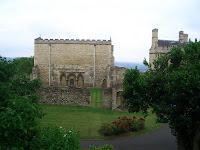 The remains of the Bishop's Palace.Then we walked a circuit around the cathedral, but decided to see the mediæval Bishop's palace instead. It is mostly a ruin these days, but an audio presentation did its best to bring its old splendour alive to us. I actually enjoyed this audio tour better than the one at the recent Titanic exhibition as this one only played fairly short clips and then waited for the user to start the next clip, thus allowing much better self-pacing.
 A rather fancy water tower.The museum closed, so we had to leave, and decided to set out to find the mysterious tower we had seen. Oh, it was a water tower. Apparently it didn't qualify for marking on any maps, just being public works, as it were. We found a pub for dinner and then descended the hill for the bus home.
 The Riverside Cafe on the High Bridge over River Witham.
 This is just High Street, it gets steeper than this.
Eventually we were at the summit of the hill. Not by coincidence, this is where the Tourist Information Centre is (there is another one down at the city centre, but it is currently closed for renovation), so I might as well stick in a bit of tourist information here:
The general area of Lincoln has been inhabited for a long time, but the name and the first stone buildings date from the Romans. There are still a few remains, such as bits of the old city wall, left from Roman times. The next high period for the town came with the Normans, who started on the castle and the cathedral, both of which were greatly expanded in mediæval times; there are also a few Tudor era houses left. The first World War I tanks were constructed in Lincoln and during World War II Lincolnshire was “Bomber county”. All these various historial eras are carefully commemorated with signs, museums and the items themselves, of course, and there are a number of marked theme trails around town, so show off Roman, Norman, etc remains. Even though the town is so obviously prepared for tourists, there didn't seem to be particularly many around, which I provisionally put down to the English school term not being over yet. Swedish tourists were clearly not common here, I suspect they only leave Regent Street to go see Mamma Mia!.
 Lincoln Castle in bronze.
 Honeybuns descending into the interior of Cobb Hall Tower. Lots of dark nooks and crannies down there.
 A view southwards from the Observatory Tower of Lincoln Castle.
Finally hunger drove us out and we found a little vegetarian restaurant on Steep Hill, where some rather surly teenagers served us a quite good lunch.
 The remains of the Bishop's Palace.
 A rather fancy water tower.
2009-06-13
Sinking feelings
Honeybuns and I went to see the Titanic exhibition in Boathall 1 by Galärvarvet (The Galley Wharf). It was somewhat pricey at 120 SEK, but waving my Friends of the Vasa card at least gave me a discount. We were equipped with rather bulky items that turned out to be mil-spec MP3 players with the guide voice track to the exhibition. Then we were photographed on a simulated gangway before we entered the exhibition itself.
The voice track pretty much locked one to a particular, pretty high pace of going through the exhibits, which in the case they were, for example, written documents, couldn't be read while listening to the guide. With time I figured out how to pause the track and use the chapter skip buttons to adjust the timing, but that required conscious effort and some training. The voice track also had background music, which I quickly realised came from the famous film. As I haven't seen the film, I asked myself whether the exposition in fact followed the run of the film, but there were no overt references to it elsewhere. But the stated meaning of the exhbition was to remind us of the people behind the legend, who'd once lived, loved and worked.
Accordingly, each exhibit was typically a huge photograph of a person who had been on the Titanic with a case next to it, often showing personal items belonging to that person, postcards, diaries, watches, but also samples of cutlery, china, etc from Olympic, the sister ship of Titanic.
The final room listed the names of all who had perished and I noted an impressive proportion of not only Swedes, but also Finns, among the third-class passengers—emigrants to America. In an appropriately solemn mood we exited, passing the desk selling photographs of us boarding the exhbition and the souvenir shop with extremely expensive Titanic souvenirs. On the way home we thought about shipping disasters—while that of the Titanic may be the most famous, certainly it's not the worst? Wikipedia to the rescue (and several hours of reading)!
As I had remembered, Wilhelm Gustloff was the sinking with the greatest loss of life, but now I found that the latest estimates suggested around 9400 dead. What I had not known was that Wilhelm Gustloff was part of a huge rescue operation, perhaps a thousand ships moving over a million Germans from East Prussia to Germany and Denmark from under the Soviet army. Several of these ships were sunk, including the Goya with another 6000 dead.
In peacetime the worst accident is the Doña Paz sinking by the Philippines with perhaps 4000 dead, and the Kiangya, lost by the Chinese coast with around 3000 dead.
Closer to home, Estonia didn't have as many victims, but a much higher proportion of the passengers died than on the Titanic, due to the ship capsizing within minutes, trapping the passengers in their cabins.
I've always thought that a major advantage of air travel is that you die instantly if there is an accident.
2009-02-12
Happy Darwin Day!

To celebrate the anniversary I have started reading Evolutionary Analysis. Expect a report in the fullness of time.
2009-01-26
There and back again
As foreshadowed earlier, Honeybuns and I have been on a cruise to Helsinki. We don't need any particular excuse to spend time holding hands and looking at each other, but it was nice to be able to go away, not have to cook dinner and get up early to make breakfast.
As we arrived in Helsinki the weather wasn't the most welcoming, just enough above freezing that there was a thin sleet and we had to jump over slushy puddles as we walked towards the city centre with trams trundling past us, their sound indicating an immense weight not to be hit by. There was still lights in the trees along the Esplanade, but the Christmas market was long gone.
Finland still considers Sunday to be a day of rest, so we had few opportunities for shopping, though we visited the SOKOS S-Market where I was fascinated and embarrassed by this food store managing to (presumably) turn a profit with manual service and a much larger assortment than similarly sized shops around Stockholm.
 Naturally, I had to pay my respects to the Ukko-Pekka model at the railway station. Sadly, you can no longer put in a coin to make the wheels spin (achieved by rollers hidden in the tracks, I now found).
 We trudged up Mannerheimintie, peering through shop windows at cleverly designed lamps and furniture.
The Opera House was closed, the Finlandia House likewise. But the National Museum was welcoming as always, with a brand-new exhibition on the War of 1808–1809 and the loss of Finland. It wasn't flawless, but it absorbed us completely until we had to head back to the boat. (Later, I realised that the corresponding exhibition at the Army Museum in Stockholm had just closed.) On the way back we passed through the celebration of the Chinese New Year at the Glass Palace.
On the way home the sea was as calm as a glass floor.
2008-06-18
I was there

Why was I there?
The intrusion into my privacy, which privacy is dear to me, is one thing, though I suspect that I personally for the most part am insignificant, blond and paleskinned enough not to arouse the curiosity of data analysts, but at some point it is even more important to me that the proposed communications interception law is yet another step in a culture of fear. One can make—and certainly they are made—elaborate conspiracy theories about how this fear is nourished by shady characters in order to further their nefarious goals, but I do not think such conspiracies are necessary, Hanlon's razor applies here as elsewhere. Peter Englund has written about the internal logics of the situation, where the ability and possibility to eavesdrop on all communication necessitates that one does so. The reasons for this can then be made up afterwards. The reason currently in fashion is terrorism. In the previous century it would have been Bolshevism.
Lately I have been reading up on the origins of the Western European dictatorships of the 20th Century. It has struck me how the threat of Communism was used to get the influential people: the industrial magnates, the clergy, the army, to go along with the numerically very small movements of Phalangism, Fascism, Nazism, … One could perhaps argue that this external anti-Communism even abetted the totalitarian dictatorship of the Soviet Union by justifying the oppression as defence against infiltration by external enemies—but yet again, by the logic of the situation, an enemy would have been found if none had naturally presented itself. And thus these attempts to stem the awful plans of the enemy have caused the violent (or indirect) deaths of tens of millions of people throughout the 20th Century. The fending off of fear seems to be worse than the actual object of fear.
This is already happening again—or perhaps still, but now with a different label for the phenomenon to be feared. Certainly international terrorism has not yet managed to kill as many as the at least hundred thousand that are now dead in the War on Terror, and almost the same number of people have been imprisoned without trial, in many cases subject to torture even according to the rather lax standards of the US President.
This is why I oppose the eavesdropping law, as I see it as yet another attempt to play on fear, in such a way that the costs in all likelihood will greatly exceed the costs of any attack that may be perpetrated.
And finally, the law does of course nothing in the way of actually protecting Sweden against electronic threats. Should we be subject to a concerted cyber-attack, such as the one recently waged against Estonia, we will be caught with our trousers at just as inconvenient a height as before the enactment of the disputed law. So just whose security are we concerned with?
(Apparently I am very angry—my readability index is lower than ever.)
2008-06-05
The Order of Events
Once when I was talking with my mother the subject of “Where were you when you heard that Kennedy had been killed?” came up.
“Oh, I remember it so well, we were at Grandma's with you and your brother when they said it on the wireless.”
[headexplode] “What!? I wasn't even born when Kennedy was killed!”
[confused] “Sure you were.”
“John F Kennedy was killed in 1963!”
“John? I'm talking about Robert.”
Lesson: precision.
“Oh, I remember it so well, we were at Grandma's with you and your brother when they said it on the wireless.”
[headexplode] “What!? I wasn't even born when Kennedy was killed!”
[confused] “Sure you were.”
“John F Kennedy was killed in 1963!”
“John? I'm talking about Robert.”
Lesson: precision.
2007-12-02
Myopic review
A non-aviation-interested friend was very amused by a review I wrote on The Aviator without ever touching on the human actors. I'll do that trick again…
Christopher Priest's book The Separation [Priest, 2002] is an alternate history with multiple layers. Alternate histories typically build on the premise that one single, but important, thing has been changed relative to “our” universe and the author then attempts to draw out the consequences of that. But, as noted by Christie [1944], everything that happens is the consequence of lots of other things that happened before that so rarely can you just posit that a single thing changed, but other things will have changed as well.
In this review I will, in the spirit of Carter [1985], pick up a throwaway line from the book and speculate over what other changes in the alternate universe had to have taken place in addition to the explicitly stated changes. The passage in question is the following:
Now, to work out the differences to our version of the universe, let us just enumerate the superficial differences and then think about the possible reasons for these.
In our universe the Me 163 was a rocket-powered interceptor. It was first flown under rocket power at the large testing site in Peenemünde by well-known test pilot Heini Dittmar; in July 1941 according to Green [1971], on August 13 according to Anderton [1975].
The F-86 Sabre was first flown in October 1947 and the MiG-15 in December the same year [Anderton, 1975], by which time the United States Army Air Forces had become the independent United States Air Force.
 So, to start with the Me 163. Clearly what is described is a completely different aircraft. “Our” Me 163 was a diminutive aircraft with a rocket engine with very limited endurance, able to reach great altitude in very short time. Merely redesigning it to use a jet engine would change the design quite considerably, at the very least requiring air intakes and ducts for the engine—or more likely, for two engines. To turn it into a (successful) ground attack aircraft would require a larger aircraft, carrying more fuel, ordinance and, not least, armour. In fact, we would probably end up with something similar to the Me 262, which aircraft is not mentioned in the passage above, though it was considerably more successful in our timeline.
 Perhaps the explanation is that in the Separation universe the Me 163 is in fact identical to our Me 262 and the rocket interceptor was never built.
This in turn requires some other things to change. Our Me 262 was not ready to fly under jet power until July 1942 after a protracted design process [Morgan and Weal, 1995]. A jet fighter had flown already in April 1941, the Heinkel 280, but neither it nor the Messerschmitt design got the necessary support from the Reichsluftfahrtministerium [Green, 1970]. The Heinkel design was killed outright and the Me 262 was not a priority project until 1944 or so. Apparently, in the Separation universe, key persons at RLM were more visionary. This would imply, in my mind, that Ernst Udet never became Generalluftzeugmeister or resigned from the post fairly soon. The question is who would replace him. It would have to be a person who would both have the organisational skills to run the technical office of RLM as well as the political skills to stand up to Göring. People such as these would be few and far between in the immediate pre-war Germany. Perhaps Ernst Heinkel could have been one of these, but what would he have been offered to take up this job, instead of his own industry? And would he have been impartial enough to award design contracts to Messerschmitt, one of his hardest competitors? Maybe this could have been achieved if the RLM had been organised more along the principles of the British Ministry of Aircraft Production, more focused on working together for a common cause than backstabbing each other, but this seems to have been utterly antithetical to the very soul of Nazi Germany. But, maybe things will work just by luck and accident, so that Germany has a technically skilled and visionary Generalluftzeugmeister who prioritises the development of a next generation of combat aircraft and that Germany manages to import the metals needed for the exotic alloys necessary for efficient jet engines. They would have to come via neutral countries, perhaps Sweden will increase its trade with Germany and in exchange receive more German military material. There could have been Bf 109s flying in the Swedish air force!
 So, with some probability we could imagine German jet fighters actually in service by 1943. Now, what about the MiG-15 and the Sabre? In our time-line they are both second-generation jet aircraft, based on aerodynamics data collected in Germany after the war by the Allies. However, as noted above, we do not have to assume that the planes in the Separation universe match the aircraft with the same names in our timeline, so they could in fact correspond to early Soviet and US jet aircraft designs, such as the Lavochkin La-15 and the Bell P-59 Airacomet, both of which would have been outperformed by almost any German jet aircraft design.
Anderton, David. 1975. Jet Fighters, Phoebus Publishing, Ltd.
Carter, Paul. 1985. “The Constitutional Origins of Westly v. Simmons”. Analog Science Fiction/Science Fact (CV)10, October 1985, pp 86–96.
Christie, Agatha. 1944. Towards Zero, Collins.
Green, William. 1970. Warplanes of the Third Reich, Doubleday & Company, Inc.
Green, William. 1971. Rocket Fighter, Random House, Inc.
Morgan, Hugh and Weal, John. 1995. German Jet Aces of World War 2, Osprey Publishing, Ltd.
Priest, Christopher. 2002. The Separation, Scribner.
Christopher Priest's book The Separation [Priest, 2002] is an alternate history with multiple layers. Alternate histories typically build on the premise that one single, but important, thing has been changed relative to “our” universe and the author then attempts to draw out the consequences of that. But, as noted by Christie [1944], everything that happens is the consequence of lots of other things that happened before that so rarely can you just posit that a single thing changed, but other things will have changed as well.
In this review I will, in the spirit of Carter [1985], pick up a throwaway line from the book and speculate over what other changes in the alternate universe had to have taken place in addition to the explicitly stated changes. The passage in question is the following:
Kurt Hofmann was a civilian test pilot working for the Messerschmitt company at a small airfield in eastern Germany. On May 10, 1941, under conditions of immense secrecy, Hofmann piloted the maiden flight of a revolutionary new type of aircraft. It was an experimental fighter powered by as jet turbine engine. The prototype Messerschmitt Me-163 flew at 995 kph (621 mph) before landing safely. This aircraft was widely used on the Russian Front from late in 1943 until the end of hostilities, becoming the standard ground-attack fighter-bomber, It was found to be superior not only to early marques of the Russian MiG-15 jet fighter, but also to the North American Sabre that was entering serviced with the USAAF at the same time.
Now, to work out the differences to our version of the universe, let us just enumerate the superficial differences and then think about the possible reasons for these.
In our universe the Me 163 was a rocket-powered interceptor. It was first flown under rocket power at the large testing site in Peenemünde by well-known test pilot Heini Dittmar; in July 1941 according to Green [1971], on August 13 according to Anderton [1975].
The F-86 Sabre was first flown in October 1947 and the MiG-15 in December the same year [Anderton, 1975], by which time the United States Army Air Forces had become the independent United States Air Force.
So, to start with the Me 163. Clearly what is described is a completely different aircraft. “Our” Me 163 was a diminutive aircraft with a rocket engine with very limited endurance, able to reach great altitude in very short time. Merely redesigning it to use a jet engine would change the design quite considerably, at the very least requiring air intakes and ducts for the engine—or more likely, for two engines. To turn it into a (successful) ground attack aircraft would require a larger aircraft, carrying more fuel, ordinance and, not least, armour. In fact, we would probably end up with something similar to the Me 262, which aircraft is not mentioned in the passage above, though it was considerably more successful in our timeline. Perhaps the explanation is that in the Separation universe the Me 163 is in fact identical to our Me 262 and the rocket interceptor was never built.
This in turn requires some other things to change. Our Me 262 was not ready to fly under jet power until July 1942 after a protracted design process [Morgan and Weal, 1995]. A jet fighter had flown already in April 1941, the Heinkel 280, but neither it nor the Messerschmitt design got the necessary support from the Reichsluftfahrtministerium [Green, 1970]. The Heinkel design was killed outright and the Me 262 was not a priority project until 1944 or so. Apparently, in the Separation universe, key persons at RLM were more visionary. This would imply, in my mind, that Ernst Udet never became Generalluftzeugmeister or resigned from the post fairly soon. The question is who would replace him. It would have to be a person who would both have the organisational skills to run the technical office of RLM as well as the political skills to stand up to Göring. People such as these would be few and far between in the immediate pre-war Germany. Perhaps Ernst Heinkel could have been one of these, but what would he have been offered to take up this job, instead of his own industry? And would he have been impartial enough to award design contracts to Messerschmitt, one of his hardest competitors? Maybe this could have been achieved if the RLM had been organised more along the principles of the British Ministry of Aircraft Production, more focused on working together for a common cause than backstabbing each other, but this seems to have been utterly antithetical to the very soul of Nazi Germany. But, maybe things will work just by luck and accident, so that Germany has a technically skilled and visionary Generalluftzeugmeister who prioritises the development of a next generation of combat aircraft and that Germany manages to import the metals needed for the exotic alloys necessary for efficient jet engines. They would have to come via neutral countries, perhaps Sweden will increase its trade with Germany and in exchange receive more German military material. There could have been Bf 109s flying in the Swedish air force!
So, with some probability we could imagine German jet fighters actually in service by 1943. Now, what about the MiG-15 and the Sabre? In our time-line they are both second-generation jet aircraft, based on aerodynamics data collected in Germany after the war by the Allies. However, as noted above, we do not have to assume that the planes in the Separation universe match the aircraft with the same names in our timeline, so they could in fact correspond to early Soviet and US jet aircraft designs, such as the Lavochkin La-15 and the Bell P-59 Airacomet, both of which would have been outperformed by almost any German jet aircraft design.Anderton, David. 1975. Jet Fighters, Phoebus Publishing, Ltd.
Carter, Paul. 1985. “The Constitutional Origins of Westly v. Simmons”. Analog Science Fiction/Science Fact (CV)10, October 1985, pp 86–96.
Christie, Agatha. 1944. Towards Zero, Collins.
Green, William. 1970. Warplanes of the Third Reich, Doubleday & Company, Inc.
Green, William. 1971. Rocket Fighter, Random House, Inc.
Morgan, Hugh and Weal, John. 1995. German Jet Aces of World War 2, Osprey Publishing, Ltd.
Priest, Christopher. 2002. The Separation, Scribner.
2007-04-03
Dysthemic, that's what I am
Almost invariably when somebody sends me something with the comment that it is “food for thought&rdquo, my reaction tends to be “it's actually crap already”.
I'm not quite sure what to think about this extract from Barbara Ehrenreich's book Dancing in the Streets, discussing how depression has become increasingly more prevalent in the Western world since the 16th Century. It is definitely in the food-for-thought category, but is it nutricious? I'm not convinced that the reason people are depressed is that they don't party enough, but the discussion about the creation of the individual and how this allows oneself to get depressed is interesting. But what says that an entire group couldn't be depressed?
I'm not quite sure what to think about this extract from Barbara Ehrenreich's book Dancing in the Streets, discussing how depression has become increasingly more prevalent in the Western world since the 16th Century. It is definitely in the food-for-thought category, but is it nutricious? I'm not convinced that the reason people are depressed is that they don't party enough, but the discussion about the creation of the individual and how this allows oneself to get depressed is interesting. But what says that an entire group couldn't be depressed?
Subscribe to:
Posts (Atom)
