2006-10-31

2006-10-21
English: yes! English: No!
There is a big article in today's Dagens Nyheter: Språkexperter räds svengelskan. The worry is that since much university-level education is given in English, neither teachers nor students will perform at their best. The final paragraph, a quote from Sven Halldin, professor of hydrology, is probably the most stupid thing I've read all this week:
The logical implication that speaking a foreign language makes you burn down mosques is not clear to me. Rather my bullshit heuristics indicate that when someone claims X will cause xenophobia it usually means “I'm xenophobic and I'm opposed to X”.
I can agree with the point that neither teachers nor students in general manage English particularly well and I'm certain this does mean that education is not performed at maximum efficiency, but the conclusions I draw from that are different: English is the lingua franca of science today—it used to be Latin, in fifty years it may be Mandarin, the particular language is not important but it is clearly impossible to translate everything into every other language, so some common language must be used. The Bologna process aims to increase movement between European universities. I do not agree with the means to achieve this increased mobility*, but I definitely embrace mobility. This means there (hopefully) will be increasingly more non-Swedish-speaking students at Swedish universities. Now, what will most decrease education efficiency: that both Swedish-speaking and non-Swedish-speaking students will be taught in English which they hopefully have some ten to fifteen years of experience in, or that the non-Swedish-speaking students are taught in Swedish, of which they typically have just a few months of experience?
I think the course is clear: If Swedish university students do not understand English well enough, they need more of it, preferrably as early as possible in school.
This does not mean I think English should be used on every occasion and another article in the same issue of DN shows an example, a drawing by Auguste Rodin, titled “Charity”. The article is written in Swedish and Rodin probably only spoke French, so either of the titles ”Barmhärtighet” or « Charité » would have made more sense, but the journalist just lazily copied whatever the English-language catalogue said. This is all too common in newspapers, news are copied from English-language sources and names and quotes are given in English, even thought the correct thing to do would be to give them in the native language or with an approriate Swedish translation. A former editor of Numero used to end all issues with a supposedly witty and/or thoughtful quote from some authority—you know the kind that pesters almanacs and such. Clearly these had been cribbed from some English-language site and it truly jarred one's mind to find that Déscartes, Julius Cæsar or Ibsen had said such-and-such in English. That's so lazy it's despicable.
*In my opinion one of the main points of mobility is that it would allow universities to specialise more and students move between them to learn from the best experts in a particular subject; instead what the Bologna process seems to aim at is to make all universities alike, so that it doesn't matter where you are and your choice of university would be based on whether you like to go swimming or skiing in your free time. That's just plain stupid.
När vi inte längre har terminologin på svenska, ska hela skolvärlden gå över till engelska då? Det ger en mycket större grogrund för främlingsfientlighet.
The logical implication that speaking a foreign language makes you burn down mosques is not clear to me. Rather my bullshit heuristics indicate that when someone claims X will cause xenophobia it usually means “I'm xenophobic and I'm opposed to X”.
I can agree with the point that neither teachers nor students in general manage English particularly well and I'm certain this does mean that education is not performed at maximum efficiency, but the conclusions I draw from that are different: English is the lingua franca of science today—it used to be Latin, in fifty years it may be Mandarin, the particular language is not important but it is clearly impossible to translate everything into every other language, so some common language must be used. The Bologna process aims to increase movement between European universities. I do not agree with the means to achieve this increased mobility*, but I definitely embrace mobility. This means there (hopefully) will be increasingly more non-Swedish-speaking students at Swedish universities. Now, what will most decrease education efficiency: that both Swedish-speaking and non-Swedish-speaking students will be taught in English which they hopefully have some ten to fifteen years of experience in, or that the non-Swedish-speaking students are taught in Swedish, of which they typically have just a few months of experience?
I think the course is clear: If Swedish university students do not understand English well enough, they need more of it, preferrably as early as possible in school.
This does not mean I think English should be used on every occasion and another article in the same issue of DN shows an example, a drawing by Auguste Rodin, titled “Charity”. The article is written in Swedish and Rodin probably only spoke French, so either of the titles ”Barmhärtighet” or « Charité » would have made more sense, but the journalist just lazily copied whatever the English-language catalogue said. This is all too common in newspapers, news are copied from English-language sources and names and quotes are given in English, even thought the correct thing to do would be to give them in the native language or with an approriate Swedish translation. A former editor of Numero used to end all issues with a supposedly witty and/or thoughtful quote from some authority—you know the kind that pesters almanacs and such. Clearly these had been cribbed from some English-language site and it truly jarred one's mind to find that Déscartes, Julius Cæsar or Ibsen had said such-and-such in English. That's so lazy it's despicable.
*In my opinion one of the main points of mobility is that it would allow universities to specialise more and students move between them to learn from the best experts in a particular subject; instead what the Bologna process seems to aim at is to make all universities alike, so that it doesn't matter where you are and your choice of university would be based on whether you like to go swimming or skiing in your free time. That's just plain stupid.
2006-10-20
You are not alone—in fact you're just like the others
2006-10-16
A people separated by a common language, a person formed by multiple languages
On occasion my lectures will touch upon sociological issues and quite often this will cause me to go into high Academic English gear. I catch myself and mumble: “This is John-speak”, so named for one of my thesis supervisors who speaks very good Academese and whose discussions of ethnography and politics have rubbed off on me, so that I unconsciously use his way of presenting the issues.
Gillian Evans is an English academic who, due to financial hardship, ended up living with the Lower Classes for over a decade and finally decided to study and document this strange tribe, which resulted in a book, several articles and lots of commentary in the Guardian. It is all very interesting but also, unintentionally or not, absolutely hilarious, as for example when she translates from the prole-speak of her informants into her own analytic English:
Evans makes a number of interesting points (the validity of which of course may, and should, be argued over) about how for example schools embody middle class values which may be at odds with what gives status and credibility in a working class (or frequently these days—unemployed class) context.
But, I was also driven to some introspection (I tend to think of myself a lot, don't I?), group membership and language. In a superficial sense I am trilingual, yet my language use is very much situationally bound, tied to what I say and how I say it.
My native language, my mother tongue, of Finnish is the language of my childhood. The form I speak is that of Finnish in the 1940s and 1960s, when my parents moved to Sweden. I have a day-to-day vocabulary and speak without an accent, yet I'm not fluent in technical, professional Finnish and I tend to be silent until spoken to (unimaginable as it may seem to those who've met me in person).
My everyday language is Swedish, it is what I speak with friends and family and I probably have the largest vocabulary in absolute terms in Swedish. Some people claim they can detect traces of a Finnish accent, others shake their heads at the idea.
Then, my professional language is English, it is the language that lets me discuss technical issues and it is the language in which I do the absolute majority of my writing. Even when nominally speaking Swedish with colleagues, our speech is peppered with English expressions or English words in Swedish form, not necessarily because there are no corresponding Swedish words, but because the English is closest at hand. [The “domain loss” of Swedish for research purposes is a hot issue these days, I'll probably return to it in some later post.] It is not merely because I want to share my thoughts with non-Swedish-reading friends that this blog is in English, but it is the language in which I normally write. The English I speak is a mirror of the English I read, it is academic, complex, dense with polysyllabics.
Of course, at the centre I still am a single person that reads a lot, has scientific training and perhaps more than a smidgeon of a need to show off, and this shines through as “posh” turns of phrase, regardless of what language I speak in, but in Finnish and Swedish I am much more likely to drop into the vernacular (and not use words like “vernacular” to begin with).
There is also some kind of class journey involved, from a working-class, lower middle-class background where we did not have “house rules” to some kind of economical upper middle class, but where I still think Magdalena Ribbing is a complete waste of space and that a person wearing shoes indoors is destined for the nearest lamppost.
Still, if you know me in one language, I may not be quite the same person in another language…
Gillian Evans is an English academic who, due to financial hardship, ended up living with the Lower Classes for over a decade and finally decided to study and document this strange tribe, which resulted in a book, several articles and lots of commentary in the Guardian. It is all very interesting but also, unintentionally or not, absolutely hilarious, as for example when she translates from the prole-speak of her informants into her own analytic English:
When I ask other people what being common means, they tell me that it is about “knowin' what it's like to be skint—down to your last two quid. There's no more money until next week and there's kids to feed.”
Being common clearly has something to do, then, with economic position and, in particular, the experience of what it is like to be constrained by the limited availability of disposable income [&hellip]
Evans makes a number of interesting points (the validity of which of course may, and should, be argued over) about how for example schools embody middle class values which may be at odds with what gives status and credibility in a working class (or frequently these days—unemployed class) context.
But, I was also driven to some introspection (I tend to think of myself a lot, don't I?), group membership and language. In a superficial sense I am trilingual, yet my language use is very much situationally bound, tied to what I say and how I say it.
My native language, my mother tongue, of Finnish is the language of my childhood. The form I speak is that of Finnish in the 1940s and 1960s, when my parents moved to Sweden. I have a day-to-day vocabulary and speak without an accent, yet I'm not fluent in technical, professional Finnish and I tend to be silent until spoken to (unimaginable as it may seem to those who've met me in person).
My everyday language is Swedish, it is what I speak with friends and family and I probably have the largest vocabulary in absolute terms in Swedish. Some people claim they can detect traces of a Finnish accent, others shake their heads at the idea.
Then, my professional language is English, it is the language that lets me discuss technical issues and it is the language in which I do the absolute majority of my writing. Even when nominally speaking Swedish with colleagues, our speech is peppered with English expressions or English words in Swedish form, not necessarily because there are no corresponding Swedish words, but because the English is closest at hand. [The “domain loss” of Swedish for research purposes is a hot issue these days, I'll probably return to it in some later post.] It is not merely because I want to share my thoughts with non-Swedish-reading friends that this blog is in English, but it is the language in which I normally write. The English I speak is a mirror of the English I read, it is academic, complex, dense with polysyllabics.
Of course, at the centre I still am a single person that reads a lot, has scientific training and perhaps more than a smidgeon of a need to show off, and this shines through as “posh” turns of phrase, regardless of what language I speak in, but in Finnish and Swedish I am much more likely to drop into the vernacular (and not use words like “vernacular” to begin with).
There is also some kind of class journey involved, from a working-class, lower middle-class background where we did not have “house rules” to some kind of economical upper middle class, but where I still think Magdalena Ribbing is a complete waste of space and that a person wearing shoes indoors is destined for the nearest lamppost.
Still, if you know me in one language, I may not be quite the same person in another language…
2006-10-14
You can never go back
As a graduate student, I had reason to travel to many places abroad for conferences, research administrative meetings and such. This means that I have a deep and intimate knowledge of airport departure lounges and university seminar rooms, but haven't in fact seen very much of “the world”. What I have seen has been due to the ticket structure that made air travel cheaper if you stayed away the night between Saturday and Sunday. This has all but disappeared with all the new low-fare airlines, but it was an important factor in travel budgets in the 1990s. So, when I had tickets of this kind and there was no work planned for the Saturday I would have a day in which to wander around strange cities.
On this particular day, I was in Geneva with two colleagues, O and K, it was a warm summer day, O's birthday as it happened, and we had the day all to ourselves.
Geneva has this strange topology where, no matter which direction you start out in, you soon find yourself on the same skewed square in the Old town, so we often came back there. When we first arrived there, from one of the other streets ending up on the square came a large group of youngsters chasing a huge red rubber ball. During the day we would run into them in other places around the city, still chasing the ball. We never found out how this crowd had assembled or if they had any other purpose than just playing with a big ball, it was just one of those mysteries that not necessarily have to be solved.
Around the slanting square and adjoining streets were all kinds of posh shops, and we ducked into one of them because K was interested in the rattan furniture in the shop front. It didn't take me long to see that anything beyond their smallest pillows was beyond my financial reach, so I wandered further into the shop. I found a door opening on the inner yard. I stepped through the door and the feeling was as if I had ended up in Tom's Midnight Garden or just the Centre of the Universe. In the small yard was a chair made of steel bands and I went and sat in it. It could have been uncomfortable but right then it was just right to sit in and watch the vines creeping up the surrounding walls over which I would see the inner walls of the surrounding houses, a half-open tap was letting a small stream trickle through the moss on the paved ground to a drain in the other end of the yard. I just sat there, feeling no need to do anything but just sit and be. I don't know how long I sat there, but eventually I remembered my friends who had been patiently waiting for me. We continued on our way.
Presently we found a little art museum. It was like the home of a rich family with artwork everywhere, so you could sit down in soft leather armchairs to admire the paintings and I and K nodded off for a quarter of an hour or so in a room where the incoming midday sun made you pleasantly sleepy. We had lunch in a restaurant somewhat off the main thoroughfares and I was introduced to salmon carpaccio.
We talked about many things and of course we also discussed our current research project and while strolling around we developed new ideas for computer-supported communication. In a toy store (O had never had a model train as a child and was thinking of getting one for his birthday) we had new and heady ideas for message passing. We stopped at an ice-cream bar and got huge bowls of ice-cream and started writing down all our ideas on whatever scraps of paper we had, including a shopping bag that K had acquired during the day. Very pleased with ourselves we walked on as the afternoon fell. As sun set we found ourselves by a restaurant by the city hall (naturally very near the sloping square) and looked through the menu for Swiss specialities. Cultural differences and expectations clashed: O, born in Southern Europe, said: “It's my birthday so the dinner is on me.” K, well-bred Swede, was aghast: “You can't pay—it's your birthday!” Both were adamant on what their honour demanded of them. K attempted a coup while O was in the lavatory and quickly asked the waitress for the bill. She went all haughty: “A woman pay for a man? Never!” I guess I could have intervened to complicate the situation further, but I was laughing too hard to think of it. O prevailed in the end.
As the night went on, O and K disappeared to some shady night club that one of K's friends in the UN was running, while I, who suspected it would be a smokey affair, retired to the hotel where I sat up late with my laptop and wrote a draft paper based on our notes of the day and, you know, I think I had as good a night as my friends had. (And so I guess this in the end had been a work day after all, but why not?)
These are pleasant memories of places I visited, perfect moments as it were. And they cannot be repeated. Even could I go back to that furniture store and they just would happen to still have their inner yard in the same state, I could not experience that same feeling of peace and inner calm because the precondition was that it was unexpected, it couldn't be created consciously. Some things can never be as good, or even good at all, as the first time. (On the other hand, the first time I tried to bicycle down a hill was a painful disaster, it has been much more pleasant on later attempts.)
On this particular day, I was in Geneva with two colleagues, O and K, it was a warm summer day, O's birthday as it happened, and we had the day all to ourselves.
Geneva has this strange topology where, no matter which direction you start out in, you soon find yourself on the same skewed square in the Old town, so we often came back there. When we first arrived there, from one of the other streets ending up on the square came a large group of youngsters chasing a huge red rubber ball. During the day we would run into them in other places around the city, still chasing the ball. We never found out how this crowd had assembled or if they had any other purpose than just playing with a big ball, it was just one of those mysteries that not necessarily have to be solved.
Around the slanting square and adjoining streets were all kinds of posh shops, and we ducked into one of them because K was interested in the rattan furniture in the shop front. It didn't take me long to see that anything beyond their smallest pillows was beyond my financial reach, so I wandered further into the shop. I found a door opening on the inner yard. I stepped through the door and the feeling was as if I had ended up in Tom's Midnight Garden or just the Centre of the Universe. In the small yard was a chair made of steel bands and I went and sat in it. It could have been uncomfortable but right then it was just right to sit in and watch the vines creeping up the surrounding walls over which I would see the inner walls of the surrounding houses, a half-open tap was letting a small stream trickle through the moss on the paved ground to a drain in the other end of the yard. I just sat there, feeling no need to do anything but just sit and be. I don't know how long I sat there, but eventually I remembered my friends who had been patiently waiting for me. We continued on our way.
Presently we found a little art museum. It was like the home of a rich family with artwork everywhere, so you could sit down in soft leather armchairs to admire the paintings and I and K nodded off for a quarter of an hour or so in a room where the incoming midday sun made you pleasantly sleepy. We had lunch in a restaurant somewhat off the main thoroughfares and I was introduced to salmon carpaccio.
We talked about many things and of course we also discussed our current research project and while strolling around we developed new ideas for computer-supported communication. In a toy store (O had never had a model train as a child and was thinking of getting one for his birthday) we had new and heady ideas for message passing. We stopped at an ice-cream bar and got huge bowls of ice-cream and started writing down all our ideas on whatever scraps of paper we had, including a shopping bag that K had acquired during the day. Very pleased with ourselves we walked on as the afternoon fell. As sun set we found ourselves by a restaurant by the city hall (naturally very near the sloping square) and looked through the menu for Swiss specialities. Cultural differences and expectations clashed: O, born in Southern Europe, said: “It's my birthday so the dinner is on me.” K, well-bred Swede, was aghast: “You can't pay—it's your birthday!” Both were adamant on what their honour demanded of them. K attempted a coup while O was in the lavatory and quickly asked the waitress for the bill. She went all haughty: “A woman pay for a man? Never!” I guess I could have intervened to complicate the situation further, but I was laughing too hard to think of it. O prevailed in the end.
As the night went on, O and K disappeared to some shady night club that one of K's friends in the UN was running, while I, who suspected it would be a smokey affair, retired to the hotel where I sat up late with my laptop and wrote a draft paper based on our notes of the day and, you know, I think I had as good a night as my friends had. (And so I guess this in the end had been a work day after all, but why not?)
These are pleasant memories of places I visited, perfect moments as it were. And they cannot be repeated. Even could I go back to that furniture store and they just would happen to still have their inner yard in the same state, I could not experience that same feeling of peace and inner calm because the precondition was that it was unexpected, it couldn't be created consciously. Some things can never be as good, or even good at all, as the first time. (On the other hand, the first time I tried to bicycle down a hill was a painful disaster, it has been much more pleasant on later attempts.)
2006-10-13
In days of yore
Jim Horning has several blogs, the one named The Way It Was tells of his experiences in the beginning of his nearly 50 years as a computer programmer. I haven't been in the business quite that long, still many of his stories resonate with my early computing experiences too.
2006-10-12
Food hygiene
An important part of Christian ritual is eating the flesh of their god. Uncooked, apparently. All kinds of diseases and parasites could be spread this way, so I propose a religious health campaign:
Braise The Lord!
Braise The Lord!
2006-10-11
Exceptional user interfaces
The Devil's Advocate has a very interesting column on cool past and future user interfaces. In particular I want this table.
2006-09-15
In the air again
In the light of the success of my recent train journey to Brussels, I thought I could go by train to London, but no such luck. Going by train all the way would have cost around 10000 SEK, which was more than I could afford right now. An alternative would be to go by train to Gothenburg and then by boat to Newcastle, which would be considerably cheaper, but seeing as the boats don't go very often (and indeed, come November they will cease completely) if would have taken me a week to travel back and forth, which would have traded most of the travel savings for accommodation costs. So, I had to give up and buy a plane ticket instead, which cost less than 1700 SEK. sigh
My flight to Heathrow was late, so I had to have lunch at Arlanda, where they of course take advantage of you in effect being locked in behind the security control: 122 SEK for a sandwich and a glass of juice!
London was hot and crowded, so after having trudged around a bit I took the opportunity to go to bed early.
The course I was there for was OK and the day after that it was time to head back home. Heathrow was plastered with signs indicating you could not take any liquids or gels with you on flights to the USA, which I didn't think was that onerous for me. There were long queues to the security controls, but they still seemed to proceed at a good pace. I noted that people took their shoes off and sent them through the X-ray machine, even though it was unclear to me if they were being requested to do so or if everyone was just imitating the person ahead of them. I followed the example. My bag was taken aside and searched and my toothpaste confiscated. The impression that only US travellers were forbidden to use toothpaste was apparently incorrect. Possibly the intended point of the signs was that I could have bought a new tube of toothpaste in the Booths on the other side of the security control, but that I wouldn't have been allowed to bring even that on a US flight. This however implies a second security control right at the gate. I did not have opportunity to observe this, however.
The flight home was also delayed, but eventually I got home.
My flight to Heathrow was late, so I had to have lunch at Arlanda, where they of course take advantage of you in effect being locked in behind the security control: 122 SEK for a sandwich and a glass of juice!
London was hot and crowded, so after having trudged around a bit I took the opportunity to go to bed early.
The course I was there for was OK and the day after that it was time to head back home. Heathrow was plastered with signs indicating you could not take any liquids or gels with you on flights to the USA, which I didn't think was that onerous for me. There were long queues to the security controls, but they still seemed to proceed at a good pace. I noted that people took their shoes off and sent them through the X-ray machine, even though it was unclear to me if they were being requested to do so or if everyone was just imitating the person ahead of them. I followed the example. My bag was taken aside and searched and my toothpaste confiscated. The impression that only US travellers were forbidden to use toothpaste was apparently incorrect. Possibly the intended point of the signs was that I could have bought a new tube of toothpaste in the Booths on the other side of the security control, but that I wouldn't have been allowed to bring even that on a US flight. This however implies a second security control right at the gate. I did not have opportunity to observe this, however.
The flight home was also delayed, but eventually I got home.
2006-09-08
Aircraft painting as a co-evolutionary process
The first aerial kill is said to have been a Aviatik B.1 shot down by Frantz and Quenault in a Voisin III on 1914-10-05.
However, I am not aware that it has been recorded who was the first victim of aerial “friendly fire”, but apparently this was soon a problem. The Royal Flying Corps entered the war with completely unmarked aircraft, but it was obvious within days that some kind of distinguishing mark was necessary, so the Union Flag was sewn or painted on the aircraft. It soon transpired that under bad visual conditions the cross shape was easily confused with the Austro-German insignia, the Iron Cross*
  , so in October 1914 RFC adopted the French cockade
  , but with reversed colours
  . (The American Expeditionary Force first used yet another permutation of red-white-blue cockade
  but eventually introduced a star in a roundel
  .)
.)
This change of national insignia is an example of character displacement—originally similar species evolve diverging characters in order to minimise competition, which is beneficial to both species. Now add to this cryptic colouration, i e camouflage.
Aircraft have the joint need to be cryptic both in the air (which, as we know, actually very seldom is as blue as the sky) and on the ground, which requires various compromises. An interesting point to note is that the light bluish or greyish undersides that are supposed to make the aircraft more difficult to spot in the air, also serve to make them more difficult to see on the ground, as the increased reflection of light decreases the contrast of the shadows underneath the aircraft. Many animals which spend their time lying on the forest floor also have this kind of colouration.


Paradoxically, while camouflage has as one purpose concealment, it secondarily is also a distinguishing character. So, just as for national insignia, the painting of aircraft went from mainly just doped tissue to distinguishable camouflages. During the first world war, RFC camouflage was soon very strictly standardised on a simple scheme: khaki on top, doped linen underneath , while the German Luftstreitkräfte used several different camouflages in parallel with multiple variations on the themes. The most characteristic was the quite complex “lozenge” camouflage
  . The other main alternative was the multi-coloured large-field wavy pattern that was also used by the French and Belgian air forces as well as the American Expeditionary Force and indeed has been the pattern for aircraft camouflage up to fairly recently, but everybody has been using different colours, which may help in the identification of friend or foe task.


During the between-the-wars period camouflage was eschewed—looking good on airshows was more important than concealment—but by the Second World War camouflage was on again.
However, as soon as the war started the need for rapid identification of aircraft in the air returned and camouflage was compromised by brightly coloured areas in many variations over the course of the war.


In Europe, modifying national insignia for recognition purposes was not necessary, as that had been sorted out the first time around, though changes were made, to improve camouflage (what was left under yellow, white and red sheets of colour) to simplify the painting process or to match changed allegiances.
But, meanwhile in the Pacific all involved air forces had a red circle in the centre of their national insignia
 , also causing a number of friendly-fire incidents. I do not know if the Japanese even considered modifying their markings, but they did not have to, as the British and United States forces quickly changed theirs. The British simply removed the central red circle from the national insignia
  . The US Army Air Force did remove the central red dot from their star insignia, but felt that the remaining roundel shape still was not sufficiently distinct from the Japanese roundel. A young draughtsman came up with the idea of adding horizontal bars on both sides of the star, creating the familiar “star-and-bars”
  . Later on in the war, British units in the Pacific added the bars to their insignia as well
  .
.
After the second world war there have been various swings back and forth between camouflage and colourful markings, but beginning in the 1980s most major air forces have moved to “low-visibility” markings, monochrome, low-contrast versions of national insignia


 intended not to compromise the camouflage, which in turn is almost universally all-round grey


 .
.
Predictions one can make based on this minimisation of distinguishing marks are that visual spotting of aircraft is as important as ever in spite of radar and IR sensors but that identification of friend and foe is not made visually. This suggests both the existence of electronic situation-awareness aids as well as a relatively low number of few aircraft in the air simultaneously, making it easier to keep track of who's who and possibly also that close-quarters dog-fighting is not very common these days.
*For some reason the Iron cross is often referred to as a Maltese Cross. It is not. It is a Mantuan cross. This is a Maltese Cross: .
.
However, I am not aware that it has been recorded who was the first victim of aerial “friendly fire”, but apparently this was soon a problem. The Royal Flying Corps entered the war with completely unmarked aircraft, but it was obvious within days that some kind of distinguishing mark was necessary, so the Union Flag
was sewn or painted on the aircraft. It soon transpired that under bad visual conditions the cross shape was easily confused with the Austro-German insignia, the Iron Cross* , so in October 1914 RFC adopted the French cockade , but with reversed colours . (The American Expeditionary Force first used yet another permutation of red-white-blue cockade but eventually introduced a star in a roundel .)This change of national insignia is an example of character displacement—originally similar species evolve diverging characters in order to minimise competition, which is beneficial to both species. Now add to this cryptic colouration, i e camouflage.
Aircraft have the joint need to be cryptic both in the air (which, as we know, actually very seldom is as blue as the sky) and on the ground, which requires various compromises. An interesting point to note is that the light bluish or greyish undersides that are supposed to make the aircraft more difficult to spot in the air, also serve to make them more difficult to see on the ground, as the increased reflection of light decreases the contrast of the shadows underneath the aircraft. Many animals which spend their time lying on the forest floor also have this kind of colouration.
Paradoxically, while camouflage has as one purpose concealment, it secondarily is also a distinguishing character. So, just as for national insignia, the painting of aircraft went from mainly just doped tissue to distinguishable camouflages. During the first world war, RFC camouflage was soon very strictly standardised on a simple scheme: khaki on top, doped linen underneath
, while the German Luftstreitkräfte used several different camouflages in parallel with multiple variations on the themes. The most characteristic was the quite complex “lozenge” camouflage . The other main alternative was the multi-coloured large-field wavy pattern that was also used by the French and Belgian air forces as well as the American Expeditionary Force and indeed has been the pattern for aircraft camouflage up to fairly recently, but everybody has been using different colours, which may help in the identification of friend or foe task. During the between-the-wars period camouflage was eschewed—looking good on airshows was more important than concealment—but by the Second World War camouflage was on again.
However, as soon as the war started the need for rapid identification of aircraft in the air returned and camouflage was compromised by brightly coloured areas in many variations over the course of the war.
In Europe, modifying national insignia for recognition purposes was not necessary, as that had been sorted out the first time around, though changes were made, to improve camouflage (what was left under yellow, white and red sheets of colour) to simplify the painting process or to match changed allegiances.
But, meanwhile in the Pacific all involved air forces had a red circle in the centre of their national insignia
, also causing a number of friendly-fire incidents. I do not know if the Japanese even considered modifying their markings, but they did not have to, as the British and United States forces quickly changed theirs. The British simply removed the central red circle from the national insignia . The US Army Air Force did remove the central red dot from their star insignia, but felt that the remaining roundel shape still was not sufficiently distinct from the Japanese roundel. A young draughtsman came up with the idea of adding horizontal bars on both sides of the star, creating the familiar “star-and-bars” . Later on in the war, British units in the Pacific added the bars to their insignia as well .After the second world war there have been various swings back and forth between camouflage and colourful markings, but beginning in the 1980s most major air forces have moved to “low-visibility” markings, monochrome, low-contrast versions of national insignia
intended not to compromise the camouflage, which in turn is almost universally all-round grey . Predictions one can make based on this minimisation of distinguishing marks are that visual spotting of aircraft is as important as ever in spite of radar and IR sensors but that identification of friend and foe is not made visually. This suggests both the existence of electronic situation-awareness aids as well as a relatively low number of few aircraft in the air simultaneously, making it easier to keep track of who's who and possibly also that close-quarters dog-fighting is not very common these days.
*For some reason the Iron cross is often referred to as a Maltese Cross. It is not. It is a Mantuan cross. This is a Maltese Cross:
.
2006-08-20
Strange music
ABBA are of course a popular band to cover, and to me the most fascinating version is the album recorded by Salma and Sabina in Hindi. I just felt I had to listen to them again and googling around came upon unexpected music collected by April Winchell. Not only does this contain the craved ABBA covers (the good ones in Hindi, as well as some absolutely horrid ones by tone-deaf Germans), but Beatles songs by, among others, Alvin and the Chipmunks, a number of versions of “Stairway to Heaven”, and other more or less amusing audio disasters or just funny songs.
2006-08-19
Audible science
A little background: I used to work with the VR Cube at KTH. It was a device for real-time wrap-around computer graphics, and was on a platform almost three metres above the floor. One of the projects I worked on was the sonification (turning into sound) of molecular dynamics simulations. I never got very far for various reasons, one of them simply the lack of good tools compatible with the graphics environment. In particular I remember one time when I tested an audio library I had found and just set the mapping to some random values to see (hear) what would happen, walked into the Cube, closed the movable front screen, and ran the program. Accidentally I had found the Sound That Causes Panic and was playing it at a very high volume. In my desperate attempt to shut it off I almost ran the wrong way, through the back screen where only the concrete floor far below would break the fall. Luckily I caught myself just in time, turned and got out through the door instead to press Ctrl-C (tricky when your hands are over your ears).
Ben Goldacre at Bad Science has dug up several sonifications that do not cause panic and the commenters chime in with several more.
Ben Goldacre at Bad Science has dug up several sonifications that do not cause panic and the commenters chime in with several more.
2006-08-18
The world gets a little sadder every day
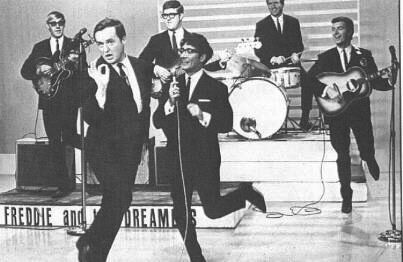
Nattsudd in its first incarnation was a surreal TV programme with bizarre clips of long-forgotten artists. One night they showed a grainy clip of a 1960s rock band, the members seemingly middle-aged gentlemen in suits, ties and horn-rimmed glasses, doing some kind of spastic aerobics while singing "You were made for me" in unembarrassed falsetto. Clearly they were having and making fun of the entire rock band thing. This was Freddie and the Dreamers.
While I have their music, they, if anyone, must have been best experienced live so I got the idea to search for them on YouTube and indeed there were several wonderful clips there but also the sad news that Freddie had passed away earlier this year, barely old enough to be retired.
Let us remember him and the other Dreamers yet awhile by watching the videos and visiting the fan sites.
2006-08-16
Structure and Interpretation of Computer Programs

The first full university course I taught was Structure and Interpretation of Computer Programs. This was an introductory course in Computer Science. Back in those days, it was still considered a good idea that the students should have a good grounding in all the major programming paradigms rather than merely learning to program in Java, so a Lisp-based course which covered functional, imperative, object-oriented and logic programming, interpreted and compiled programs, was just the thing.
Furthermore, the lectures were done on video by Hal Abelson and Gerry Sussman, so I did not actually have to lecture myself. I was there to answer questions, go through the exercises and in general help out. This was something I enjoyed and I made the most of it. Not only had I read the book and seen the film, but the preceding summer I had entirely unexpectedly actually met Abelson and Sussman during a visit to MIT and gotten their autographs. I had also bought the T-shirt. I wore this the first lecture, certain it would make an impression on the students, and all during the rest of the course I tried to match my clothing to the subject of the day.
Now, one of my students from those days mailed me to tell me that the video lectures have been put online. So download them, watch them and see what a really good introductory CS course can be like.
2006-08-15
Visible science

Way back when, when I had the privilege of being taught medical engineering by leading physicians at various Stockholm hospitals, one of the things you would find in all medical research departments was a huge wall chart titled “Biochemical Pathways”. This showed the chemical interactions in living organisms (primarily humans, I assumed).
You may remember the Prime Radiant displaying the Seldon Plan in such a way that the equations themselves formed a visible representation of the plan, where it was heading, the deviations from the intended path and the corrections performed. This was much the impression I got of “Biochemical Pathways”.
I was proud and humbled by the effort that had gone into finding all this out, especially when I found the Citrate Cycle, that I had spent so much effort to learn and, superficially, understand, as a small area slightly right of centre, towards the bottom. I was also excited by the knowledge that this was work in progress, every year more information about biochemistry would be found out, adding to what was already there, making the map ever more complex. And in particular that this knowledge was there as a physical map you could look at and study, rather than just an abstract collection of research papers. (Not that I then fully understood the concept of research papers, but I did vaguely realise that research was somehow created and collected.)
I don't know if this wall chart actually was updated regularly and made available in new editions, or if it was a one-shot effort made at some specific time, but I've later found it was created by Roche Applied Science and, as far as I can tell, it is now long out of print. Maybe the sum total of our knowledge of biochemical pathways has grown so much that it no longer can be contained on a wall chart that will fit on the wall of a hospital research department.
It was thus with nostalgic joy I found that ExPASy have scanned the entire chart and put it online. Not only that, they have made all the enzymes clickable so that you can look them up in their ENZYME Data Bank to get references to papers referring to that enzyme, alternate designations, where it is expressed and other things I know too little of.
Probably ExPASy will not update the underlying graphics and network, but, oh, how I wish they or someone else would. Imagine putting that on a really big tiled display. And imagine that every new biochemistry Ph.D. would get to add their contribution to science to the Prime Radiant, so that they and others can see what they have done, and its relation to the vast expanse of what others have done before them.
2006-08-14

2006-08-13

The funnies
McSweeney's Internet Tendency is an online collection of humorous articles, including such gems as Superman Returns (a Defective DVD Player).
2006-08-12
The Thatcher Legacy—higher public expenses
Simon Jenkins has written an article in the Guardian, quoting a study that shows how the privatisation of rail transport in the UK has led to HM Government having to pay more than three times the earlier national operating costs in subsidies to the “private” companies.
It would be quite interesting to see what a similar study would find about the privatisation of Swedish rail transport. The least it would find is that it certainly does not even operate as well as British rail— there still isn't a single site similar to National Rail that will tell you how to get from point A to point B regardless of operating company. In fact, the recommended method is to use the site of Deutsche Bahn to figure out how to get from Laxå to Gällivare!
And now 440 km of track is to be closed (and torn up?) because Banverket can't afford to maintain the track. It seems eminently stupid, both for environmental reasons and as flying is becoming more complicated anyway.
What is the Government doing about all this, I ask?
It would be quite interesting to see what a similar study would find about the privatisation of Swedish rail transport. The least it would find is that it certainly does not even operate as well as British rail— there still isn't a single site similar to National Rail that will tell you how to get from point A to point B regardless of operating company. In fact, the recommended method is to use the site of Deutsche Bahn to figure out how to get from Laxå to Gällivare!
And now 440 km of track is to be closed (and torn up?) because Banverket can't afford to maintain the track. It seems eminently stupid, both for environmental reasons and as flying is becoming more complicated anyway.
What is the Government doing about all this, I ask?
2006-08-10
Music reviews and history
Georgij Starostin maintains a huge site with lots of his irreverent, informative and incisive music reviews. They are highly enjoyable to wade through.
Subscribe to:
Posts (Atom)

